Heinz Cyrus
1936–1965
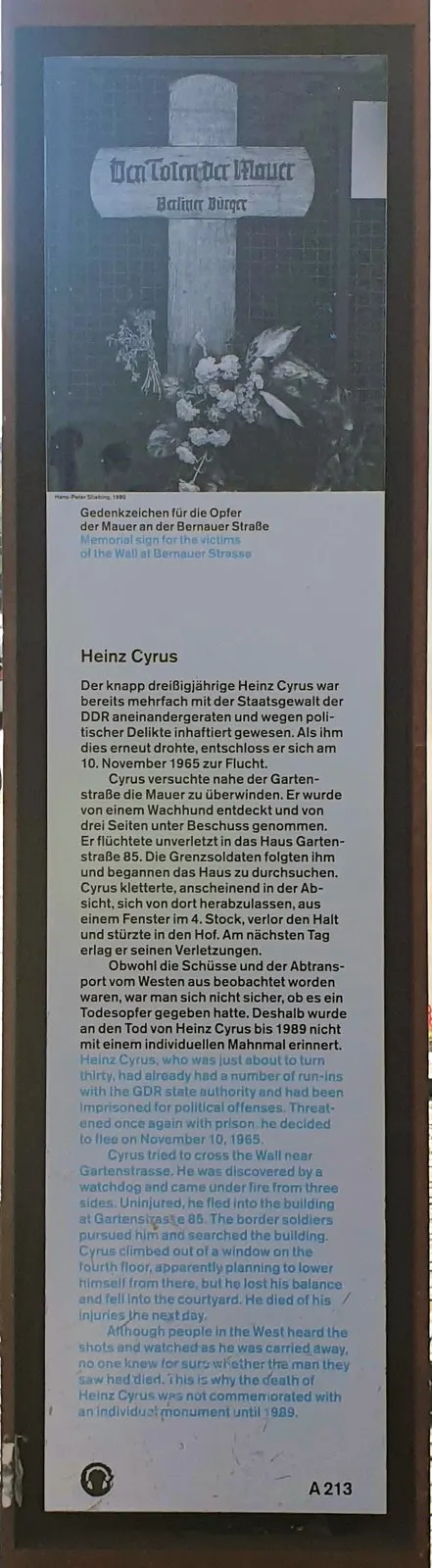
Heinz Cyrus, a 29-year-old farm worker from Rügen and father of four, was discovered trying to escape near the Nordbahnhof on 10 November 1965. Fleeing gunfire into Gartenstrasse 85, he fell or jumped from a fourth-floor window and died of his injuries the next morning.
_Heinz_Cyrus.jpg)
Heinz Cyrus was born on 5 June 1936, the child of an unmarried nurse in Greifswald, and spent his early years in a children's home. In 1943 he was taken in by foster parents and grew up in Dreschvitz on the island of Rügen. He trained as a dairy worker and worked on a number of state farms on the island. He married in 1954 and had four children. A school friend remembered him as a strong man and a capable worker, well brought up by his foster parents, if perhaps a little wild.
Jailed in October 1956 for beating up People's Police officers, he was let out of the prison work camp early, and in April 1957 he and his wife took over an eight-hectare farm in Teschvitz. Two years later they joined the local cooperative, where he became deputy chairman and was put in charge of the cattle. His eldest daughter, Monika, remembered a carefree childhood, with a television, a refrigerator and a father who rode a motorcycle and played football, until, as she recalled, men in long coats and leather jackets appeared on the farm in 1960.
In October 1959 informants reported that, during a quarrel and under the influence of alcohol, he had abused communists and threatened the cooperative's chairman. The Stasi arrested him in March 1960, as forced collectivisation was intensifying, and in June 1960 a public trial in Rostock sentenced him to seven years for alleged harmful activities, including neglecting the cooperative's cattle. He denied every charge; no defence witnesses were allowed. In his final words he told the court he had not acted as an enemy of East Germany and asked for a milder sentence, in vain. He was sent to the prison in Torgau.
An amnesty in September 1964 brought his early release. By then divorced, he worked with a crop brigade on a state farm in Güttin. In July 1965 he received a six-month prison sentence for assault, suspended with a two-year probation period, and in early November the People's Police investigated him again on suspicion, whether rightly or not is unknown, of a violent crime. The threat of another arrest was probably what made him resolve to escape to West Berlin; he had four siblings in West Germany. According to a Stasi report, he had said goodbye to his foster mother on the evening of 9 November, telling her he had taken a few days' leave and had to go away.
Shortly before 9 p.m. on 10 November 1965 he was moving towards the border installations near the Nordbahnhof when a guard dog picked up his scent. Police were called in and sealed off the area; after the guards allegedly called on him to surrender and he refused, they fired at him from three sides. Unhurt, he escaped into the building at Gartenstrasse 85, and as his pursuers searched it he climbed from floor to floor. In the end he climbed out of a fourth-floor hallway window, clung to the gutter and plunged into the courtyard below; whether he jumped or fell is not certain. He was taken to the People's Police Hospital with a fractured skull and other broken bones, and died early the next morning despite an emergency operation.
The Stasi told his foster mother and his former wife that he had run from an identity check while drunk and jumped from a window, and the local police representative in his home village and the deputy director of his farm were told only that he had had an accident. On 5 January 1966 he was laid to rest, with only his closest family present, in the Protestant cemetery at Samtens on Rügen. According to his daughter Monika, his ashes were placed in the grave of his foster father, and his foster mother received only his wristwatch, its glass broken. The Berlin public prosecutor's investigation, opened at the end of 1990, was discontinued on 6 October 1993: the border guards were held to have acted in accordance with their service regulations and therefore without guilt. No one was ever held legally responsible for his persecution or his death.
Also died on the sector border between Berlin-Mitte and Berlin-Wedding
- Ida Siekmann 22 August 1961
- Rudolf Urban 17 September 1961
- Olga Segler 26 September 1961
- Bernd Lünser 4 October 1961
- Ernst Mundt 4 September 1962
- Otfried Reck 27 November 1962
- Egon Schultz 5 October 1964
- Dieter Brandes 11 January 1966
- Leo Lis 20 September 1969
Sources
This profile is a summary written for this site. Every fact in it is taken from source 1, which also gives the full account with archival references.
- Martin Ahrends/Udo Baron/Hans-Hermann Hertle, “Heinz Cyrus”, biography in Chronik der Mauer, Federal Agency for Civic Education, Centre for Contemporary History Potsdam and Deutschlandradio. Accessed 23 September 2026. Read online. Basis for every fact in this profile, including the dates and place of death.
- German version of the same biography. Accessed 23 September 2026. Read online.
- Hans-Hermann Hertle and Maria Nooke (eds.), The Victims at the Berlin Wall, 1961–1989: A Biographical Handbook. Centre for Contemporary History Potsdam and Berlin Wall Foundation, Berlin 2011. The printed handbook from which the online biography is taken.
- Hans-Hermann Hertle and Maria Nooke, “140 Victims at the Berlin Wall, 1961–1989” (list), Centre for Contemporary History Potsdam and Berlin Wall Foundation, August 2017. PDF. Used to cross-check names and dates.
- Hans-Hermann Hertle and Maria Nooke, “The Victims at the Berlin Wall, 1961–1989: Findings of a Research Project”, August 2017. PDF. Source of the classification into escapees, people with no intent to escape, and border soldiers.
Further reading
Image credits
- Memorial panel for Heinz Cyrus at Gartenstraße 85 in Berlin-Mitte, photographed in 2024. OTFW, Berlin, CC BY-SA 3.0, Wikimedia Commons.
Cite this page
“Heinz Cyrus”, Victims of the Berlin Wall, Berlin Experiences. https://victimsofthewall.com/victims/cyrus-heinz/
Map
The pin position is based on the place of death described in source 1. Base map © OpenStreetMap contributors; course of the Wall in 1989 from Geoportal Berlin (dl-de/zero-2.0). Accessed 23 September 2026.