Klaus Schulze
1953–1972
Klaus Schulze, an 18-year-old unskilled worker from Falkensee, was fatally shot in the chest by border guards on 7 March 1972 at Falkenhöh, across from the Eiskeller exclave, while his friend made it over the last fence.
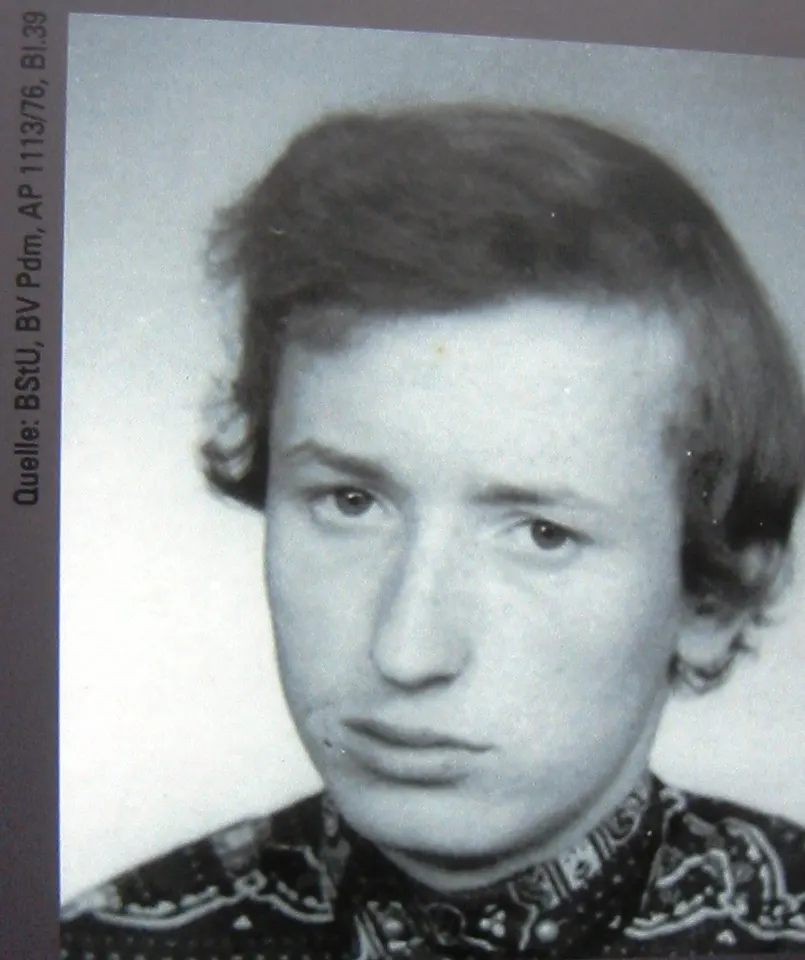

Klaus Schulze was born on 13 October 1953 in Falkensee, a town on the edge of West Berlin. At 14 he had already tried, without success, to get to West Berlin; as a minor he was not charged. The difficult circumstances of his upbringing may have been behind that attempt. He attended the Geschwister-Scholl school in Falkenhöh from 1960 to 1968 but fell behind, later gave up training as a cattle breeder, and got by as an unskilled worker.
He spent most of his time with a group of young people his own age of the kind the Stasi dismissed as groups of loafers or "negative" youth groups. Like such groups all over East Germany at the time, they wanted anything but to live as their parents had. In East Germany, however, being without a steady job brought trouble. After he and his friend Dieter Krause left their jobs at the Hennigsdorf steel mill in the summer of 1971, the Falkensee council warned them to find work at once, and they had been threatened with a re-education work camp. On 5 March 1972 he was reprimanded again for absenteeism. Both young men wanted to leave East Germany as soon as they could.
A friend of theirs had a plot in Falkenhöh right on the border. The two looked at the area once by day and once by night, and noticed that overgrown vegetation gave cover and that one light in the control strip was out. Late in the afternoon of 7 March 1972 they went round several bars in Falkensee, and at about 8 p.m. they set off on foot for Falkenhöh. Their friend was not at home and knew nothing of the plan. They took a 2.7-metre ladder from his shed and carried it into the border strip.
They crossed the signal fence with the ladder, not realising they had triggered an alarm. Klaus, carrying one end of the ladder bent low, tripped over a wire and fell behind. Dieter Krause reached the last fence, 2.5 metres high on a steep concrete slope, set the ladder against it, and got over amid heavy fire from the two guards. Klaus Schulze was hit in the chest by a bullet that tore his aorta and lungs.
The next day his sister was questioned and told only that her brother had died dishonourably. Three days after his death, a public prosecutor and Stasi officers told his parents he had died in an accident during an attempt to break through the border for which he himself was to blame, and pressured them to agree to cremation. His belongings came back to them against a receipt: one pair of black men's shoes. Stasi informants kept watch on the family, and their mail was read. His urn was buried in the cemetery in Falkensee on 3 April 1972; the young people of the town, who had hoped to turn the funeral into a protest against the order to shoot, were not told the date.
In spring 1991 his siblings asked the Berlin senator for justice to investigate, and in autumn 1994 the two guards were charged. The proceedings against one were discontinued because he was permanently unfit to stand trial; the other, who said he had deliberately fired over the ladder, was acquitted in early 1997 by the Potsdam Regional Court.
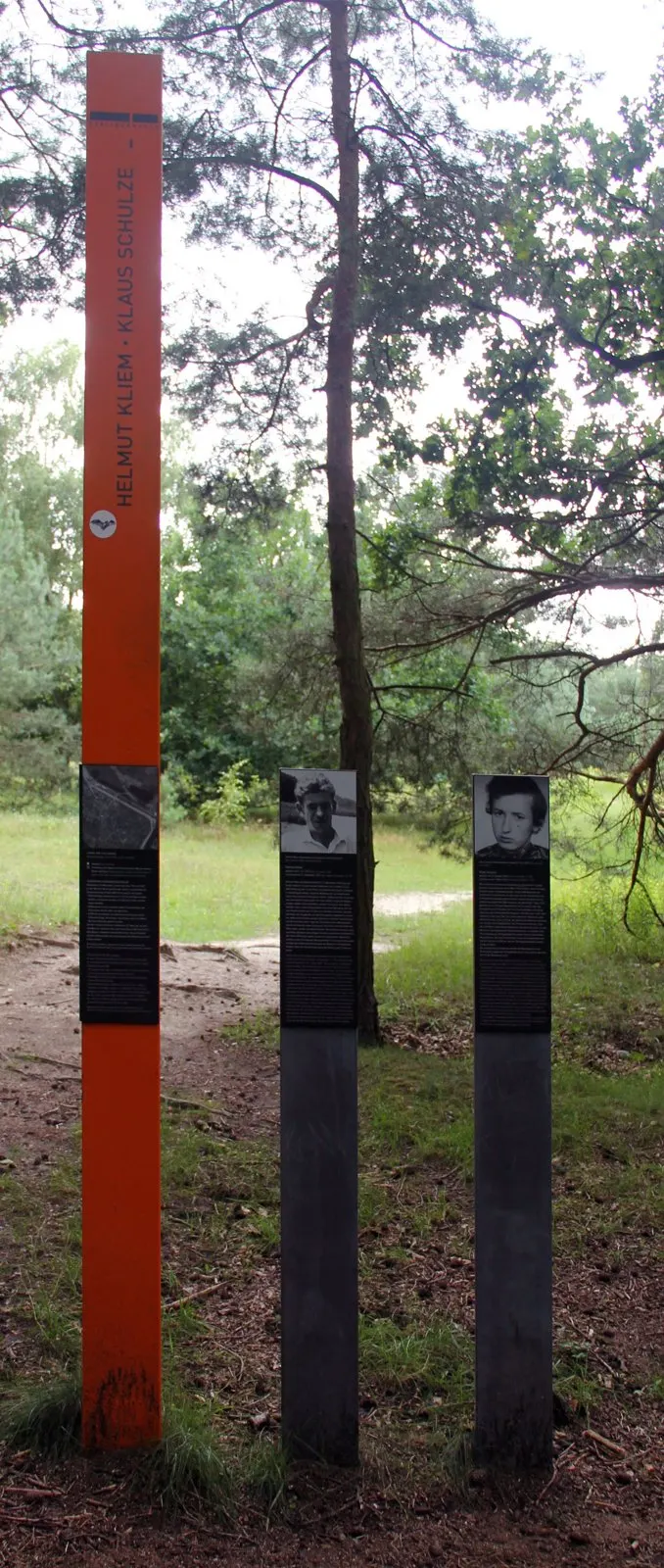
_Schulze_Kliem.jpg)
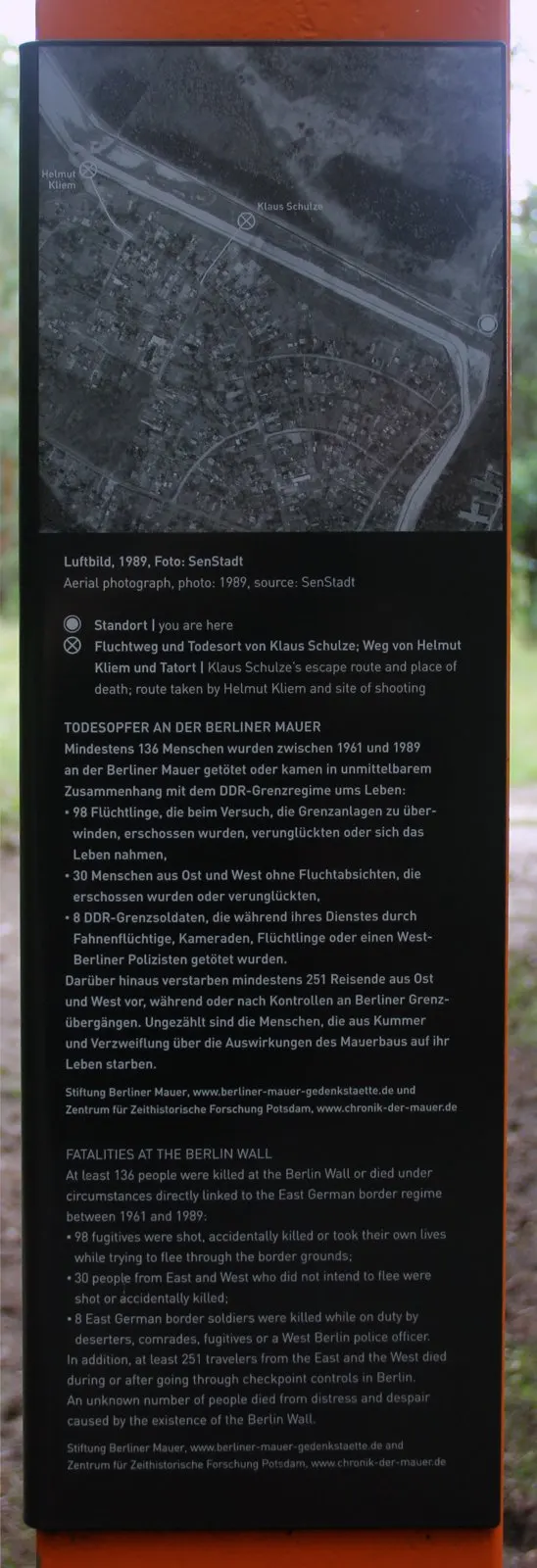
_Schulze_Kliem2.jpg)
Also died on the outer ring between Berlin-Spandau and Falkensee
- Helmut Kliem 13 November 1970
Sources
This profile is a summary written for this site. Every fact in it is taken from source 1, which also gives the full account with archival references.
- Martin Ahrends/Udo Baron/Hans-Hermann Hertle, “Klaus Schulze”, biography in Chronik der Mauer, Federal Agency for Civic Education, Centre for Contemporary History Potsdam and Deutschlandradio. Accessed 23 September 2026. Read online. Basis for every fact in this profile, including the dates and place of death.
- German version of the same biography. Accessed 23 September 2026. Read online.
- Hans-Hermann Hertle and Maria Nooke (eds.), The Victims at the Berlin Wall, 1961–1989: A Biographical Handbook. Centre for Contemporary History Potsdam and Berlin Wall Foundation, Berlin 2011. The printed handbook from which the online biography is taken.
- Hans-Hermann Hertle and Maria Nooke, “140 Victims at the Berlin Wall, 1961–1989” (list), Centre for Contemporary History Potsdam and Berlin Wall Foundation, August 2017. PDF. Used to cross-check names and dates.
- Hans-Hermann Hertle and Maria Nooke, “The Victims at the Berlin Wall, 1961–1989: Findings of a Research Project”, August 2017. PDF. Source of the classification into escapees, people with no intent to escape, and border soldiers.
Further reading
Image credits
- Klaus Schulze, as reproduced on an information column on the Finkenkruger Weg between Berlin-Staaken and Brandenburg (source: BStU). Assenmacher, CC BY-SA 3.0, Wikimedia Commons.
- Memorial for Helmut Kliem and Klaus Schulze in the Spandauer Forst, Berlin-Hakenfelde, photographed in 2017. OTFW, Berlin, CC BY-SA 3.0, Wikimedia Commons.
- Panel with a 1989 aerial photograph marking Klaus Schulze's escape route and place of death, Spandauer Forst memorial. OTFW, Berlin, CC BY-SA 3.0, Wikimedia Commons.
Cite this page
“Klaus Schulze”, Victims of the Berlin Wall, Berlin Experiences. https://victimsofthewall.com/victims/schulze-klaus/
Map
The pin position is based on the place of death described in source 1. Base map © OpenStreetMap contributors; course of the Wall in 1989 from Geoportal Berlin (dl-de/zero-2.0). Accessed 23 September 2026.