Helmut Kliem
1939–1970
Helmut Kliem, a 31-year-old East German police officer and father of two, was shot on 13 November 1970 after he took a wrong turn by motorcycle towards the border gate in Falkenhöhe and turned back; he bled to death.
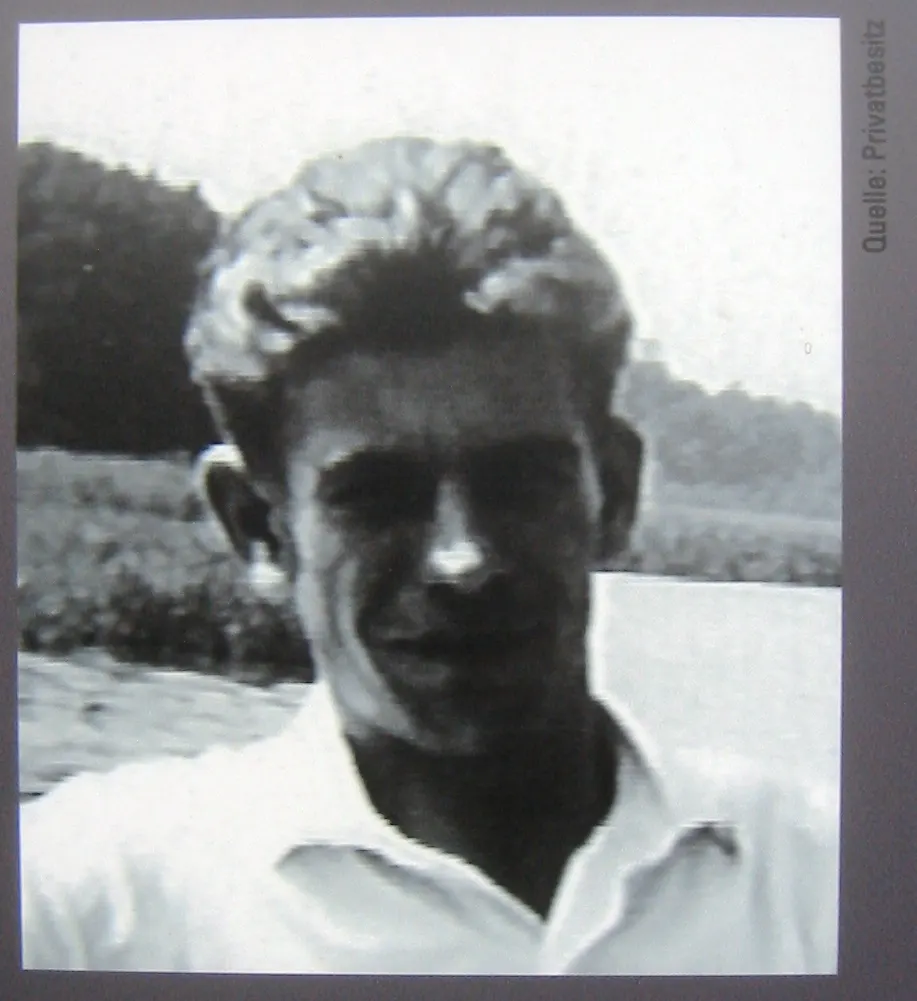

Helmut Kliem was born in Ebereschenhof on 2 June 1939. From 1957 he served as an East German police officer, and after years of guard, patrol and local station duty he had recently been assigned, with the rank of head constable, to the works security unit of the locomotive and electrical plant in Hennigsdorf. He lived in Staaken, right on the border with the West Berlin district of Spandau, with his wife and their two children.
On 13 November 1970 he came home from a night shift at about 6.45 a.m. His wife had already taken the children to daycare on her way to work. His half-brother Bernhard, who had the day off, came to visit, and the two went to the Volkshaus restaurant in Staaken for lunch with beer and schnapps. They were looking forward to the weekend and meant to go to a Carnival party that evening.
At around 3 p.m. they set off on Helmut Kliem's motorcycle with sidecar; the plan was to collect his wife from her early shift and then the children. Absorbed in conversation, he missed the turning to her workplace, drove straight on, overlooked the signs marking the border area, and stopped about ten metres short of the gate into the border grounds. He had plainly taken the wrong road, and he turned the motorcycle round. Perhaps he did not take the soldier's order to stop seriously, or perhaps he did not hear it, or any warning shot, over the engine; either way, he accelerated away.
The guard at the gate aimed at the tyres from about 30 metres and fired seven shots; he later claimed he had not realised that his rifle was set to automatic fire. A bullet passed through Helmut Kliem's shoulder blade and struck the artery and vein in his upper arm; his brother was hit in the hand. Helmut Kliem braked, got off the motorcycle, took a few steps towards the guard and collapsed. Guards held back a local resident who ran to help. The brothers received medical treatment only an hour later, after an ambulance had taken them to Staaken Hospital, and by then it was too late for Helmut Kliem. He died at about 4.30 p.m.
Even under the border troops' own rules the shooting was not justified, as there had been no apparent attempt to cross the border. Yet the military prosecutor did not investigate; the guards were decorated and promoted that same day. His wife waited in vain at 4 p.m. and walked the children home. She learned of his death only on 14 November, was not told how he had died, and was refused permission to see his body and was falsely told that it had already been cremated. Bernhard was taken from hospital to a Stasi remand prison, held for three weeks on suspicion of attempting to leave East Germany illegally, and then released with the death described to him as an accident.
Both his wife and his half-brother were sworn to secrecy, and rumours circulated in Staaken. The supervisor of the police "Border Work Group" in Nauen, who apparently learned what had really happened during questioning at the hospital, handed in his weapon in protest and announced that he was leaving border service. Helmut Kliem's urn was buried in the cemetery in Falkensee on 4 February 1971. The guard who had fired, who had been awarded a medal and from whom the fatal outcome had been kept hidden until the 1990s, was convicted by the Potsdam Regional Court in 1997 of manslaughter together with attempted manslaughter and given a youth sentence of one year and eight months, suspended on probation.
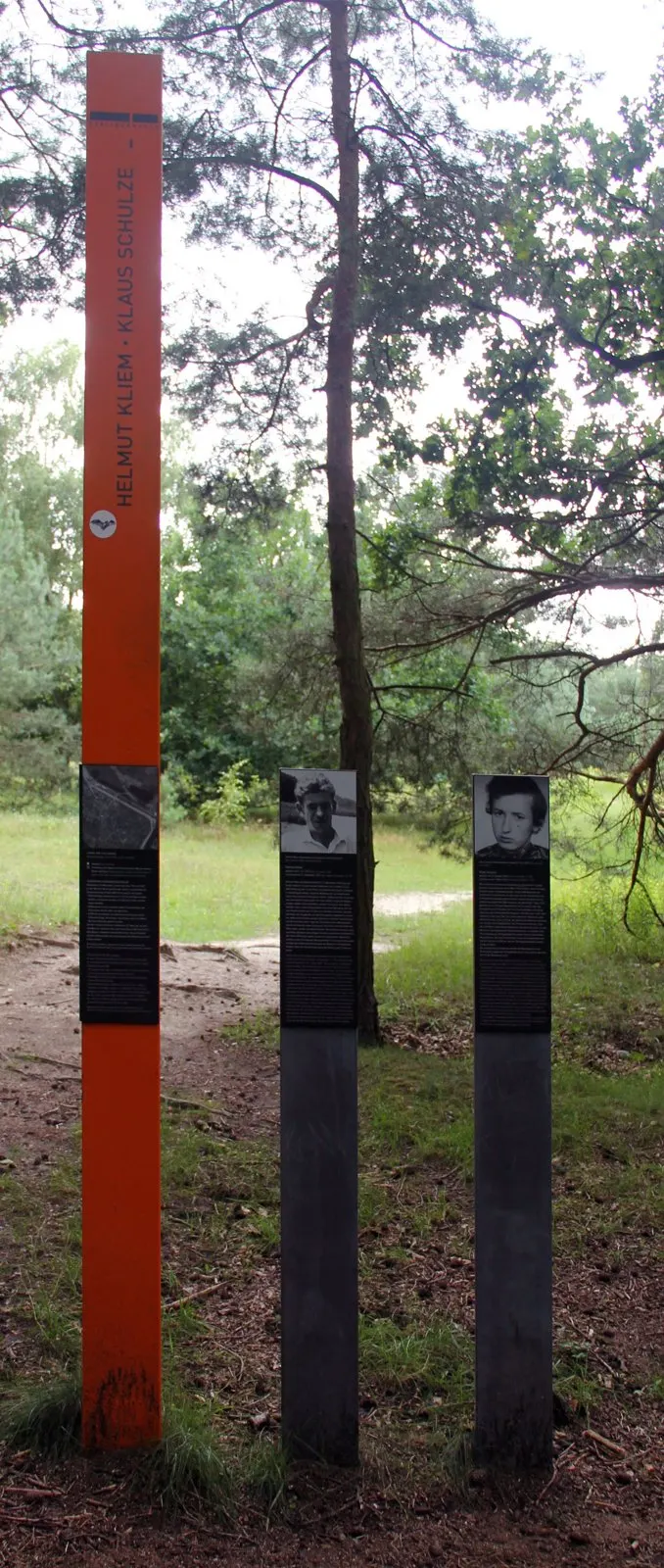
_Schulze_Kliem.jpg)
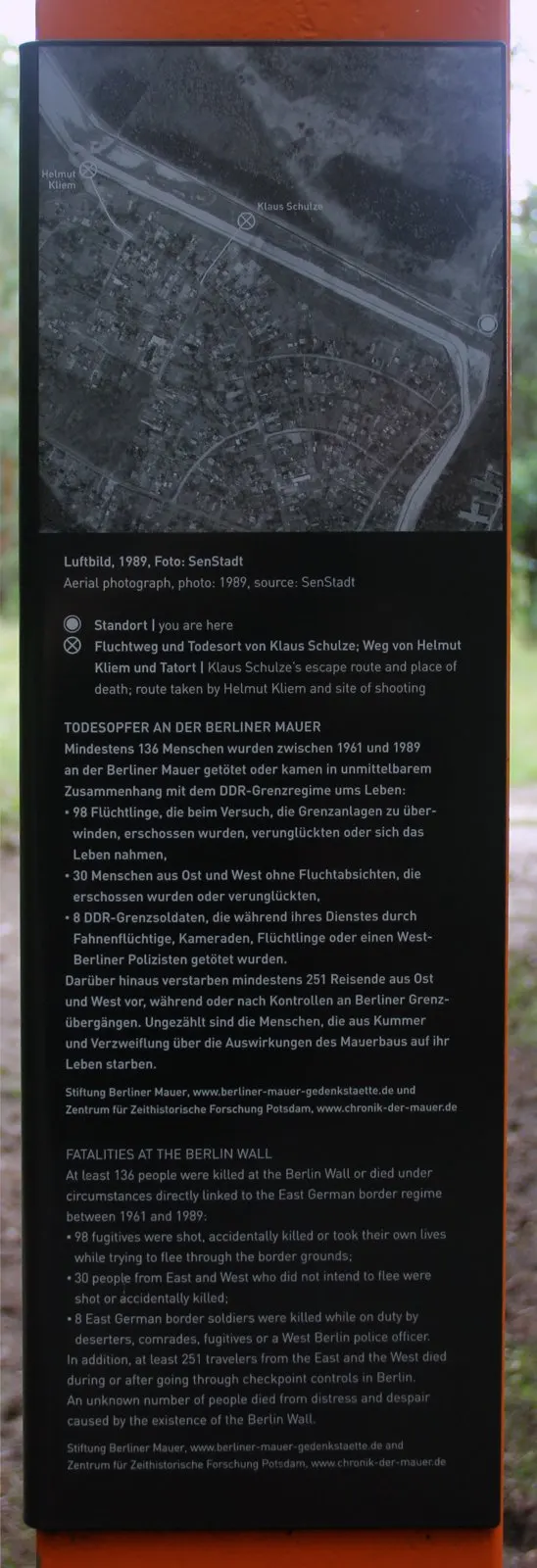
_Schulze_Kliem2.jpg)
Also died on the outer ring between Berlin-Spandau and Falkensee
- Klaus Schulze 7 March 1972
Sources
This profile is a summary written for this site. Every fact in it is taken from source 1, which also gives the full account with archival references.
- Martin Ahrends/Udo Baron/Hans-Hermann Hertle, “Helmut Kliem”, biography in Chronik der Mauer, Federal Agency for Civic Education, Centre for Contemporary History Potsdam and Deutschlandradio. Accessed 23 September 2026. Read online. Basis for every fact in this profile, including the dates and place of death.
- German version of the same biography. Accessed 23 September 2026. Read online.
- Hans-Hermann Hertle and Maria Nooke (eds.), The Victims at the Berlin Wall, 1961–1989: A Biographical Handbook. Centre for Contemporary History Potsdam and Berlin Wall Foundation, Berlin 2011. The printed handbook from which the online biography is taken.
- Hans-Hermann Hertle and Maria Nooke, “140 Victims at the Berlin Wall, 1961–1989” (list), Centre for Contemporary History Potsdam and Berlin Wall Foundation, August 2017. PDF. Used to cross-check names and dates.
- Hans-Hermann Hertle and Maria Nooke, “The Victims at the Berlin Wall, 1961–1989: Findings of a Research Project”, August 2017. PDF. Source of the classification into escapees, people with no intent to escape, and border soldiers.
Further reading
Image credits
- Helmut Kliem, date unknown, as reproduced on an information column on the Finkenkruger Weg between Berlin-Staaken and Brandenburg (photo: private ownership). Assenmacher, CC BY-SA 3.0, Wikimedia Commons.
- Memorial for Helmut Kliem and Klaus Schulze in the Spandauer Forst, Berlin-Hakenfelde, photographed in 2017. OTFW, Berlin, CC BY-SA 3.0, Wikimedia Commons.
- Panel with a 1989 aerial photograph marking the route taken by Helmut Kliem and the site of the shooting, Spandauer Forst memorial. OTFW, Berlin, CC BY-SA 3.0, Wikimedia Commons.
Cite this page
“Helmut Kliem”, Victims of the Berlin Wall, Berlin Experiences. https://victimsofthewall.com/victims/kliem-helmut/
Map
The pin position is based on the place of death described in source 1. Base map © OpenStreetMap contributors; course of the Wall in 1989 from Geoportal Berlin (dl-de/zero-2.0). Accessed 23 September 2026.