Gerald Thiem
1928–1970
Gerald Thiem, a 41-year-old West Berlin foreman and father of two, was shot by East German border guards on 7 August 1970 after climbing into the border strip between Neukölln and Treptow; his daughters learned the truth only in 1994.
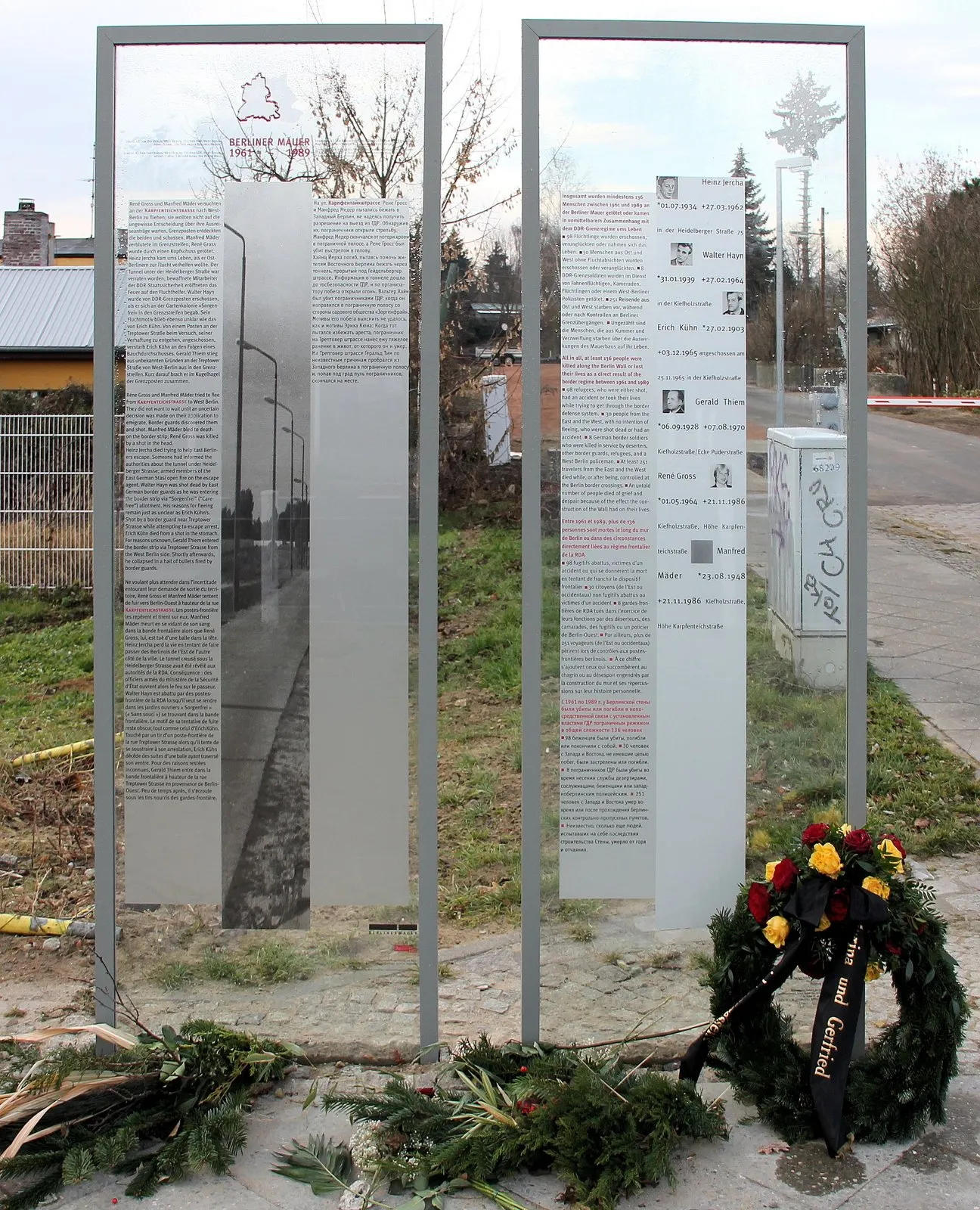
_Jercha_Hayn_K%C3%BChn_Thiem_Gross_M%C3%A4der.jpg)
Gerald Thiem was born in Berlin on 6 September 1928. He lived in Britz, in West Berlin, with his wife and their two daughters. A pipe layer by trade, he worked as a foreman for a building firm.
On Friday 7 August 1970 he did not come home after work. His wife knew he liked a drink on payday and was not worried at first, but as the hours passed she grew anxious; he had promised to take the girls on a steamboat trip the next day. She would never learn in her lifetime what had become of him.
That evening, having drunk heavily, he was near the Wall between Neukölln and Treptow. Why he was there is not known. He insulted the border soldiers and at about 11:15 p.m. climbed over first the old and then the new Wall, in what was then a confusing stretch of the border, heading towards East Berlin. When a soldier called out to him and tried to arrest him, he ran on through a railway underpass and came out straight into the glare of the border lights and the field of fire of two more guards, who opened fire at once. In all, six guards took aim at him and fired a total of 177 bullets at him from several positions until he fell into the anti-vehicle trench. At about 11:35 p.m. the guards recovered him and took him to the rear area, from where an ambulance brought him to the People's Police Hospital in Berlin-Mitte; when he arrived there after midnight, he had already died of gunshot wounds to the chest.
Although he could easily have been arrested without shots being fired, the most zealous guards were awarded the border troops' performance badge the next day, and all the other guards involved received bonuses in kind. The Stasi knew who he was from the papers he carried. But because the West had not connected his sudden disappearance with the shooting at the Wall, the East decided to conceal his death: the killing could have disturbed the détente diplomacy from which the SED leadership hoped to gain international recognition, only days before the Moscow Treaty was signed. A Stasi file note of 10 August 1970 recorded that the case was to be treated and closed as an unknown body, with every measure taken to keep it secret. He was cremated, registered as an unknown dead man, and on 22 September 1970 his ashes were scattered at the cemetery beside the Baumschulenweg Crematorium.
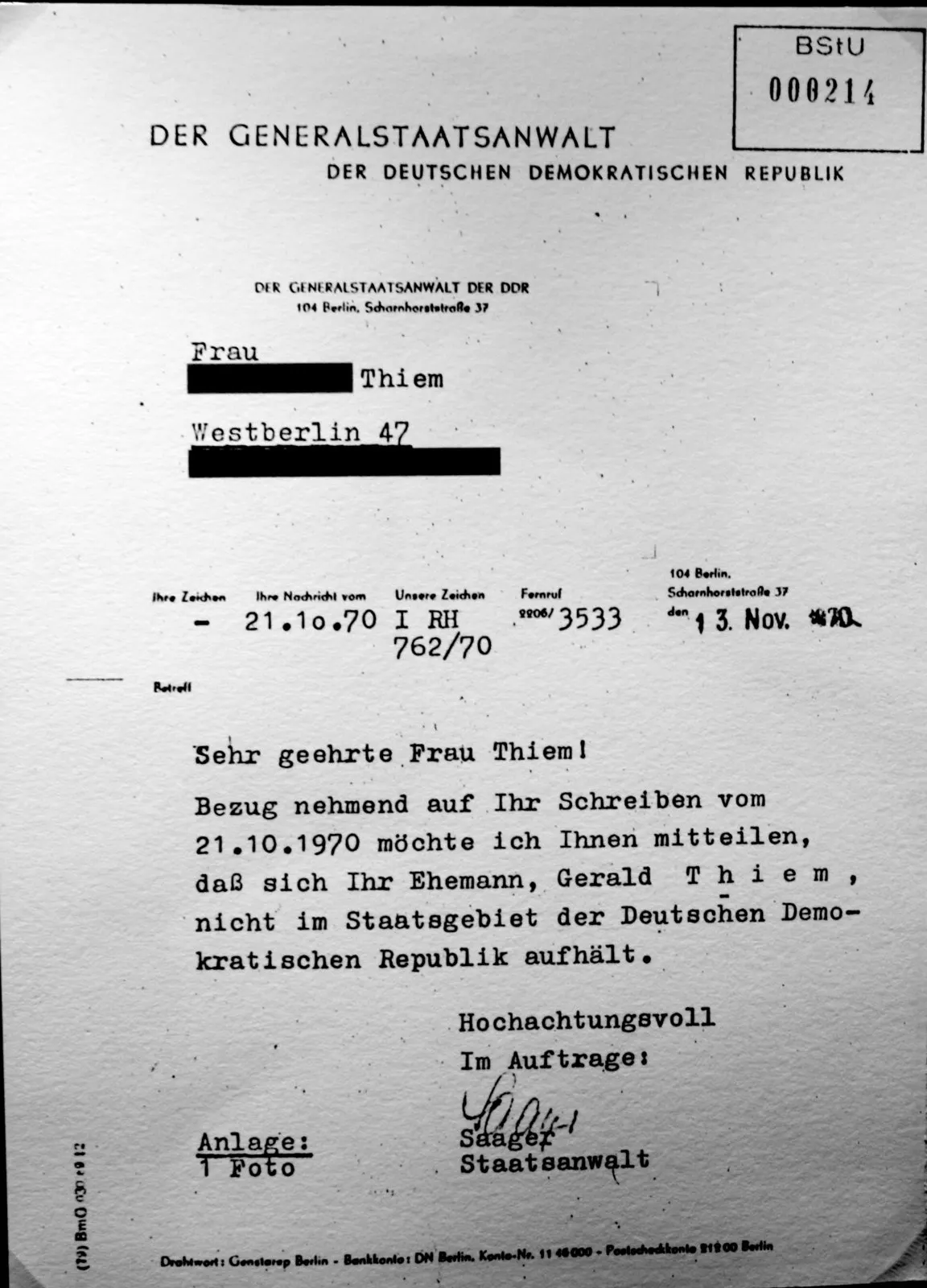
In West Berlin the shots had been heard, but police had no reason to link them with the missing-person report his wife had filed. She extended her search to East Berlin, only to be told by the East German attorney general that her husband was not on East German territory. At her request he was declared dead on 10 June 1981, with 31 December 1975 recorded as the date of death.
Only in the autumn of 1994, after West Berlin investigators came across the case in border troop and Stasi files, did his daughters learn what had happened to their father. His wife, Charlotte Thiem, had died by then. In mid-1998 the Berlin Regional Court convicted two of the guards of jointly committed manslaughter and gave each a suspended youth sentence of one year and three months.

Also died on the sector border between Berlin-Neukölln and Berlin-Treptow
- Georg Feldhahn 19 December 1961
- Heinz Jercha 27 March 1962
- Wolfgang Glöde 11 June 1962
- Horst Kutscher 15 January 1963
- Siegfried Widera 8 September 1963
- Dieter Berger 13 December 1963
- Walter Hayn 27 February 1964
- Hans-Joachim Wolf 26 November 1964
- Erich Kühn 3 December 1965
- Jörg Hartmann 14 March 1966
- Lothar Schleusener 14 March 1966
- Michael Kollender 25 April 1966
- Max Sahmland 27 January 1967
- Christian Peter Friese 25 December 1970
- Werner Kühl 24 July 1971
- Johannes Sprenger 10 May 1974
- Manfred Mäder 21 November 1986
- René Gross 21 November 1986
- Lutz Schmidt 12 February 1987
- Chris Gueffroy 5 February 1989
Sources
This profile is a summary written for this site. Every fact in it is taken from source 1, which also gives the full account with archival references.
- Martin Ahrends/Udo Baron/Hans-Hermann Hertle, “Gerald Thiem”, biography in Chronik der Mauer, Federal Agency for Civic Education, Centre for Contemporary History Potsdam and Deutschlandradio. Accessed 23 September 2026. Read online. Basis for every fact in this profile, including the dates and place of death.
- German version of the same biography. Accessed 23 September 2026. Read online.
- Hans-Hermann Hertle and Maria Nooke (eds.), The Victims at the Berlin Wall, 1961–1989: A Biographical Handbook. Centre for Contemporary History Potsdam and Berlin Wall Foundation, Berlin 2011. The printed handbook from which the online biography is taken.
- Hans-Hermann Hertle and Maria Nooke, “140 Victims at the Berlin Wall, 1961–1989” (list), Centre for Contemporary History Potsdam and Berlin Wall Foundation, August 2017. PDF. Used to cross-check names and dates.
- Hans-Hermann Hertle and Maria Nooke, “The Victims at the Berlin Wall, 1961–1989: Findings of a Research Project”, August 2017. PDF. Source of the classification into escapees, people with no intent to escape, and border soldiers.
Further reading
Image credits
- Memorial for Gerald Thiem and other victims of the Wall at Kiefholzstraße 79 in Berlin-Plänterwald, photographed in 2011. OTFW, Berlin, CC BY-SA 3.0, Wikimedia Commons.
- Letter from the Prosecutor General of the GDR to Gerald Thiem's wife, dated 13 November 1970, stating that her husband was not on GDR territory. TobiToaster, Public domain, Wikimedia Commons.
Cite this page
“Gerald Thiem”, Victims of the Berlin Wall, Berlin Experiences. https://victimsofthewall.com/victims/thiem-gerald/
Map
The pin position is based on the place of death described in source 1. Base map © OpenStreetMap contributors; course of the Wall in 1989 from Geoportal Berlin (dl-de/zero-2.0). Accessed 23 September 2026.