Johannes Sprenger
1905–1974
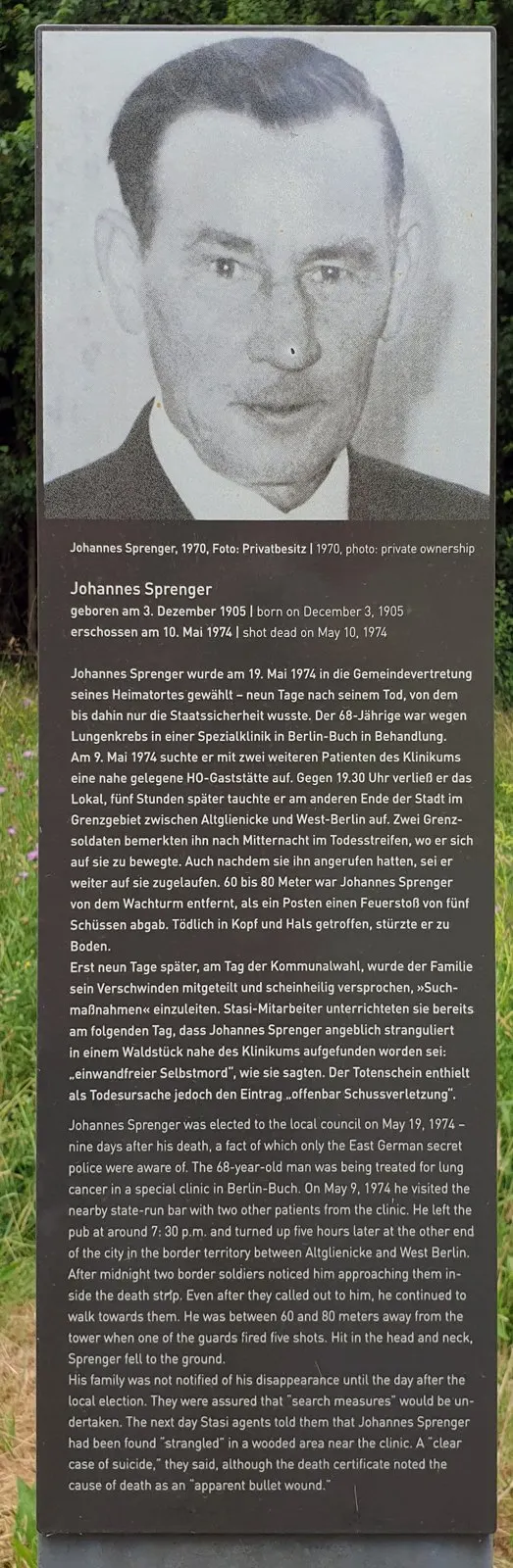
Johannes Sprenger, a 68-year-old pensioner, father of nine and local councillor, was shot dead by a border guard on 10 May 1974 in the death strip near Hornkleepfad in Altglienicke; why he went to the border remains unknown.
_Johannes_Sprenger.jpg)
Johannes Sprenger was born on 3 December 1905 in Greifenhagen in Pomerania, today Gryfino in Poland. A trained road construction worker and father of nine, he lived with his second wife in Lüttenhagen/Weitendorf in the Neustrelitz district. Though already drawing a pension, he still worked on the farm of the Dolgen cooperative. He had joined the KPD before 1945, was politically active in the SED, the ruling party, and had sat on his village council since retiring in 1970. He stood again in the local elections of 1974.
He had lung cancer, though no one in his village knew and even he had not been given a clear diagnosis. By April 1974 he seemed to sense that he was seriously ill. He was treated at a special clinic in Berlin-Buch, where doctors decided against surgery because of his age. Three days before he died, on a visit home, he told his wife that he would return in a coffin, without explaining more.
On the afternoon of 9 May 1974 he went with two other patients to a nearby bar, and left at around 7:30 p.m. He was next seen about five hours later, more than 30 kilometres away at the other end of the city, in the border area between Altglienicke and West Berlin. How he got there, and why, is unknown. As a pensioner he was free to travel to the West and had done so in 1970 and 1972. In 2000 the Berlin Regional Court suggested that he had presumably not intended to flee but had perhaps gone into the border area to have his life ended by the guards' fire, echoing the Stasi's own speculation; his biographers point out that there is no proof of this and considerable reason to doubt it. It also remains unclear how a weakened man managed to climb the inner fence.
At about 12:40 a.m. guards on the "Entenfarm" watchtower saw a man walking towards them between the inner fence and the signal fence, making no attempt to cross further barriers. According to the guards, he kept walking after they called out to him. When he was 60 to 80 metres from the tower, the head guard gave the order to shoot, and the other guard, without firing a warning shot, fired a burst of five shots. Hit in the head and neck, Johannes Sprenger fell. The guards could easily have arrested him, yet both received a merit badge.
No one else seemed to have noticed, and the Stasi decided to hide what had happened. Although he carried identification, his body was kept as that of an unknown man, with no autopsy. On 19 May, the day he was re-elected to his council, Stasi officers posing as police told his wife and a son that he had gone missing from the clinic. They later claimed he had been found strangled in woods near the clinic, a clear suicide, and persuaded the family to agree to cremation without seeing him. The urn came by post, and he was buried in his home village on 1 June 1974.
His wife doubted the suicide story all her life. The truth came out only in 1997, two years after her death, in the course of the criminal investigation of the guards who shot him; the Berlin Regional Court later sentenced both, for joint manslaughter, to suspended prison sentences of nine months each.
_Kutscher_Sprenger3.jpg)
_Kutscher_Sprenger2.jpg)
Also died on the sector border between Berlin-Neukölln and Berlin-Treptow
- Georg Feldhahn 19 December 1961
- Heinz Jercha 27 March 1962
- Wolfgang Glöde 11 June 1962
- Horst Kutscher 15 January 1963
- Siegfried Widera 8 September 1963
- Dieter Berger 13 December 1963
- Walter Hayn 27 February 1964
- Hans-Joachim Wolf 26 November 1964
- Erich Kühn 3 December 1965
- Jörg Hartmann 14 March 1966
- Lothar Schleusener 14 March 1966
- Michael Kollender 25 April 1966
- Max Sahmland 27 January 1967
- Gerald Thiem 7 August 1970
- Christian Peter Friese 25 December 1970
- Werner Kühl 24 July 1971
- Manfred Mäder 21 November 1986
- René Gross 21 November 1986
- Lutz Schmidt 12 February 1987
- Chris Gueffroy 5 February 1989
Sources
This profile is a summary written for this site. Every fact in it is taken from source 1, which also gives the full account with archival references.
- Martin Ahrends/Udo Baron/Hans-Hermann Hertle, “Johannes Sprenger”, biography in Chronik der Mauer, Federal Agency for Civic Education, Centre for Contemporary History Potsdam and Deutschlandradio. Accessed 23 September 2026. Read online. Basis for every fact in this profile, including the dates and place of death.
- German version of the same biography. Accessed 23 September 2026. Read online.
- Hans-Hermann Hertle and Maria Nooke (eds.), The Victims at the Berlin Wall, 1961–1989: A Biographical Handbook. Centre for Contemporary History Potsdam and Berlin Wall Foundation, Berlin 2011. The printed handbook from which the online biography is taken.
- Hans-Hermann Hertle and Maria Nooke, “140 Victims at the Berlin Wall, 1961–1989” (list), Centre for Contemporary History Potsdam and Berlin Wall Foundation, August 2017. PDF. Used to cross-check names and dates.
- Hans-Hermann Hertle and Maria Nooke, “The Victims at the Berlin Wall, 1961–1989: Findings of a Research Project”, August 2017. PDF. Source of the classification into escapees, people with no intent to escape, and border soldiers.
Further reading
Image credits
- Memorial stele for Johannes Sprenger on the Berlin Wall Trail (Mauerweg) in Berlin-Altglienicke, with his photograph from 1970 (private ownership), photographed in 2019. OTFW, Berlin, CC BY-SA 3.0, Wikimedia Commons.
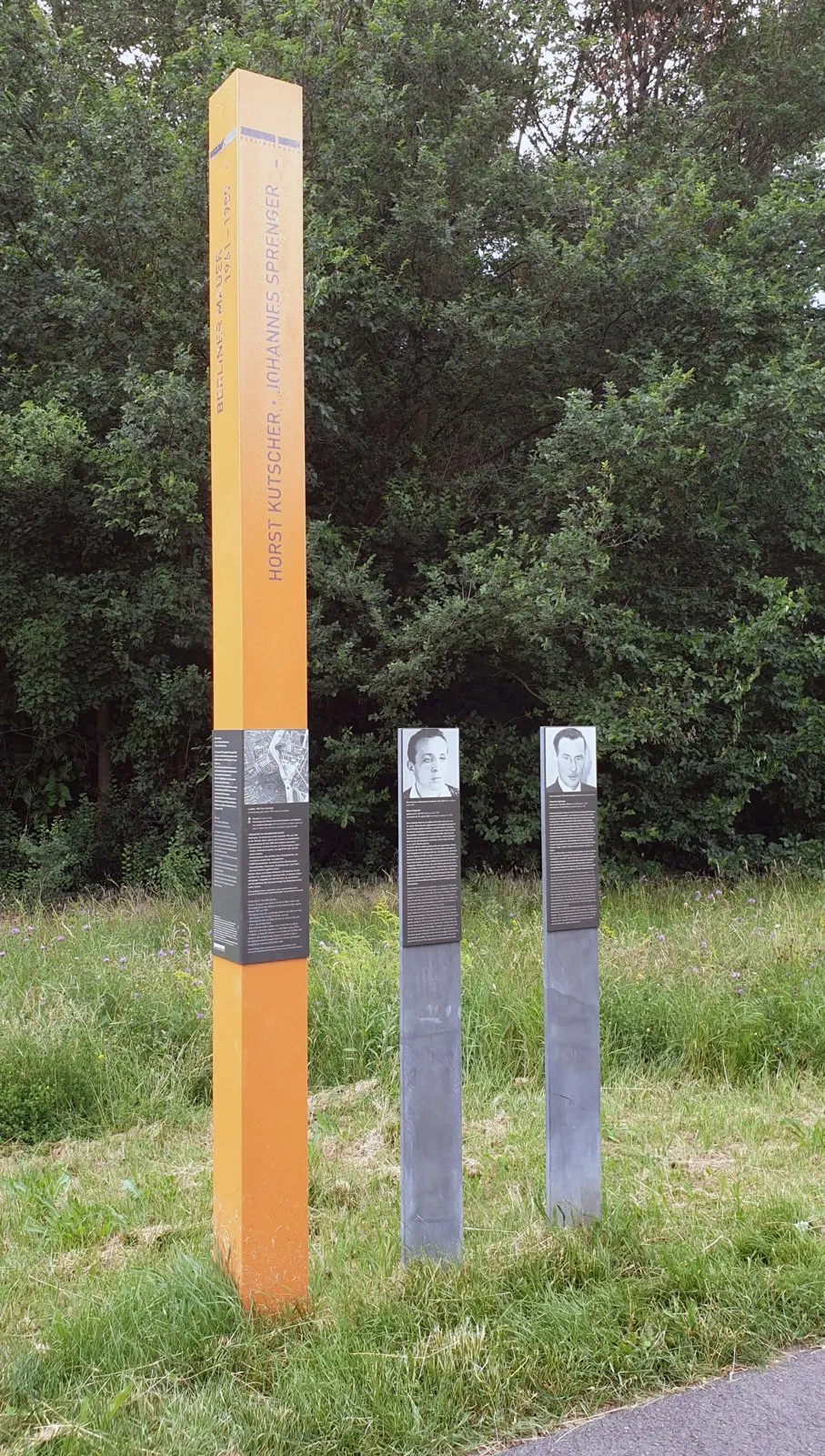
- Memorial for Horst Kutscher and Johannes Sprenger on the Berlin Wall Trail in Berlin-Altglienicke, photographed in 2019. OTFW, Berlin, CC BY-SA 3.0, Wikimedia Commons.
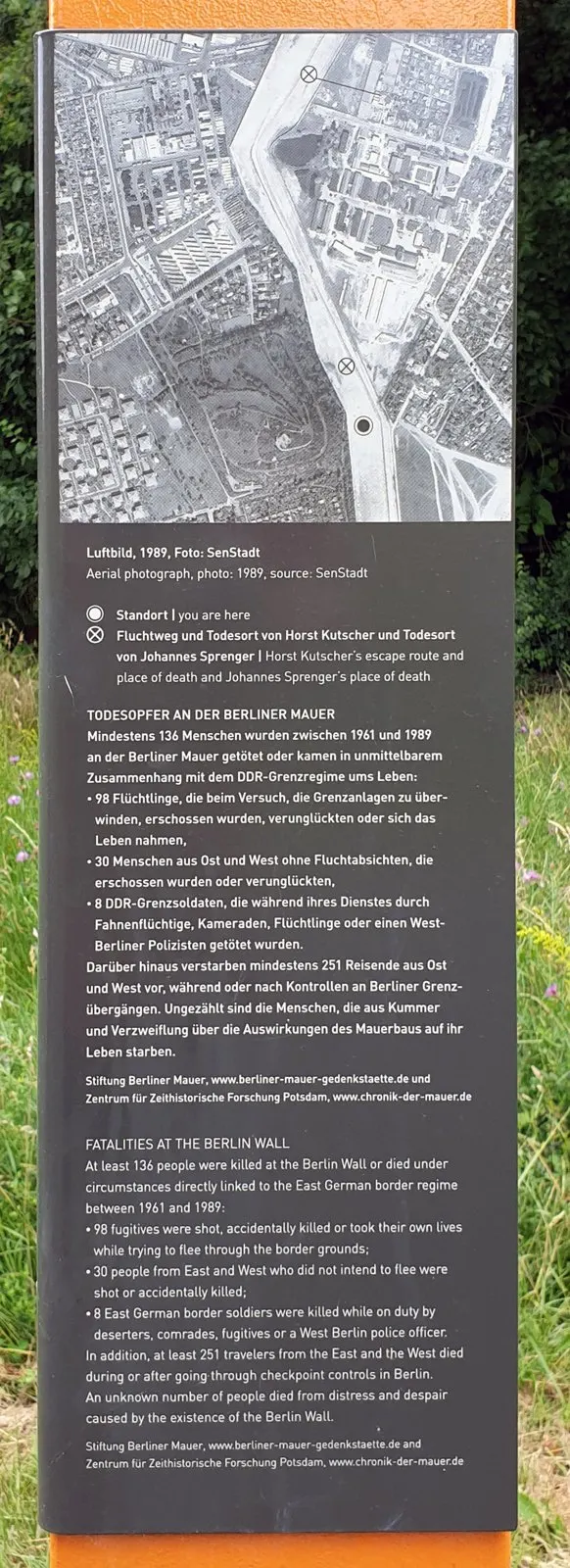
- Panel with a 1989 aerial photograph marking Johannes Sprenger's place of death and Horst Kutscher's escape route, Berlin-Altglienicke. OTFW, Berlin, CC BY-SA 3.0, Wikimedia Commons.
Cite this page
“Johannes Sprenger”, Victims of the Berlin Wall, Berlin Experiences. https://victimsofthewall.com/victims/sprenger-johannes/
Map
The pin position is based on the place of death described in source 1. Base map © OpenStreetMap contributors; course of the Wall in 1989 from Geoportal Berlin (dl-de/zero-2.0). Accessed 23 September 2026.