Michael Kollender
1945–1966
Michael Kollender, a 21-year-old National People's Army soldier from Oberlungwitz, was shot in the head while crawling towards the Teltow Canal in Johannisthal early on 25 April 1966, and died in hospital.
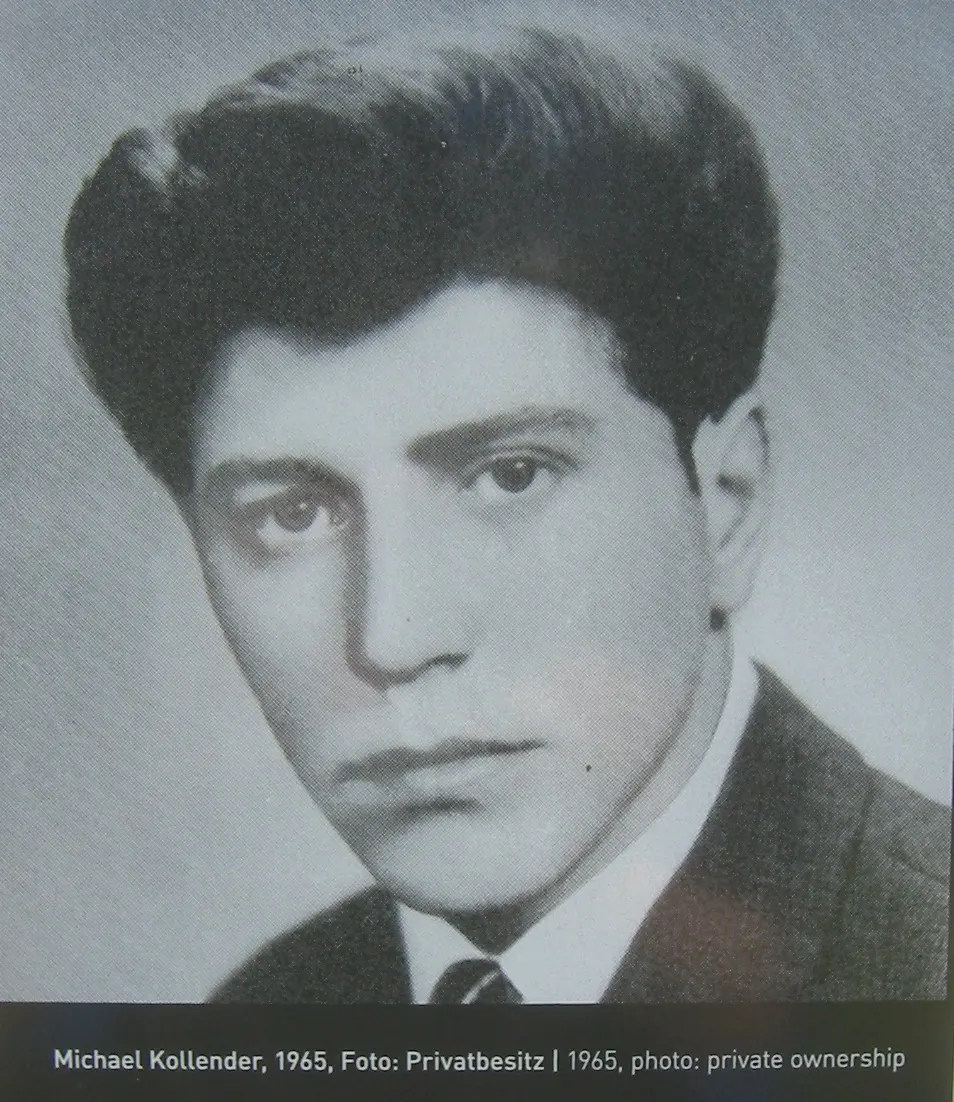

Michael Kollender was born in Silesia on 19 February 1945 and grew up in Oberlungwitz in Saxony, the eldest of three children in a Catholic family. He drove a tractor at the machine and tractor station in a neighbouring town. In early November 1965 he was drafted into the National People's Army and trained as a gunner in an air force anti-aircraft missile regiment.
His regiment was due to take part in the May Day parade in East Berlin on 1 May 1966, which can hardly have pleased him: he was a Catholic critical of the regime, and his superiors regarded him as recalcitrant. He had been thinking of escape since joining up, and had once confided to his younger brother that he would cross the border illegally into West Berlin if the opportunity arose.
On the night of 24 to 25 April 1966 he was on duty where his unit stored its combat equipment, in the old Hentschel factory halls in Berlin-Johannisthal. Still in uniform and carrying his loaded machine pistol, he left his post and ran across the old Johannisthal airfield towards the border, getting through the inner fence. At about 3.45 a.m. a flare was fired from the watchtower at Wrede Bridge.
Four guards were on duty by the canal. Three of them were due to be discharged within days, and by their own account, given when they were questioned in the early 1990s, they had just been saying how glad they were that no one had tried to escape on their watch. In the light of the flare they saw the shadow of a fugitive some distance away. One of them later claimed that, despite the darkness and the distance, he had made out an army uniform and a gun in the fugitive's hand; the other three said they had taken him for an ordinary escapee. They took their machine pistols from their shoulders and opened aimed fire, pursuing and encircling him and firing salvo after salvo; when they drew level with him, two of them allegedly fired barrage fire parallel to the border to stop him. He was already crawling across the control strip; only the triple barbed-wire fence stood between him and the canal bank, which was already West Berlin. He was only a few metres from the actual border line. The four guards fired at least 109 shots. He was hit twice in the head and suffered many other serious wounds. He had not fired a single shot himself.
The guards dragged him into a ditch, tried to give first aid and notified their command post. For half an hour the badly injured man lay in the death strip without medical care. Then, wrapped in a tarpaulin, he was pushed under a medical vehicle and loaded on the side facing away from the West, so that no one there could see him being taken away. He was taken to the People's Police Hospital in Berlin-Mitte, where he died. That same day the four guards were commended as a model group; the one presumed to have fired the fatal shot received a medal for exemplary border service and was promoted, and the other three were each given a gold wristwatch and a cash bonus.
Two days later army officers told his parents only that he had been shot while trying to escape, and urged them to stay silent; the family's papers about his service were taken away. He was buried in his home town among his family and many friends, watched by the Stasi. In autumn 1995 the Berlin Regional Court convicted one of the guards of attempted manslaughter and gave him a nine-month suspended sentence, but acquitted the guard presumed to have fired the fatal shot, holding that desertion was a wrong that could be prosecuted even under the rule of law. On appeal by the prosecution and the convicted guard, the Federal Court of Justice acquitted him as well: under East German military law of 1962 desertion was a crime, and killing deserters was excused because, in this special case, the unlawfulness of the shooting could not have been obvious to the guards.
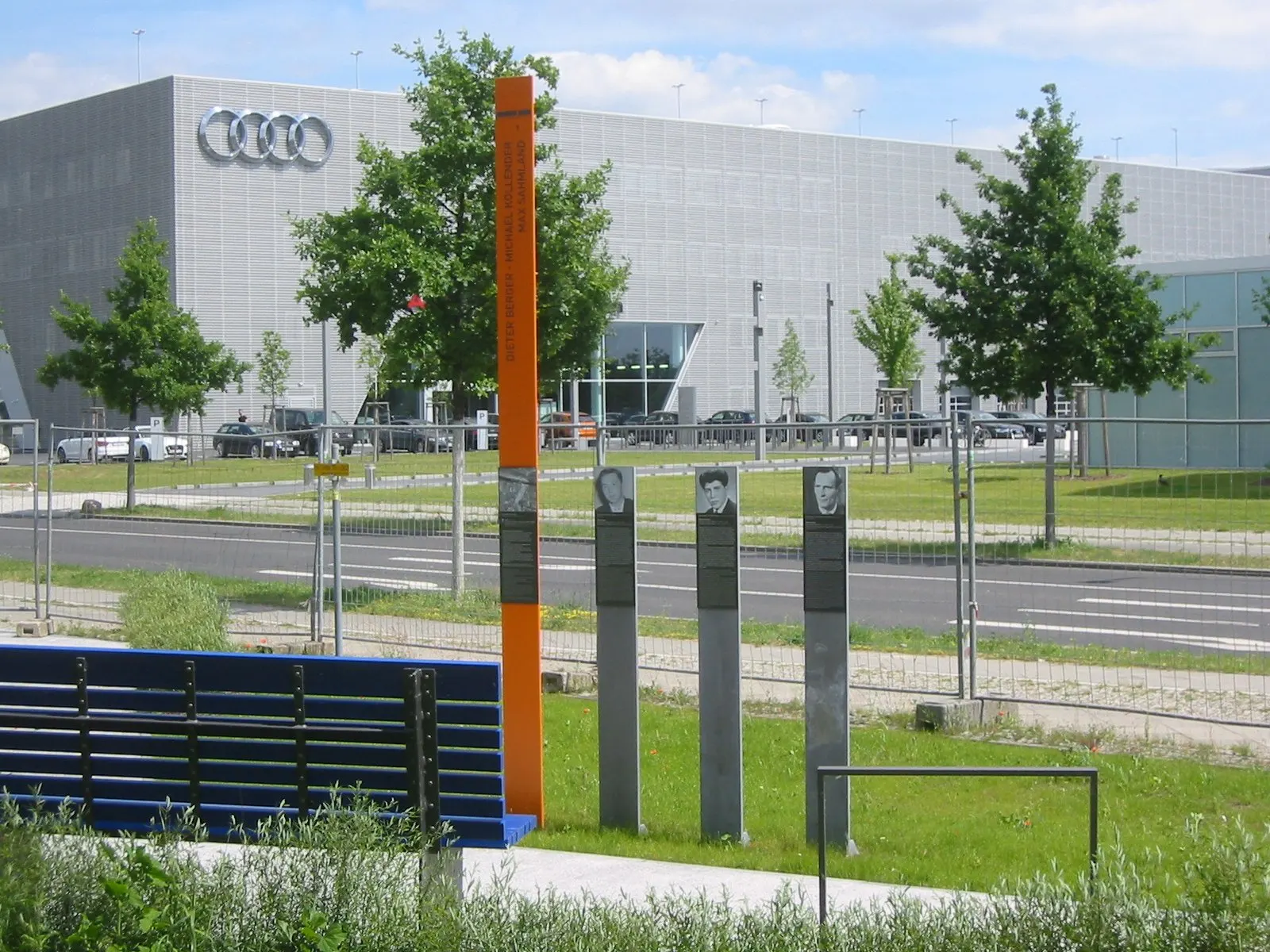

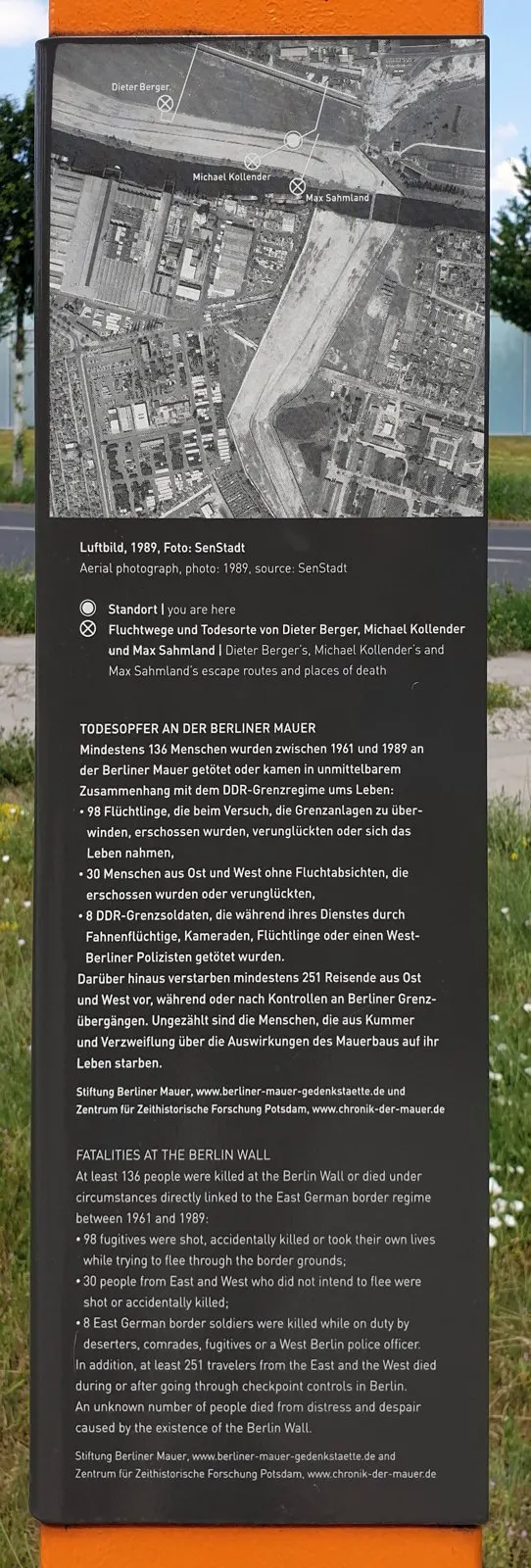
_Berger_Kollender_Sahmland.jpg)
Read more
Also died on the sector border between Berlin-Neukölln and Berlin-Treptow
- Georg Feldhahn 19 December 1961
- Heinz Jercha 27 March 1962
- Wolfgang Glöde 11 June 1962
- Horst Kutscher 15 January 1963
- Siegfried Widera 8 September 1963
- Dieter Berger 13 December 1963
- Walter Hayn 27 February 1964
- Hans-Joachim Wolf 26 November 1964
- Erich Kühn 3 December 1965
- Jörg Hartmann 14 March 1966
- Lothar Schleusener 14 March 1966
- Max Sahmland 27 January 1967
- Gerald Thiem 7 August 1970
- Christian Peter Friese 25 December 1970
- Werner Kühl 24 July 1971
- Johannes Sprenger 10 May 1974
- Manfred Mäder 21 November 1986
- René Gross 21 November 1986
- Lutz Schmidt 12 February 1987
- Chris Gueffroy 5 February 1989
Sources
This profile is a summary written for this site. Every fact in it is taken from source 1, which also gives the full account with archival references.
- Martin Ahrends/Udo Baron/Hans-Hermann Hertle, “Michael Kollender”, biography in Chronik der Mauer, Federal Agency for Civic Education, Centre for Contemporary History Potsdam and Deutschlandradio. Accessed 23 September 2026. Read online. Basis for every fact in this profile, including the dates and place of death.
- German version of the same biography. Accessed 23 September 2026. Read online.
- Hans-Hermann Hertle and Maria Nooke (eds.), The Victims at the Berlin Wall, 1961–1989: A Biographical Handbook. Centre for Contemporary History Potsdam and Berlin Wall Foundation, Berlin 2011. The printed handbook from which the online biography is taken.
- Hans-Hermann Hertle and Maria Nooke, “140 Victims at the Berlin Wall, 1961–1989” (list), Centre for Contemporary History Potsdam and Berlin Wall Foundation, August 2017. PDF. Used to cross-check names and dates.
- Hans-Hermann Hertle and Maria Nooke, “The Victims at the Berlin Wall, 1961–1989: Findings of a Research Project”, August 2017. PDF. Source of the classification into escapees, people with no intent to escape, and border soldiers.
Further reading
Image credits
- Michael Kollender in 1965 (photo: private ownership), photographed from his memorial stele at Ernst-Ruska-Ufer in Berlin-Adlershof. Assenmacher, CC BY-SA 3.0, Wikimedia Commons.
- Memorial column and steles for Max Sahmland, Michael Kollender and Dieter Berger at Ernst-Ruska-Ufer in Berlin-Adlershof, photographed in 2013. Assenmacher, CC BY-SA 3.0, Wikimedia Commons.
- Panel at the Adlershof memorial with a 1989 aerial photograph marking the escape routes and places of death of Dieter Berger, Michael Kollender and Max Sahmland, photographed in 2019. OTFW, Berlin, CC BY-SA 3.0, Wikimedia Commons.
Cite this page
“Michael Kollender”, Victims of the Berlin Wall, Berlin Experiences. https://victimsofthewall.com/victims/kollender-michael/
Map
The pin position is based on the place of death described in source 1. Base map © OpenStreetMap contributors; course of the Wall in 1989 from Geoportal Berlin (dl-de/zero-2.0). Accessed 23 September 2026.