Christian Peter Friese
1948–1970
Christian Peter Friese, a 22-year-old motor mechanic from Naumburg, was shot dead on Christmas night 1970 in the border strip at the Köllnische Heide railway embankment in Johannisthal, a few metres short of the last fence.
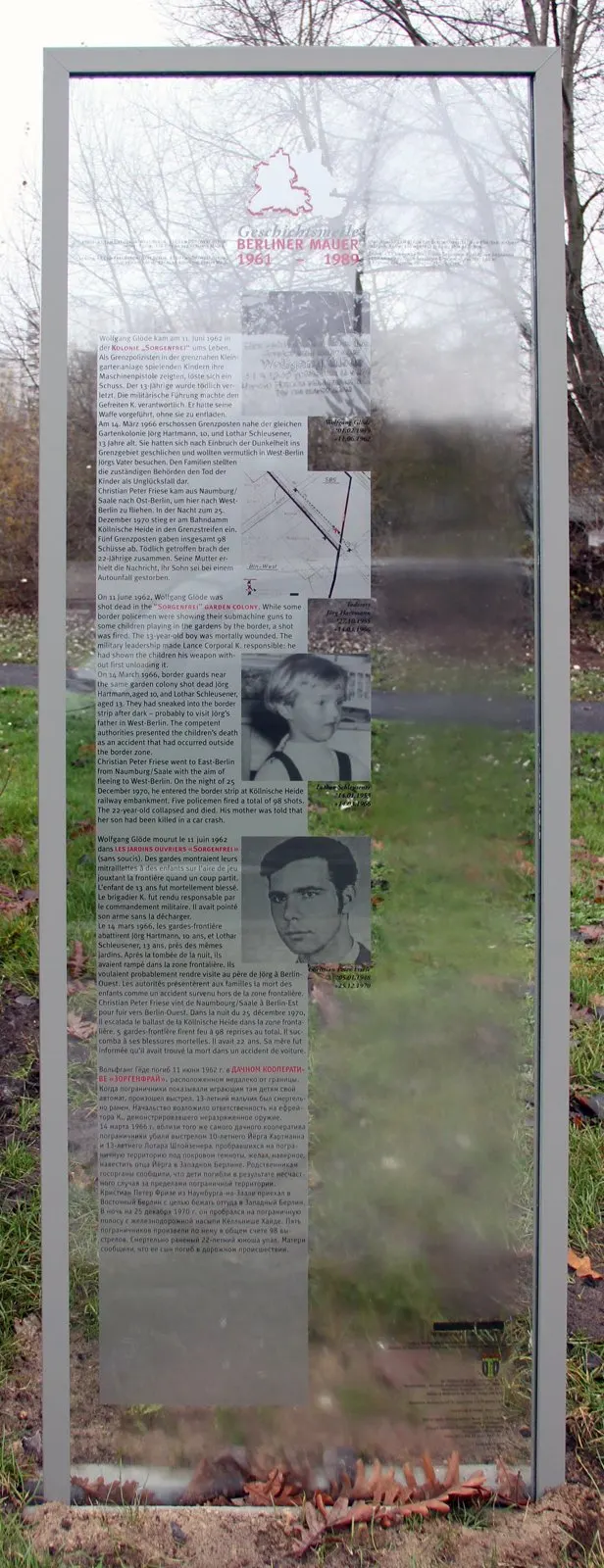
_Gl%C3%B6de_Hartmann_Friese.jpg)
Christian Peter Friese was born in Munich on 5 January 1948 and grew up as an only child with his mother in Naumburg. Her husband had been missing since 1944 and was later declared dead, and his natural father does not appear in the records. After school he trained as a motor mechanic, moved with his fiancée to Karl-Marx-Stadt, but soon returned to Naumburg alone, where he worked as a motor mechanic for the Reichsbahn.
In his spare time he volunteered at a youth club in Naumburg. Its director praised his commitment and called him a good role model for the young people; she said he gave up leading the club because of his evening classes. The Stasi told a different story: he allegedly had a poor reputation in his neighbourhood because of his liking for western beat music, had spread decadent views of art and held an unstable attitude towards social development in East Germany, and for this reason, it said, he had had to be replaced as club leader.
At the end of 1992 his mother told the Naumburg police that he had said several times he would leave for the West if the chance arose. According to her, he disagreed with the way things were in East Germany and, above all, did not want to do military service in the National People's Army. A friend's failed escape in 1968, which ended in prison, did not deter him; he told his mother they would not catch him.
At the end of 1970 he lived in the same building as his mother. When she called for him on Christmas Eve he was gone, without a goodbye or a letter, and a photo album, a tape recorder and some clothes were missing. Her first thought was that he had gone to Berlin to escape. That evening he took a train to East Berlin, hid in a small allotment colony near the border in Treptow and watched the border grounds.
At around midnight he climbed the inner fence unseen, but set off an alarm as he crawled through the signal fence and jumped the tripwires behind it. The area was well lit and overlooked by two watchtowers and by an alarm group posted on Christmas night on the Köllnische Heide railway embankment. Five border guards fired 98 shots. He tried to hide in the anti-vehicle trench, ran on when the firing briefly stopped, came under fire again and collapsed a few metres from the last fence. He was hit in the legs, and according to one of the guards he cried out about his legs; he died in the border strip from a gunshot wound through his abdomen and chest.
The shots woke residents on both sides, and bullets struck trees and houses in West Berlin. The West Berlin Senate and the American city commander protested, and the West Berlin police opened an investigation. On Christmas Day a western television report about a young man killed at the Wall made his mother fear it was her son. Only on 7 January 1971 did the Stasi tell her he was dead, claiming he had crashed a car into a tree, that his body was already cremated, and forcing her to sign a statement promising to tell her acquaintances the same story. His urn was sent to Naumburg a month after his death and buried in the municipal cemetery under Stasi surveillance.
Twenty-eight years later the Berlin Regional Court acquitted the border guards involved, as neither an intent to kill nor the identity of the guard who actually killed him could be established.
Also died on the sector border between Berlin-Neukölln and Berlin-Treptow
- Georg Feldhahn 19 December 1961
- Heinz Jercha 27 March 1962
- Wolfgang Glöde 11 June 1962
- Horst Kutscher 15 January 1963
- Siegfried Widera 8 September 1963
- Dieter Berger 13 December 1963
- Walter Hayn 27 February 1964
- Hans-Joachim Wolf 26 November 1964
- Erich Kühn 3 December 1965
- Jörg Hartmann 14 March 1966
- Lothar Schleusener 14 March 1966
- Michael Kollender 25 April 1966
- Max Sahmland 27 January 1967
- Gerald Thiem 7 August 1970
- Werner Kühl 24 July 1971
- Johannes Sprenger 10 May 1974
- Manfred Mäder 21 November 1986
- René Gross 21 November 1986
- Lutz Schmidt 12 February 1987
- Chris Gueffroy 5 February 1989
Sources
This profile is a summary written for this site. Every fact in it is taken from source 1, which also gives the full account with archival references.
- Martin Ahrends/Udo Baron/Hans-Hermann Hertle, “Christian Peter Friese”, biography in Chronik der Mauer, Federal Agency for Civic Education, Centre for Contemporary History Potsdam and Deutschlandradio. Accessed 23 September 2026. Read online. Basis for every fact in this profile, including the dates and place of death.
- German version of the same biography. Accessed 23 September 2026. Read online.
- Hans-Hermann Hertle and Maria Nooke (eds.), The Victims at the Berlin Wall, 1961–1989: A Biographical Handbook. Centre for Contemporary History Potsdam and Berlin Wall Foundation, Berlin 2011. The printed handbook from which the online biography is taken.
- Hans-Hermann Hertle and Maria Nooke, “140 Victims at the Berlin Wall, 1961–1989” (list), Centre for Contemporary History Potsdam and Berlin Wall Foundation, August 2017. PDF. Used to cross-check names and dates.
- Hans-Hermann Hertle and Maria Nooke, “The Victims at the Berlin Wall, 1961–1989: Findings of a Research Project”, August 2017. PDF. Source of the classification into escapees, people with no intent to escape, and border soldiers.
Image credits
- Memorial panel for Wolfgang Glöde, Jörg Hartmann and Christian-Peter Friese at Kiefholzstraße 100 in Berlin-Plänterwald, photographed in 2014. OTFW, Berlin, CC BY-SA 3.0, Wikimedia Commons.
Cite this page
“Christian Peter Friese”, Victims of the Berlin Wall, Berlin Experiences. https://victimsofthewall.com/victims/friese-christian-peter/
Map
The pin position is based on the place of death described in source 1. Base map © OpenStreetMap contributors; course of the Wall in 1989 from Geoportal Berlin (dl-de/zero-2.0). Accessed 23 September 2026.