Rolf-Dieter Kabelitz
1951–1971
Rolf-Dieter Kabelitz, a 19-year-old from Potsdam, was shot by a border guard on 7 January 1971 in the border grounds near Bergfelde after he had turned back from the border, and died in hospital in Hennigsdorf on 30 January 1971 without seeing his family.
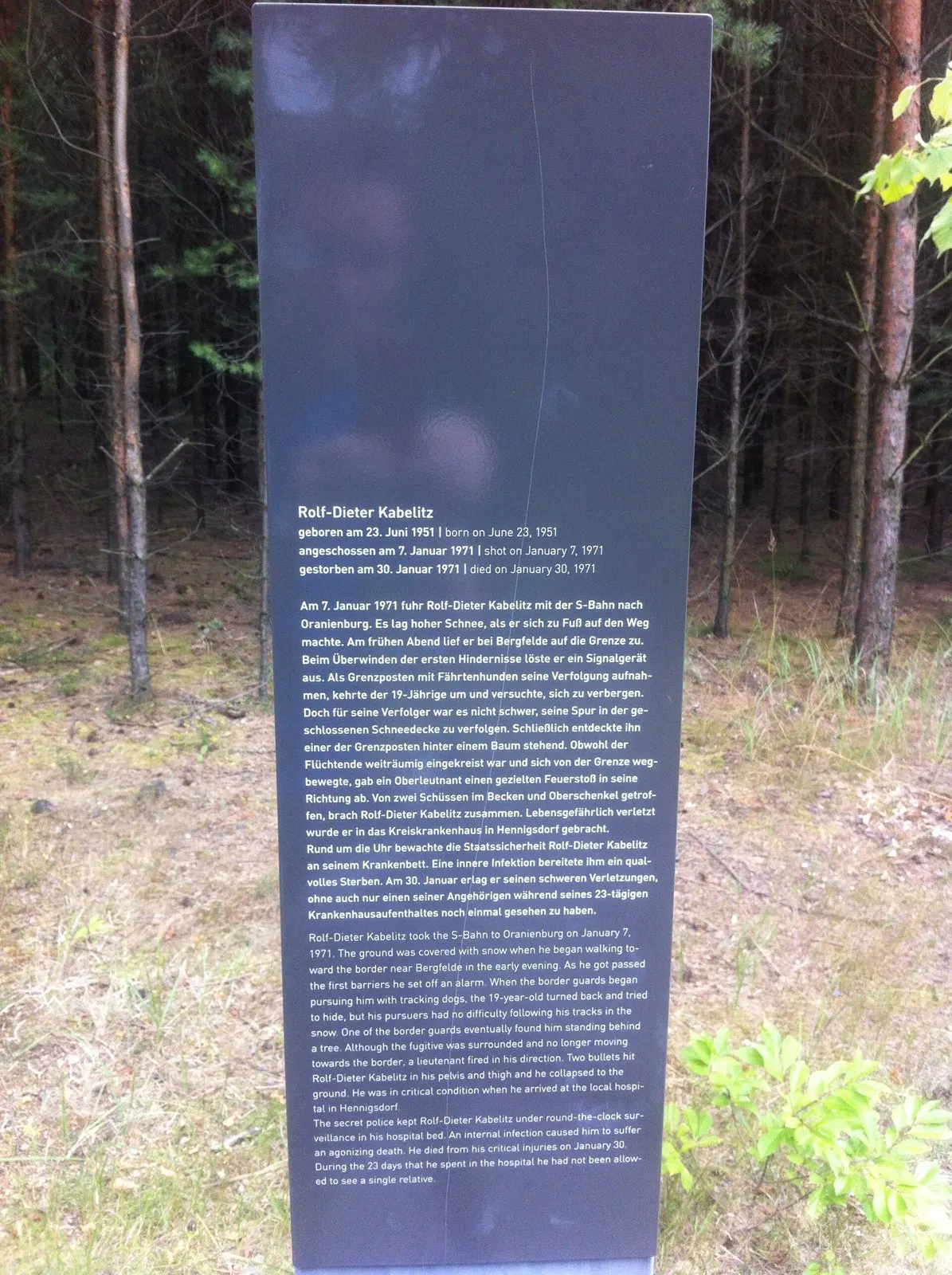

Rolf-Dieter Kabelitz was born on 23 June 1951. When he was four his mother, divorced from his father, remarried, and he grew up in Potsdam with her and his stepfather, a captain in the East German police. Relations with his stepfather were strained; his parents, both party members, thought him undisciplined and disliked his long hair. He gave up a lathe operator apprenticeship at the locomotive works in Babelsberg, and in August 1969 his parents found him a job at the Warnow shipyard in Rostock. He handed in his notice there, to take effect on 10 January 1971, wanting to work nearer home, which led to a row that spoiled the family's New Year.
Early on 4 January 1971 he left home, saying he was going back to Rostock for a late shift. Where he spent the next three days is not known. On 7 January he took the S-Bahn to Oranienburg and walked back along the snow-covered tracks through Birkenwerder to Hohen Neuendorf. In the early evening darkness he left the tracks near Bergfelde and headed towards the border. At about 7.55 p.m., as he tried to get past the first obstacles, he set off an alarm device and alerted the guards.
At first he kept moving towards West Berlin. When he realised he was being followed by guards with tracking dogs, he turned back towards the railway, dropping his bag so he could run faster. His footprints in the snow were easy to follow. At about 9.45 p.m. one of the guards found him standing behind a tree. Although he was surrounded over a wide area and was moving away from the border, a first lieutenant fired an aimed burst in his direction, supposedly after calling out to him. Two bullets hit him in the pelvis and thigh. According to a note by one of his Stasi guards, he said that after someone called out behind him he had heard no warning shot, only the double report of a submachine gun. Half asleep in hospital, he spoke of a dog crouching in front of him, which may suggest that he was being guarded by a dog and dared not move.
He was taken, critically injured, to the Friedrich Wolf Hospital in Hennigsdorf. Although he was weakened by blood loss and shock and not fully conscious, the Stasi began questioning him as soon as he arrived, at 2 a.m. Doctors reported that a gunshot wound through the intestine had put his life in danger, but on 9 January the Stasi and the director of the Oranienburg district court came to the hospital, announced the arrest warrant to him while he was intermittently unconscious after an operation, and took him into pre-trial detention. The Stasi guarded him around the clock at his bedside, and staff were forbidden to admit visitors or tell his relatives anything. He repeatedly insisted to his interrogators and guards that he had not meant to flee but had lost his way; the Stasi did not believe him.
Infection spread through his body over the following weeks. He was operated on twice and briefly improved, but on 30 January doctors diagnosed pneumonia, and he died at 11.50 that night. In his 23 days in hospital he did not see a single member of his family again. His body was cremated and his ashes buried.
West Berlin knew nothing at first; a defector later reported the incident but said the unnamed fugitive had been arrested unharmed. An investigation opened in July 1991 could not establish whether he had strayed into the border area by mistake or had meant to escape. Of the two guards who had fired, one said he had fired into the air, which his fellow guard confirmed; the first lieutenant who had fired the burst at him had died in 1986, and the Berlin public prosecutor discontinued the investigation on 15 August 1994 without bringing charges.
Also died on the outer ring between Bergfelde and Berlin-Reinickendorf
- Willi Born 7 July 1970
Sources
This profile is a summary written for this site. Every fact in it is taken from source 1, which also gives the full account with archival references.
- Martin Ahrends/Udo Baron, “Rolf-Dieter Kabelitz”, biography in Chronik der Mauer, Federal Agency for Civic Education, Centre for Contemporary History Potsdam and Deutschlandradio. Accessed 23 September 2026. Read online. Basis for every fact in this profile, including the dates and place of death.
- German version of the same biography. Accessed 23 September 2026. Read online.
- Hans-Hermann Hertle and Maria Nooke (eds.), The Victims at the Berlin Wall, 1961–1989: A Biographical Handbook. Centre for Contemporary History Potsdam and Berlin Wall Foundation, Berlin 2011. The printed handbook from which the online biography is taken.
- Hans-Hermann Hertle and Maria Nooke, “140 Victims at the Berlin Wall, 1961–1989” (list), Centre for Contemporary History Potsdam and Berlin Wall Foundation, August 2017. PDF. Used to cross-check names and dates.
- Hans-Hermann Hertle and Maria Nooke, “The Victims at the Berlin Wall, 1961–1989: Findings of a Research Project”, August 2017. PDF. Source of the classification into escapees, people with no intent to escape, and border soldiers.
Further reading
Image credits
- Memorial stele for Rolf-Dieter Kabelitz on the Berlin Wall Trail (Mauerweg) in Frohnau, photographed in 2014. Josef Papi, CC BY-SA 4.0, Wikimedia Commons.
Cite this page
“Rolf-Dieter Kabelitz”, Victims of the Berlin Wall, Berlin Experiences. https://victimsofthewall.com/victims/kabelitz-rolf-dieter/
Map
The pin position is based on the place of death described in source 1. Base map © OpenStreetMap contributors; course of the Wall in 1989 from Geoportal Berlin (dl-de/zero-2.0). Accessed 23 September 2026.