Czesław Jan Kukuczka
1935–1974
Czesław Jan Kukuczka, a 38-year-old Polish fireman and father of three, was shot in the back during a Stasi operation at the Friedrichstrasse station border crossing on 29 March 1974 and bled to death that evening.
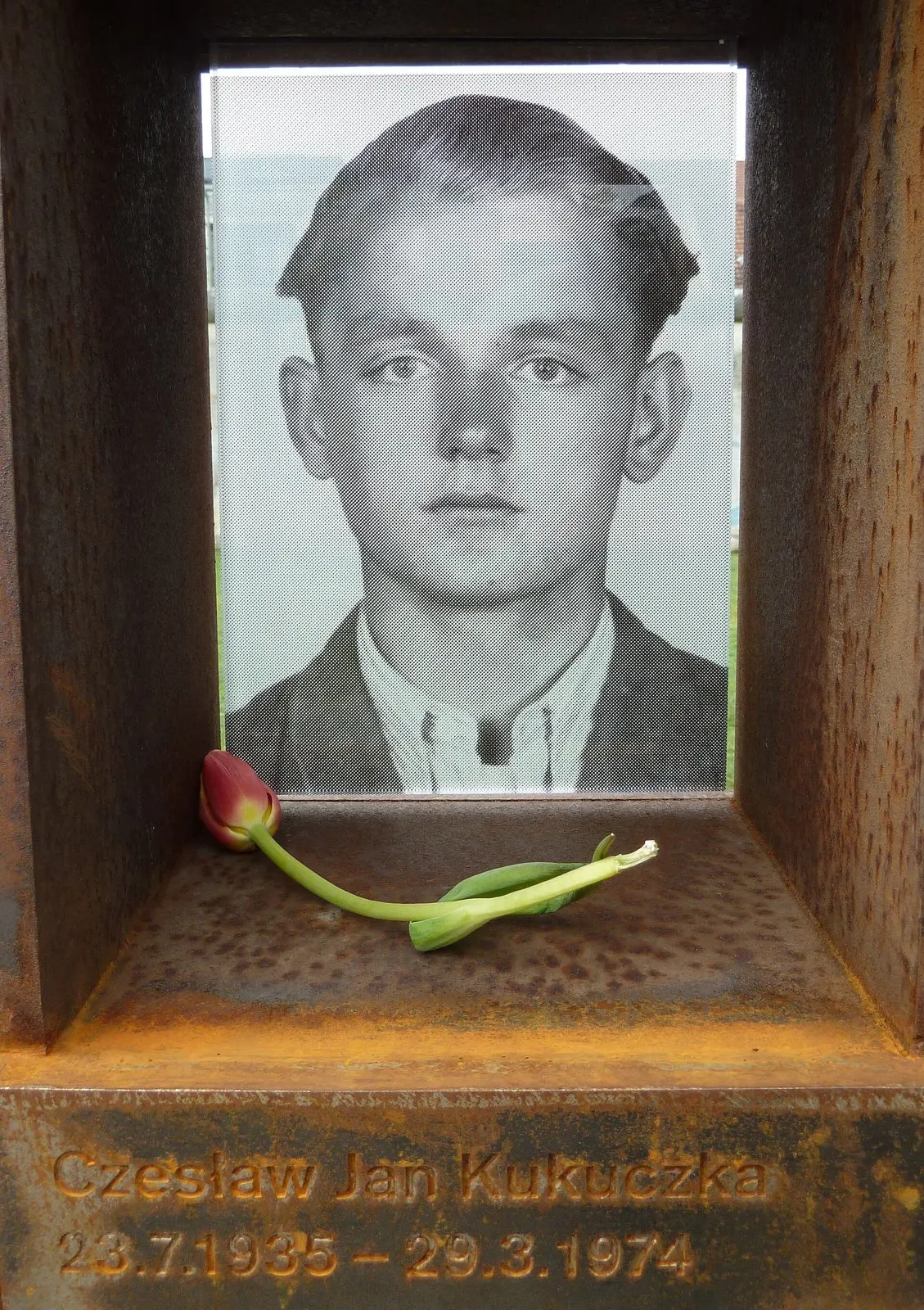

Czesław Kukuczka was born on 23 July 1935 in Kamienica, in Limanowa county in Poland, and went to primary school there up to seventh grade. A local periodical, Gorczańskie Wieści, counted him among the most active and imaginative young people of the area. At 17 he was recruited to help build Nowa Huta, the new socialist workers' town on the edge of Krakau, but he soon came home; according to an anonymous report by a delegate from Nowa Huta, he said the work was unbearable and talked others out of volunteering.
In October 1953 he was sentenced to two and a half years for alleged embezzlement, and was paroled in November 1954. He married, and he and his wife had three children. After a spell with a building company he served for several years in the fire brigades of Jaworzno, Limanowa and Bielsko-Biała, reaching the rank of junior fire brigade master. He told Polish officials he hoped to emigrate to the United States, where he had two aunts.
On 3 March 1974 he failed to turn up for work, and nothing more was known of his whereabouts until 29 March. At around 12.30 p.m. that day he came to the Polish embassy on Unter den Linden in East Berlin. There he told Polish security officials that unless he was allowed through the Friedrichstrasse crossing into West Berlin by 3 p.m., he would blow up the embassy with a bomb he claimed to be carrying; he held a stuffed briefcase on his knees. When he spoke of his family, according to one report, he had tears in his eyes. The Polish side informed the Stasi, and a deputy Stasi minister decided that he should be put out of action, if possible outside the embassy.
A Stasi officer issued him a substitute passport with an exit visa, and he was assured that the photograph could be taken at the border. At about 2.40 p.m. he left the embassy and was driven by a plain-clothes Stasi officer to the departure hall at Friedrichstrasse station. That afternoon, during the checks, he was shot in the back. Schoolgirls aged 15 to 17 from Bad Hersfeld on their way back to West Berlin saw it happen; a newspaper later quoted them as saying that a man in civilian clothes had fired from a distance of two metres.
Rather than being taken to the nearest hospital, he was driven several kilometres to the Stasi prison hospital in Hohenschönhausen, where he died from loss of blood during surgery at 6.32 p.m. The briefcase held all kinds of things, among them a shaving brush, shoe polish and sewing thread, but no explosives. Only after the "Bild" newspaper reported the shooting did a Stasi report, dated 4 April 1974, claim that he had threatened two border guards with a pistol and that one of them had then shot him. All the evidence suggests that this story was fabricated afterwards to justify his killing. The autopsy established that he had been shot in the back.
East German and Polish officials kept the case quiet, and his family was not consulted about cremation. On 24 May 1974 his widow, Emilia Kukuczka, received his urn and belongings, and the next day the head of the Kamienica municipality reported that a church funeral had taken place with close family. A Stasi officer involved and the head of the Polish operational group in East Berlin were later decorated. His identity was connected to the shooting only in the late 1990s, through a review of autopsy records. In December 2005 Berlin prosecutors closed the case, unable to identify the gunman with certainty. The shot in his back went unpunished.
Read more
Sources
This profile is a summary written for this site. Every fact in it is taken from source 1, which also gives the full account with archival references.
- Filip Gańczak/Hans-Hermann Hertle, “Czesław Jan Kukuczka”, biography in Chronik der Mauer, Federal Agency for Civic Education, Centre for Contemporary History Potsdam and Deutschlandradio. Accessed 23 September 2026. Read online. Basis for every fact in this profile, including the dates and place of death.
- German version of the same biography. Accessed 23 September 2026. Read online.
- Hans-Hermann Hertle and Maria Nooke (eds.), The Victims at the Berlin Wall, 1961–1989: A Biographical Handbook. Centre for Contemporary History Potsdam and Berlin Wall Foundation, Berlin 2011. The printed handbook from which the online biography is taken.
- Hans-Hermann Hertle and Maria Nooke, “140 Victims at the Berlin Wall, 1961–1989” (list), Centre for Contemporary History Potsdam and Berlin Wall Foundation, August 2017. PDF. Used to cross-check names and dates.
- Hans-Hermann Hertle and Maria Nooke, “The Victims at the Berlin Wall, 1961–1989: Findings of a Research Project”, August 2017. PDF. Source of the classification into escapees, people with no intent to escape, and border soldiers.
Further reading
Image credits
- Czesław Jan Kukuczka in the Window of Remembrance at the Berlin Wall Memorial, Bernauer Straße. Brewer Bob, CC BY-SA 4.0, Wikimedia Commons.
Cite this page
“Czesław Jan Kukuczka”, Victims of the Berlin Wall, Berlin Experiences. https://victimsofthewall.com/victims/kukuczka-czesaw-jan/
Map
The pin position is based on the place of death described in source 1. Base map © OpenStreetMap contributors; course of the Wall in 1989 from Geoportal Berlin (dl-de/zero-2.0). Accessed 23 September 2026.