Horst Körner
1947–1968
Horst Körner, a 21-year-old police officer from Wolfen, was shot dead in the border area of Klein Glienicke on 15 November 1968 during an escape attempt, after he had fired on a border patrol and killed the soldier Rolf Henniger.
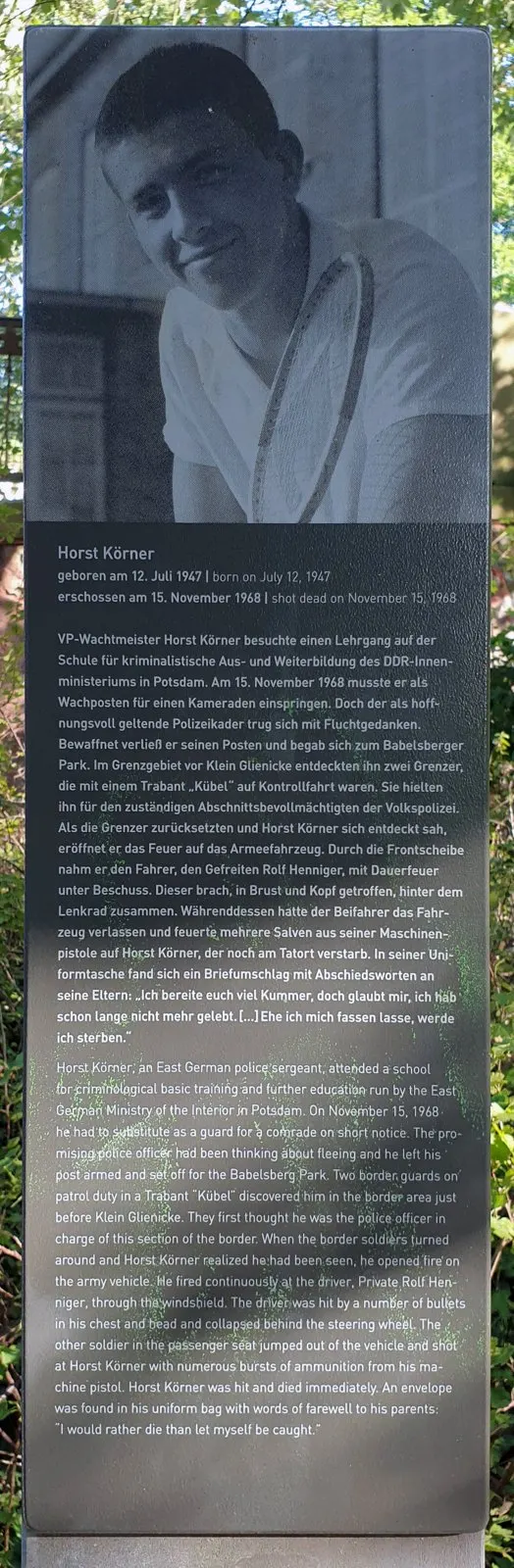
_Horst_K%C3%B6rner.jpg)
Horst Körner was born in Wolfen on 12 July 1947. After secondary school he attended the vocational school of the state-owned film factory there, and by summer 1967 he was a qualified mechanic with his school-leaving certificate. Instead of military service, which he may have wished to avoid, he became a candidate for the Criminal Police in Bitterfeld, and that same year he was promoted to the rank of Unterwachtmeister.
One of his main tasks was dealing with property crime, work that did not satisfy him. In early March 1968 he asked to leave the police and applied to study veterinary medicine at a college in Beichlingen. His superiors probably convinced him that his application, made without their approval, was hopeless; under pressure, he withdrew his request and agreed to a plan to train as an officer. He was a party member and was regarded as promising. In September 1968 he was sent to a police training school in Potsdam. Outwardly he seemed to have come to terms with things, but the farewell letter to his parents that he carried when he fled shows that he had by no means accepted his situation at work; in it he wrote that he had not really lived for a long time.
On 15 November 1968 he stood in for a colleague on guard at the school from 9 to 11 p.m. A few days earlier he had quarrelled with his girlfriend, which may have been what decided him. He asked for the outer post, managed to leave it with his weapon, and walked along the railway tracks across the Havel Bridge to Potsdam City station. From there he probably made his way through the Babelsberg Palace Park towards Klein Glienicke, opposite the Glienicke Bridge. It is not known whether he knew this difficult stretch of the border or not.
Two border guards on patrol in a vehicle saw a man in police uniform standing behind a tree and at first took him for the local People's Police officer responsible for that area. According to the Stasi's findings, when they reversed and he realised he had been seen, he opened fire, hitting the driver, Lance Corporal Rolf Henniger, in the chest and head and killing him. The second soldier got out of the vehicle and shot Horst Körner down with several bursts from his machine pistol; he died at the scene. He had written on an envelope that he would rather die than be caught. Rolf Henniger, the soldier who lost his life, had apparently been thinking about escaping himself.
The next day the Stasi searched his parents' home and told them what had happened. His body was cremated on Stasi orders, and he was buried in Greppin near Bitterfeld with only close family present. The authorities kept his identity from the public; the party-controlled media spoke only of an armed provocateur and murderer and gave no further details. Rolf Henniger was buried in Saalfeld in a large propaganda ceremony. Klaus Schütz, then mayor of West Berlin, described both men as victims of inhumanity. An investigation by the Berlin public prosecutor's office into the guard who shot Horst Körner was opened in 1992 and discontinued in early 1994, as his use of the weapon was deemed justified as self-defence.
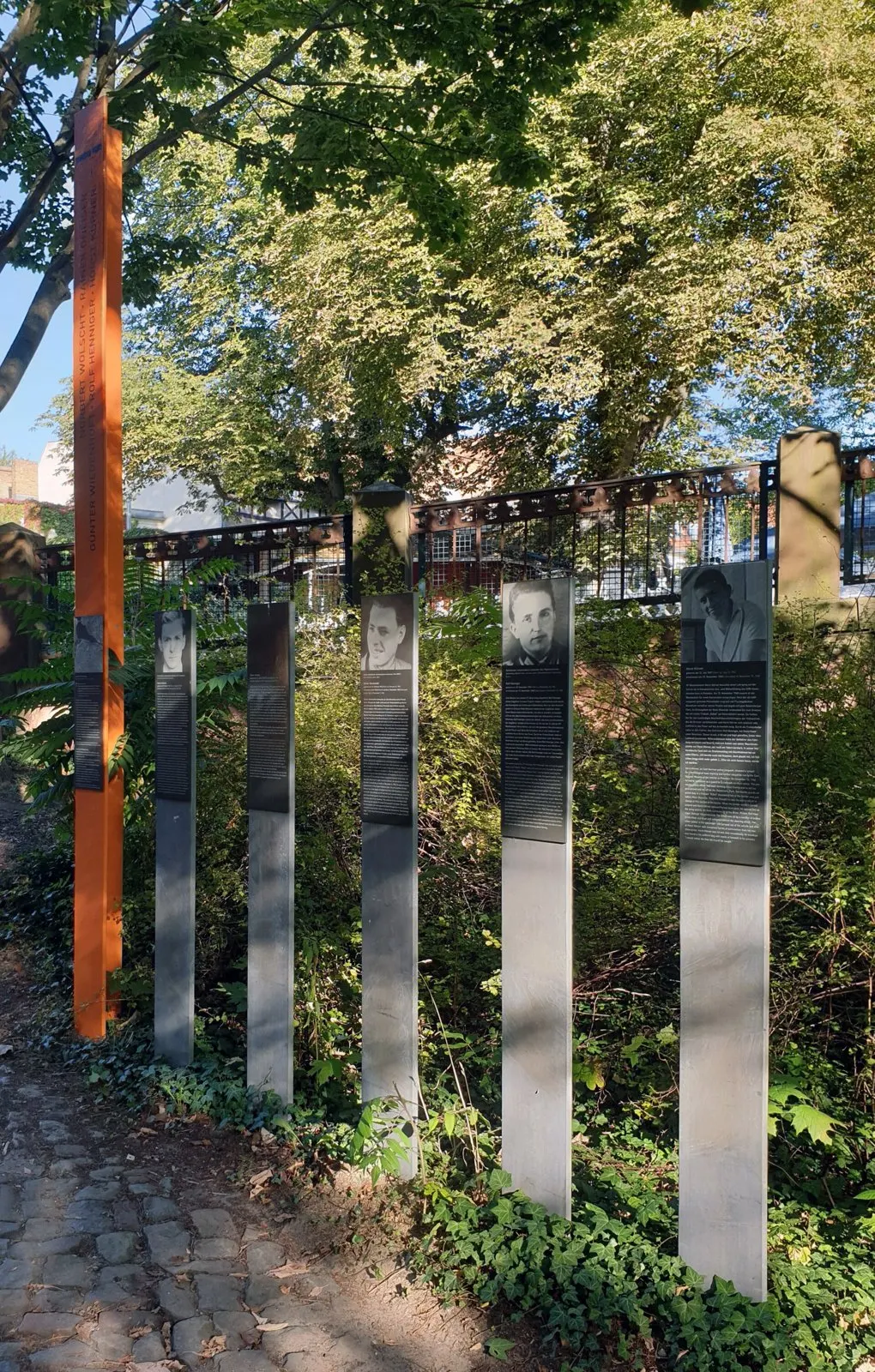
_Gneiser_Henninger_K%C3%B6rner_Wiedenh%C3%B6ft_Wolscht.jpg)
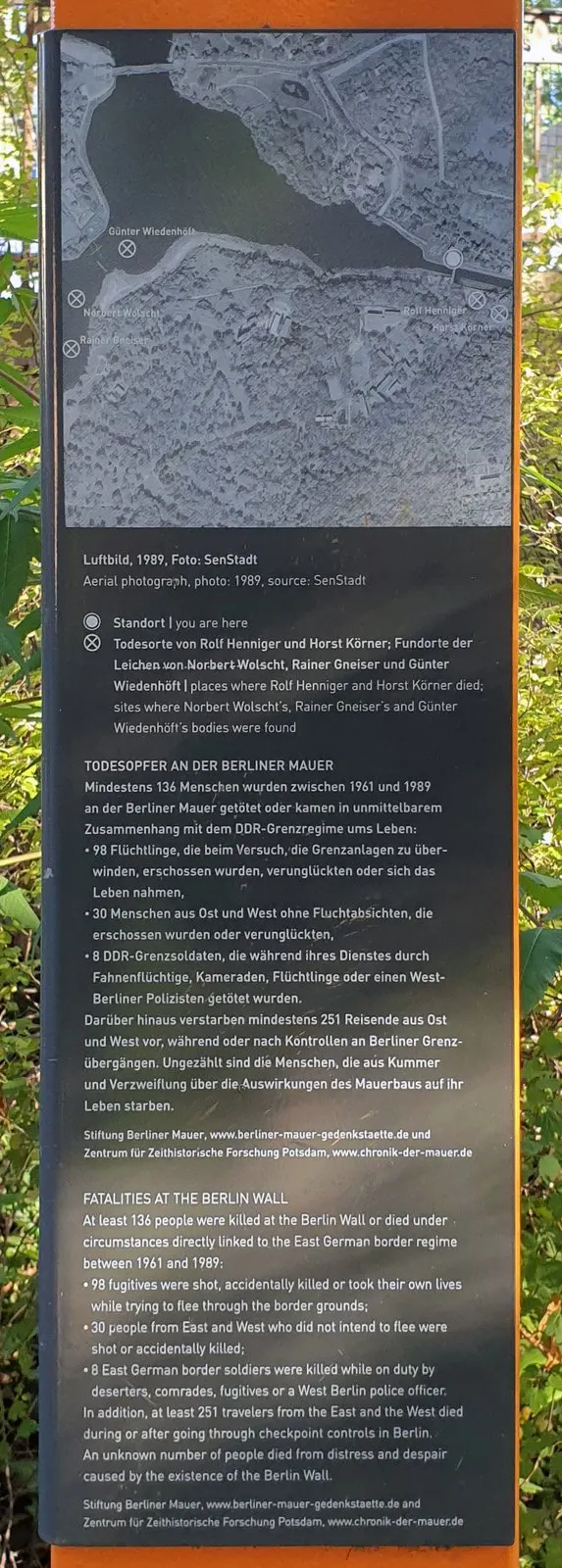
_Gneiser_Henninger_K%C3%B6rner_Wiedenh%C3%B6ft_Wolscht2.jpg)
Read more
Also died on the outer ring between Berlin-Zehlendorf and Potsdam-Babelsberg
- Jörgen Schmidtchen 18 April 1962
- Peter Böhme 18 April 1962
- Günter Wiedenhöft Night of 5 to 6 December 1962
- Norbert Wolscht 28 July 1964
- Rainer Gneiser 28 July 1964
- Peter Hauptmann 3 May 1965
- Willi Marzahn 19 March 1966
- Holger H. 22 January 1973
Sources
This profile is a summary written for this site. Every fact in it is taken from source 1, which also gives the full account with archival references.
- Martin Ahrends/Udo Baron/Hans-Hermann Hertle, “Horst Körner”, biography in Chronik der Mauer, Federal Agency for Civic Education, Centre for Contemporary History Potsdam and Deutschlandradio. Accessed 23 September 2026. Read online. Basis for every fact in this profile, including the dates and place of death.
- German version of the same biography. Accessed 23 September 2026. Read online.
- Hans-Hermann Hertle and Maria Nooke (eds.), The Victims at the Berlin Wall, 1961–1989: A Biographical Handbook. Centre for Contemporary History Potsdam and Berlin Wall Foundation, Berlin 2011. The printed handbook from which the online biography is taken.
- Hans-Hermann Hertle and Maria Nooke, “140 Victims at the Berlin Wall, 1961–1989” (list), Centre for Contemporary History Potsdam and Berlin Wall Foundation, August 2017. PDF. Used to cross-check names and dates.
- Hans-Hermann Hertle and Maria Nooke, “The Victims at the Berlin Wall, 1961–1989: Findings of a Research Project”, August 2017. PDF. Source of the classification into escapees, people with no intent to escape, and border soldiers.
Further reading
Image credits
- Memorial panel for Horst Körner at Lankestraße 2 in Klein Glienicke, with his portrait and biography, photographed in 2023. OTFW, Berlin, CC BY-SA 3.0, Wikimedia Commons.
- Memorial site at Lankestraße 2 in Klein Glienicke for Rainer Gneiser, Rolf Henniger, Horst Körner, Günter Wiedenhöft and Norbert Wolscht, photographed in 2023. OTFW, Berlin, CC BY-SA 3.0, Wikimedia Commons.
- Panel at the Klein Glienicke memorial with a 1989 aerial photograph marking where Rolf Henniger and Horst Körner died and where the bodies of three other victims were found. OTFW, Berlin, CC BY-SA 3.0, Wikimedia Commons.
Cite this page
“Horst Körner”, Victims of the Berlin Wall, Berlin Experiences. https://victimsofthewall.com/victims/koerner-horst/
Map
The pin position is based on the place of death described in source 1. Base map © OpenStreetMap contributors; course of the Wall in 1989 from Geoportal Berlin (dl-de/zero-2.0). Accessed 23 September 2026.