Rolf Henniger
1941–1968
Rolf Henniger, a 26-year-old border soldier and trained train driver from Saalfeld, was shot dead on 15 November 1968 in Babelsberg Palace Park by a fleeing East German policeman, Horst Körner, who was himself shot dead by Henniger's platoon leader.
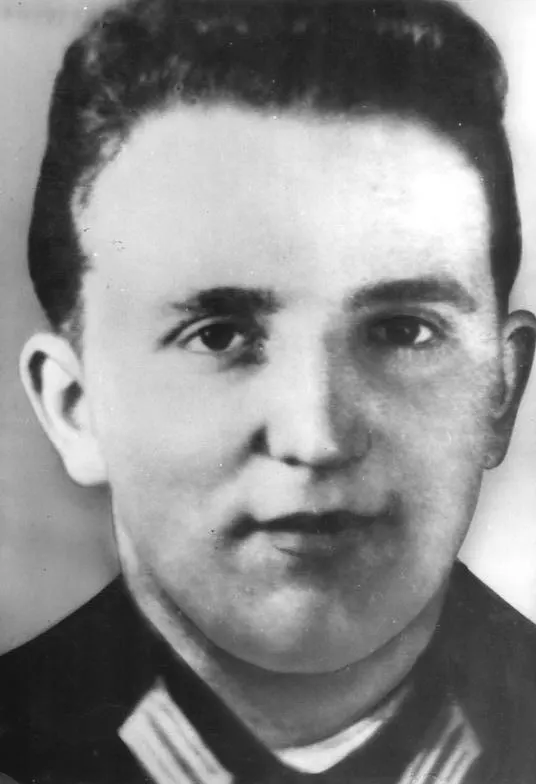

Rolf Henniger was born on 30 November 1941 in Saalfeld in eastern Thuringia. After school he trained with the German railway to become a train driver. He had only just married when he was called up to the border troops in November 1967. After training he was posted as a military driver and border guard to a regiment in Potsdam-Babelsberg, and in October 1968, on the state's anniversary, he was promoted early to lance corporal, which was not unusual on such occasions.
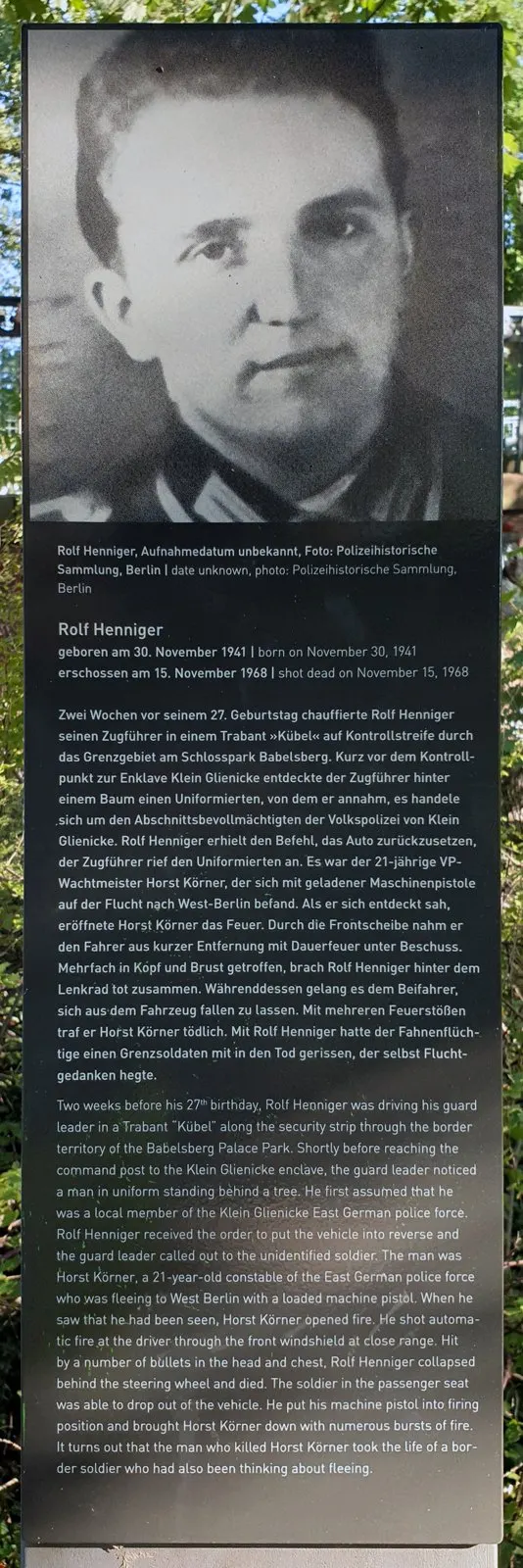
On the evening of 15 November 1968, two weeks before his 27th birthday, he was driving his platoon leader in a Trabant on a control patrol through the border area at Babelsberg Palace Park; his superior was to be the only surviving witness of what followed. Shortly before the checkpoint at the bridge over the Teltow Canal into Klein Glienicke, the platoon leader spotted a uniformed man behind a tree, whom he at first took for the local People's Police officer, and ordered Rolf to reverse. The man was Horst Körner, a 21-year-old East German police constable who was trying to flee to West Berlin with a loaded machine pistol. Seeing that he had been noticed, he fired through the windscreen at close range. Rolf Henniger, hit in the head and chest, collapsed at the wheel. The platoon leader let himself drop out of the vehicle and shot Horst Körner dead.
This account comes from the Stasi's investigation report, which the Berlin public prosecutor later did not question. At the time, however, the details were kept secret; the state news agency reported only that an armed provocateur had tried to force his way through the border and that a border soldier had been fatally injured.
On 21 November 1968 he was buried in Saalfeld with great propaganda ceremony, in which his family had no say. His coffin, draped in the flag, was driven through the town on an open truck. He was posthumously promoted to sergeant and decorated, and a stadium and youth collectives were named after him; for years he was commemorated as a hero. The platoon leader, who was also a Stasi informant, was sent by the city commandant to visit the family on Rolf's birthday, and the Stasi instructed him to sound out their mood and hide the fact that the shots had come from an East German policeman.
Rumours spread in Saalfeld, and the family doubted the official story. According to the Stasi, his stepfather suspected that Rolf himself had wanted to flee and had been shot down by border troops. Apparently Rolf had told close family members that he meant to flee, and relatives in southern Germany also knew of his plans. For years his relatives were left wondering how he had really died. Only in the 1990s, after the archives were opened, did the circumstances come to light. His closest relatives kept as a family secret, hidden from the state, that Rolf Henniger had probably been waiting for his own chance to escape.
_Rolf_Henninger.jpg)
_Gneiser_Henninger_K%C3%B6rner_Wiedenh%C3%B6ft_Wolscht.jpg)
_Gneiser_Henninger_K%C3%B6rner_Wiedenh%C3%B6ft_Wolscht2.jpg)
Read more
Sources
This profile is a summary written for this site. Every fact in it is taken from source 1, which also gives the full account with archival references.
- Martin Ahrends/Udo Baron/Hans-Hermann Hertle, “Rolf Henniger”, biography in Chronik der Mauer, Federal Agency for Civic Education, Centre for Contemporary History Potsdam and Deutschlandradio. Accessed 23 September 2026. Read online. Basis for every fact in this profile, including the dates and place of death.
- German version of the same biography. Accessed 23 September 2026. Read online.
- Hans-Hermann Hertle and Maria Nooke (eds.), The Victims at the Berlin Wall, 1961–1989: A Biographical Handbook. Centre for Contemporary History Potsdam and Berlin Wall Foundation, Berlin 2011. The printed handbook from which the online biography is taken.
- Hans-Hermann Hertle and Maria Nooke, “140 Victims at the Berlin Wall, 1961–1989” (list), Centre for Contemporary History Potsdam and Berlin Wall Foundation, August 2017. PDF. Used to cross-check names and dates.
- Hans-Hermann Hertle and Maria Nooke, “The Victims at the Berlin Wall, 1961–1989: Findings of a Research Project”, August 2017. PDF. Source of the classification into escapees, people with no intent to escape, and border soldiers.
Image credits
- Rolf Henniger in uniform. Photograph from the GDR news agency Zentralbild, dated 21 November 1968 (German Federal Archive, Bild 183-G1121-0028-001). Bundesarchiv, Bild 183-G1121-0028-001 / CC-BY-SA 3.0, CC BY-SA 3.0 de, Wikimedia Commons.
- Memorial panel for Rolf Henniger at Lankestraße 2 in Klein Glienicke, with his portrait (photo: Polizeihistorische Sammlung, Berlin) and biography, photographed in 2023. OTFW, Berlin, CC BY-SA 3.0, Wikimedia Commons.
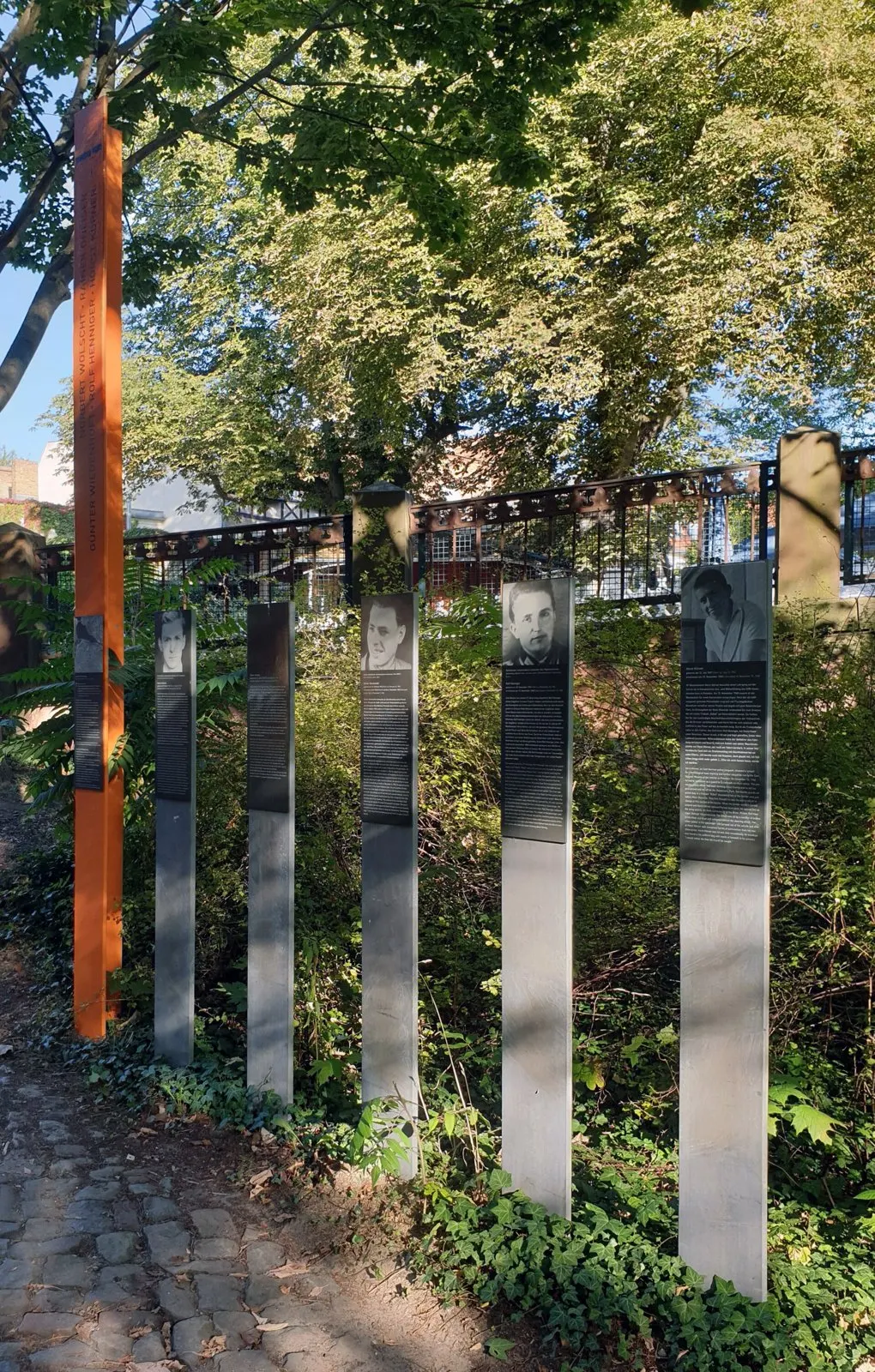
- Memorial site at Lankestraße 2 in Klein Glienicke for Rainer Gneiser, Rolf Henniger, Horst Körner, Günter Wiedenhöft and Norbert Wolscht, photographed in 2023. OTFW, Berlin, CC BY-SA 3.0, Wikimedia Commons.
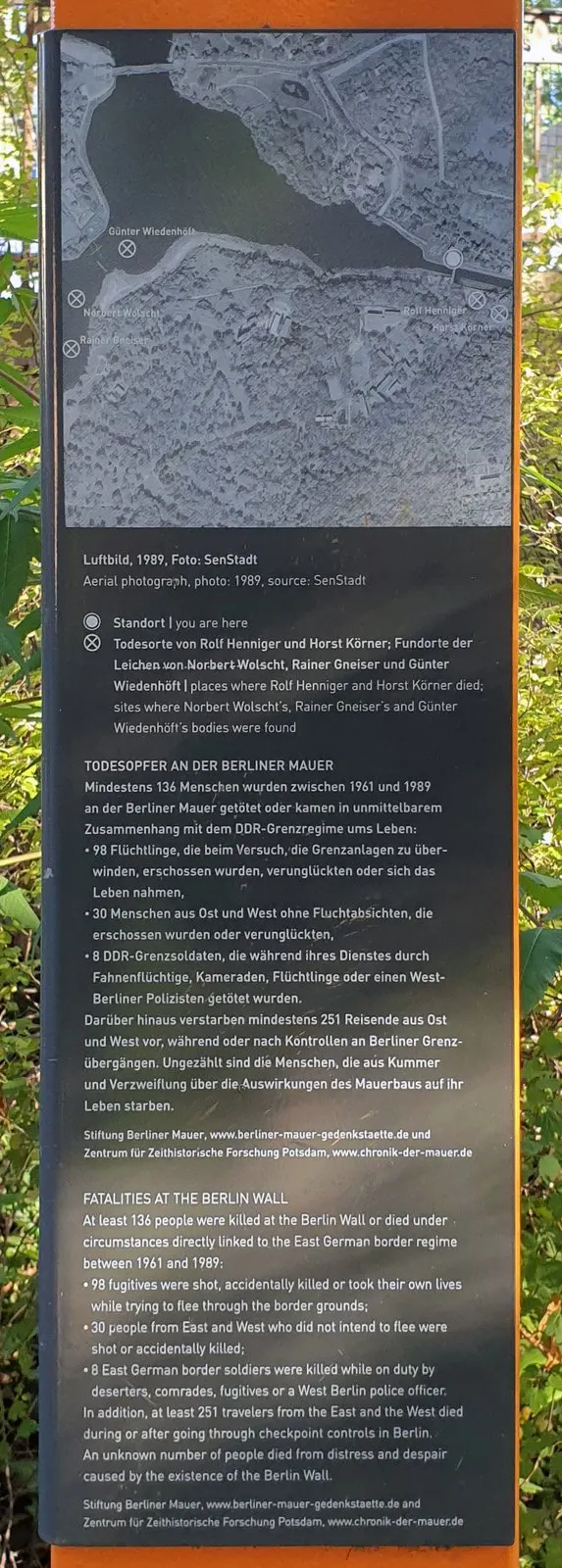
- Panel at the Klein Glienicke memorial with a 1989 aerial photograph marking where Rolf Henniger and Horst Körner died. OTFW, Berlin, CC BY-SA 3.0, Wikimedia Commons.
Cite this page
“Rolf Henniger”, Victims of the Berlin Wall, Berlin Experiences. https://victimsofthewall.com/victims/henniger-rolf/
Map
The pin position is based on the place of death described in source 1. Base map © OpenStreetMap contributors; course of the Wall in 1989 from Geoportal Berlin (dl-de/zero-2.0). Accessed 23 September 2026.