Horst Frank
1942–1962
Horst Frank, a 19-year-old gardener from Saxony, was shot in the Schönholz garden settlement on 29 April 1962 while caught in the last barbed wire fence before West Berlin. His friend escaped; he died of his wounds that same night.
_in_Berlin-Wilhelmsruh.jpg)
Horst Frank was born on 7 May 1942 in Lommatzsch in Saxony. After an apprenticeship as a gardener he moved to East Berlin a few months before the Wall was built, working for a state-owned horticultural firm in Weissensee and sharing a company dormitory with other workers.
Visiting his parents over Easter 1962, he got talking with Detlev W., two years younger, whom he had known since childhood, and they found that both wanted to leave East Germany. Detlev W. hoped to meet his natural father in the West; he did not say what his friend's reasons were. Conscription had been introduced in January 1962, and Horst Frank's impending call-up to the National People's Army probably played a part. His conscription medical notice, dated 23 March 1962, was among the few things he carried when he was shot.
The two met in East Berlin on 28 April 1962. Horst Frank had chosen the spot: the Schönholz garden settlement, bordering Reinickendorf in the north of the city. After dark, equipped with wire cutters, they approached the border installations from there, cut through the inner fence and entered the border strip, an open field about 80 metres wide. They moved slowly, crawling and ducking to avoid the guards and carefully passing a trip wire, and after four hours both reached the last barrier, a three-layered barbed wire fence, unseen.
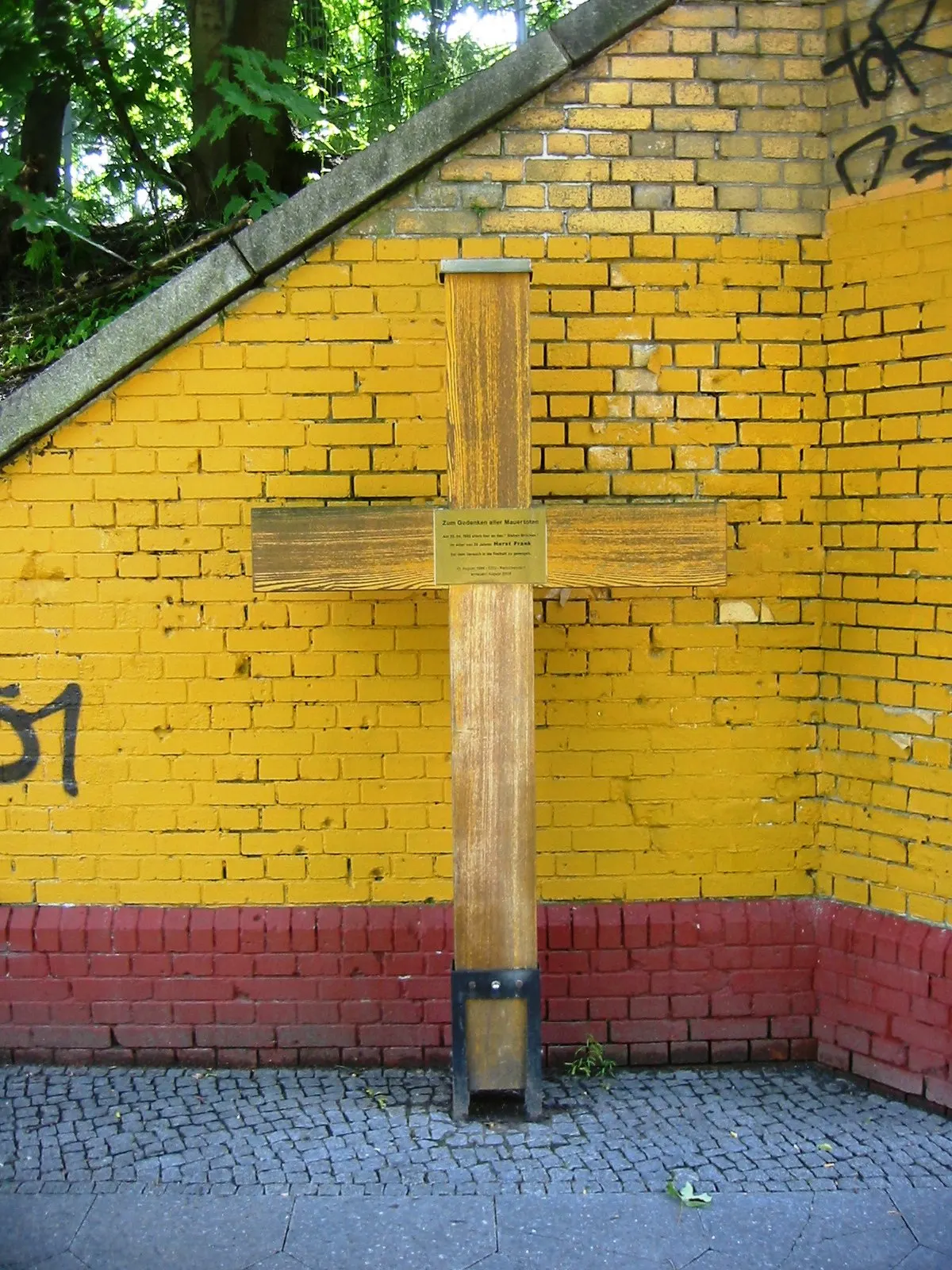
At around half past midnight on 29 April, guards spotted Horst Frank, but not his friend, who got through to West Berlin. From 20 metres the two guards opened fire on him as he lay on the ground; alerted by the shots, a third guard also fired at him, by then hopelessly caught in the barbed wire. He was hit three times; a bullet passed through his stomach and lung. Residents, police and French military police on the western side watched as he was carried away showing no sign of life, and the next day residents put up a wooden cross.
He lived only a short time after being freed from the wire. Even so, the East German authorities opened an investigation against him for an attempted border breach; according to Stasi records, an arrest warrant was requested at once, his transfer to the prison ward of the People's Police Hospital was arranged, and he was even to be questioned soon. He died that same night without regaining consciousness; according to a border police report, he died in the People's Police Hospital at about 4 a.m. Four or five days passed before Stasi officers informed his family and released his body. He was buried in Lommatzsch on 12 May 1962.
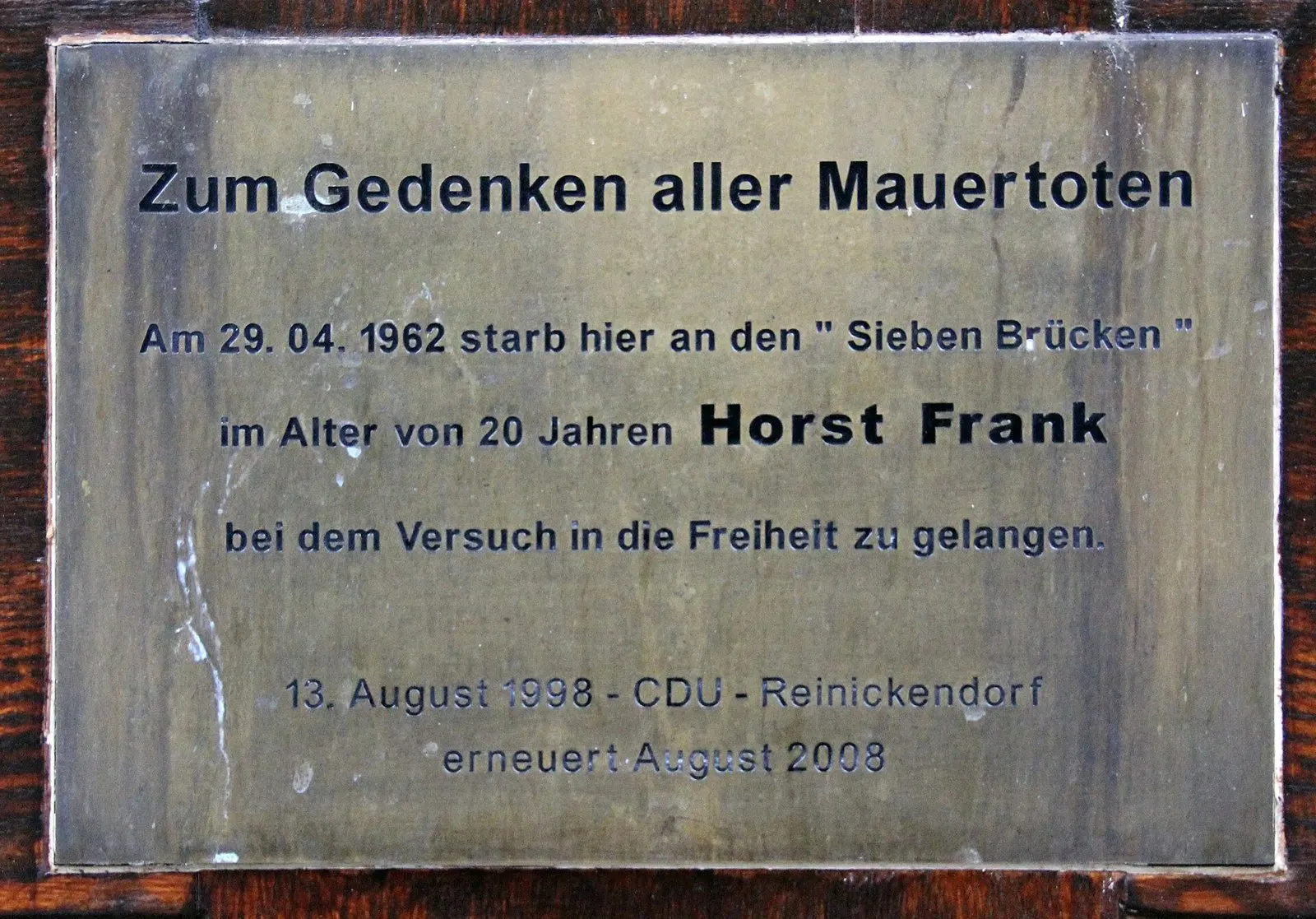
Decades later the three guards were tried. The court could not establish who fired the fatal shot, but convicted all three of joint manslaughter and gave them suspended sentences of between one year and three months and one and a half years. In August 2013 a bridge on Klemkestrasse was given his name at the suggestion of the Reinickendorf district council, and a plaque close by tells his story.
_Horst_Frank.jpg)
_Horst_Frank3.jpg)
Also died on the sector border between Berlin-Pankow and Berlin-Reinickendorf
- Dorit Schmiel 19 February 1962
- Wernhard Mispelhorn 20 August 1964
- Horst Einsiedel 15 March 1973
- Dr. Johannes Muschol 16 March 1981
- Silvio Proksch 25 December 1983
- Michael Schmidt 1 December 1984
- Winfried Freudenberg 8 March 1989
Sources
This profile is a summary written for this site. Every fact in it is taken from source 1, which also gives the full account with archival references.
- Christine Brecht, “Horst Frank”, biography in Chronik der Mauer, Federal Agency for Civic Education, Centre for Contemporary History Potsdam and Deutschlandradio. Accessed 23 September 2026. Read online. Basis for every fact in this profile, including the dates and place of death.
- German version of the same biography. Accessed 23 September 2026. Read online.
- Hans-Hermann Hertle and Maria Nooke (eds.), The Victims at the Berlin Wall, 1961–1989: A Biographical Handbook. Centre for Contemporary History Potsdam and Berlin Wall Foundation, Berlin 2011. The printed handbook from which the online biography is taken.
- Hans-Hermann Hertle and Maria Nooke, “140 Victims at the Berlin Wall, 1961–1989” (list), Centre for Contemporary History Potsdam and Berlin Wall Foundation, August 2017. PDF. Used to cross-check names and dates.
- Hans-Hermann Hertle and Maria Nooke, “The Victims at the Berlin Wall, 1961–1989: Findings of a Research Project”, August 2017. PDF. Source of the classification into escapees, people with no intent to escape, and border soldiers.
Further reading
Image credits
- Memorial cross for Horst Frank on Klemkestrasse, Berlin-Reinickendorf. Assenmacher, CC BY-SA 3.0, Wikimedia Commons.
- Memorial plaque for Horst Frank on Klemkestrasse, Berlin-Reinickendorf. OTFW, Berlin, CC BY-SA 3.0, Wikimedia Commons.
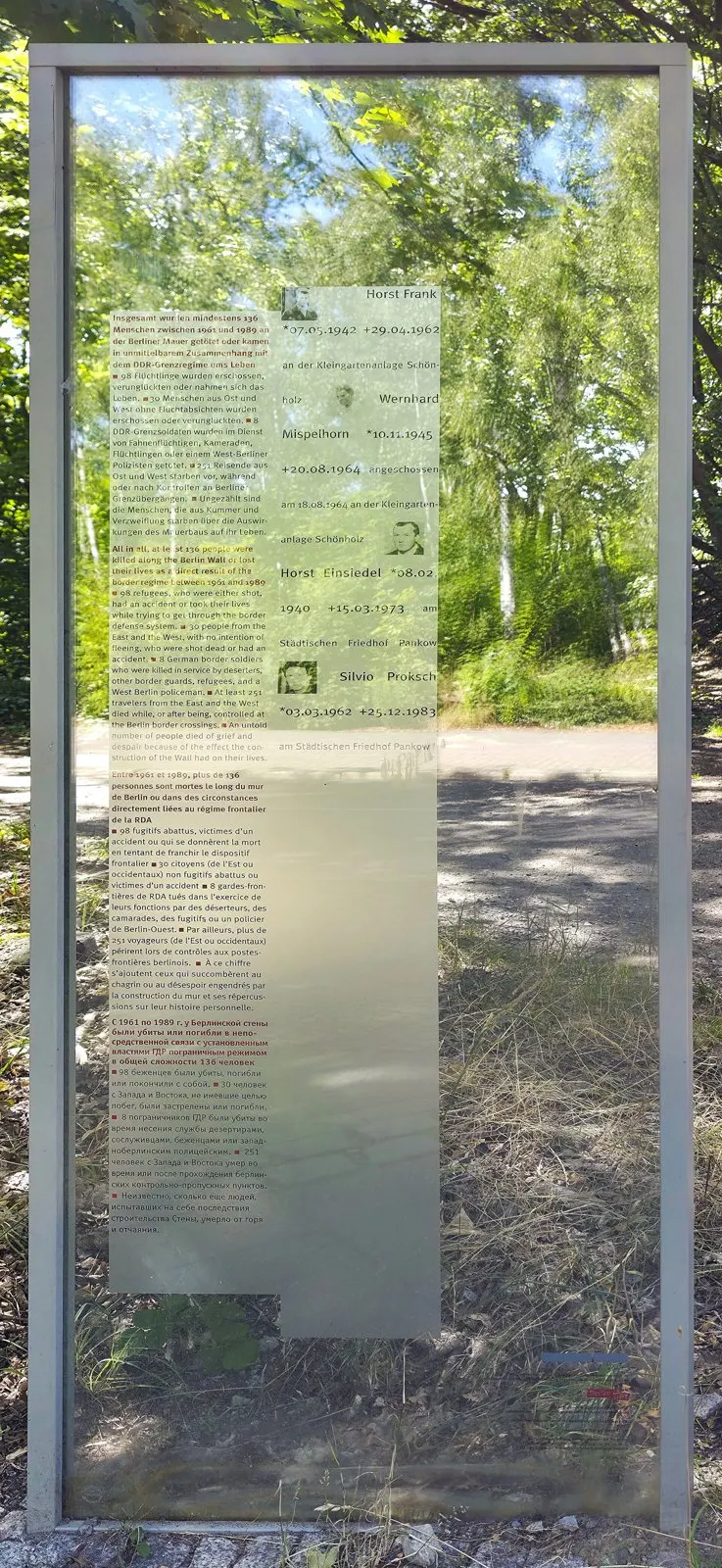
- Memorial panel on Klemkestrasse for Horst Frank, Wernhard Mispelhorn, Horst Einsiedel and Silvio Proksch. OTFW, Berlin, CC BY-SA 3.0, Wikimedia Commons.
Cite this page
“Horst Frank”, Victims of the Berlin Wall, Berlin Experiences. https://victimsofthewall.com/victims/frank-horst/
Map
The pin position is based on the place of death described in source 1. Base map © OpenStreetMap contributors; course of the Wall in 1989 from Geoportal Berlin (dl-de/zero-2.0). Accessed 23 September 2026.