Wernhard Mispelhorn
1945–1964
Wernhard Mispelhorn, an 18-year-old metalworker from Berlin-Buchholz, was shot in the head on 18 August 1964 in the Schönholz garden settlement while trying to reach his girlfriend in West Berlin; he died two days later.
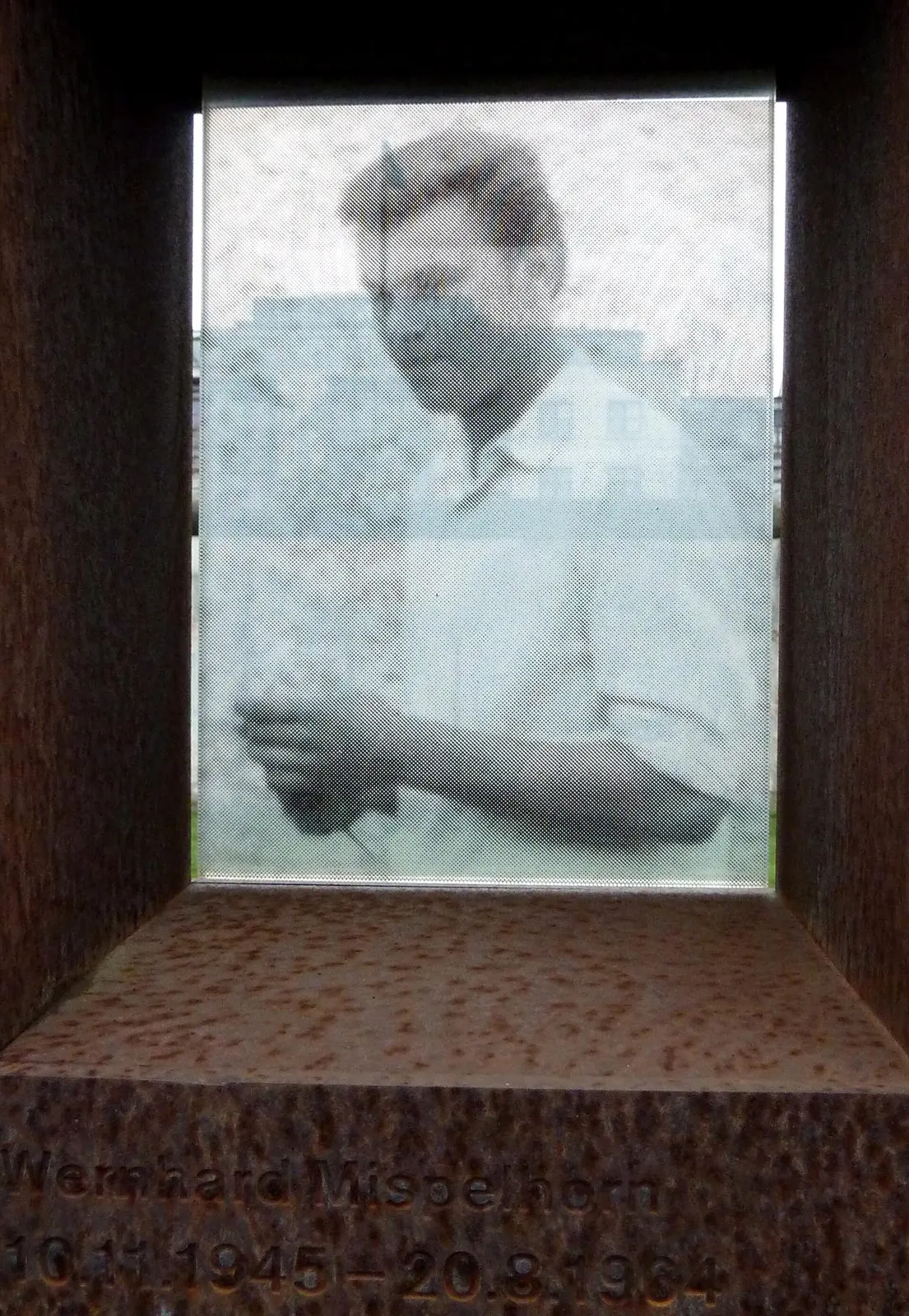

Wernhard Mispelhorn was born in Berlin on 10 November 1945 and grew up in his parents' house in Berlin-Buchholz, the youngest of four children. His brother remembered that as children they regularly visited relatives in the western sectors, and how much they enjoyed it when their grandmother in Wedding gave them money for the cinema. Their parents were fairly relaxed with the two boys, who were mischievous children. After the parents divorced, the boys stayed with their mother; one sister studied biology in East Berlin, and the other moved west in 1960 and settled in Hanover. Wernhard trained as a gas and water pipe fitter with a private firm and later worked as a metalworker outside Berlin.
He was 15 when the Wall was built. He and his friends had little interest in the official socialist project; they listened to the American station AFN, wore jeans and loved western motorbikes and cars. They sometimes talked about leaving, but it stayed talk. Besides a general discontent with life in East Germany, there was another reason for the risk he took in August 1964: not long before, his girlfriend had been able to move to West Berlin, apparently in one of the few family reunions the East German authorities allowed. He told his brother he wanted to risk crossing the border to be with her. His brother tried, without success, to dissuade him.
On the evening of 17 August 1964 he was in a bar in Prenzlauer Berg with his friends Hans and Dieter, who did not know that he wanted to go west because of the girl. They always maintained that the idea of going to Schönholz that night arose spontaneously after several beers, and that they only wanted to look around. According to their account, once in the garden colony they lifted the inner fence at one spot so that he could crawl under it and look at the border strip. They said they were completely surprised when he suddenly got up and ran, and that when shots rang out shortly afterwards they panicked and ran away.
Shortly after midnight on 18 August 1964, two border soldiers on an additional patrol in the rear area, which a Stasi report described as a focal point for people trying to approach the border, spotted him and kept firing after him until he collapsed just short of the border fence. West Berlin police saw two soldiers with a stretcher, but not that a gravely injured young man was being carried away. He had been shot in the head, and he died in an East Berlin hospital two days later. The East Berlin city commandant at once reported to Erich Honecker that a border breakthrough had been prevented, and had the guards given the usual awards; his report took no interest in the fate of the wounded man or in who had fired the fatal shot, a question that the later criminal investigation could not resolve either.
While he lay dying, the Stasi questioned neighbours and colleagues and wrote lengthy reports that accused him, among other things, of hooliganism. Only after these inquiries did the Stasi tell his mother that he had been critically injured at the border, and she was not allowed to visit him. After his death she had to undertake to keep silent about what lay behind it and not to make inquiries. The family spoke of an accident in the death notice and at the funeral, and his two friends kept quiet for fear of punishment. Within the family, though, the truth was acknowledged: his eldest sister wrote letters so that what little they knew would be documented, and urged that his death should not simply be accepted.
_Horst_Frank3.jpg)
_Horst_Frank4.jpg)
Also died on the sector border between Berlin-Pankow and Berlin-Reinickendorf
- Dorit Schmiel 19 February 1962
- Horst Frank 29 April 1962
- Horst Einsiedel 15 March 1973
- Dr. Johannes Muschol 16 March 1981
- Silvio Proksch 25 December 1983
- Michael Schmidt 1 December 1984
- Winfried Freudenberg 8 March 1989
Sources
This profile is a summary written for this site. Every fact in it is taken from source 1, which also gives the full account with archival references.
- Christine Brecht, “Wernhard Mispelhorn”, biography in Chronik der Mauer, Federal Agency for Civic Education, Centre for Contemporary History Potsdam and Deutschlandradio. Accessed 23 September 2026. Read online. Basis for every fact in this profile, including the dates and place of death.
- German version of the same biography. Accessed 23 September 2026. Read online.
- Hans-Hermann Hertle and Maria Nooke (eds.), The Victims at the Berlin Wall, 1961–1989: A Biographical Handbook. Centre for Contemporary History Potsdam and Berlin Wall Foundation, Berlin 2011. The printed handbook from which the online biography is taken.
- Hans-Hermann Hertle and Maria Nooke, “140 Victims at the Berlin Wall, 1961–1989” (list), Centre for Contemporary History Potsdam and Berlin Wall Foundation, August 2017. PDF. Used to cross-check names and dates.
- Hans-Hermann Hertle and Maria Nooke, “The Victims at the Berlin Wall, 1961–1989: Findings of a Research Project”, August 2017. PDF. Source of the classification into escapees, people with no intent to escape, and border soldiers.
Further reading
Image credits
- Wernhard Mispelhorn; his photograph in the Window of Remembrance at the Berlin Wall Memorial on Bernauer Straße. Brewer Bob, CC BY-SA 4.0, Wikimedia Commons.
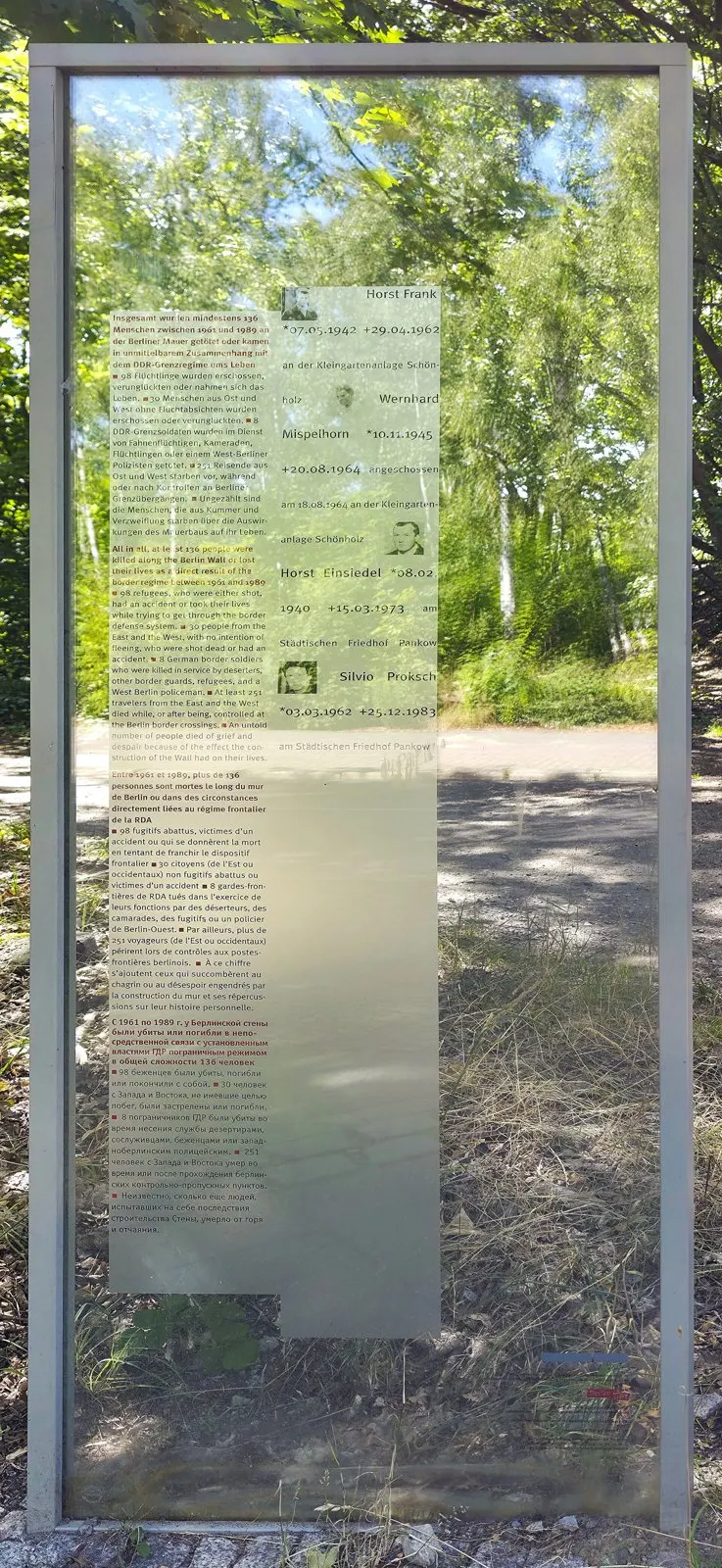
- Memorial panel on Klemkestraße in Berlin-Reinickendorf for Horst Frank, Wernhard Mispelhorn, Horst Einsiedel and Silvio Proksch, photographed in 2016. OTFW, Berlin, CC BY-SA 3.0, Wikimedia Commons.
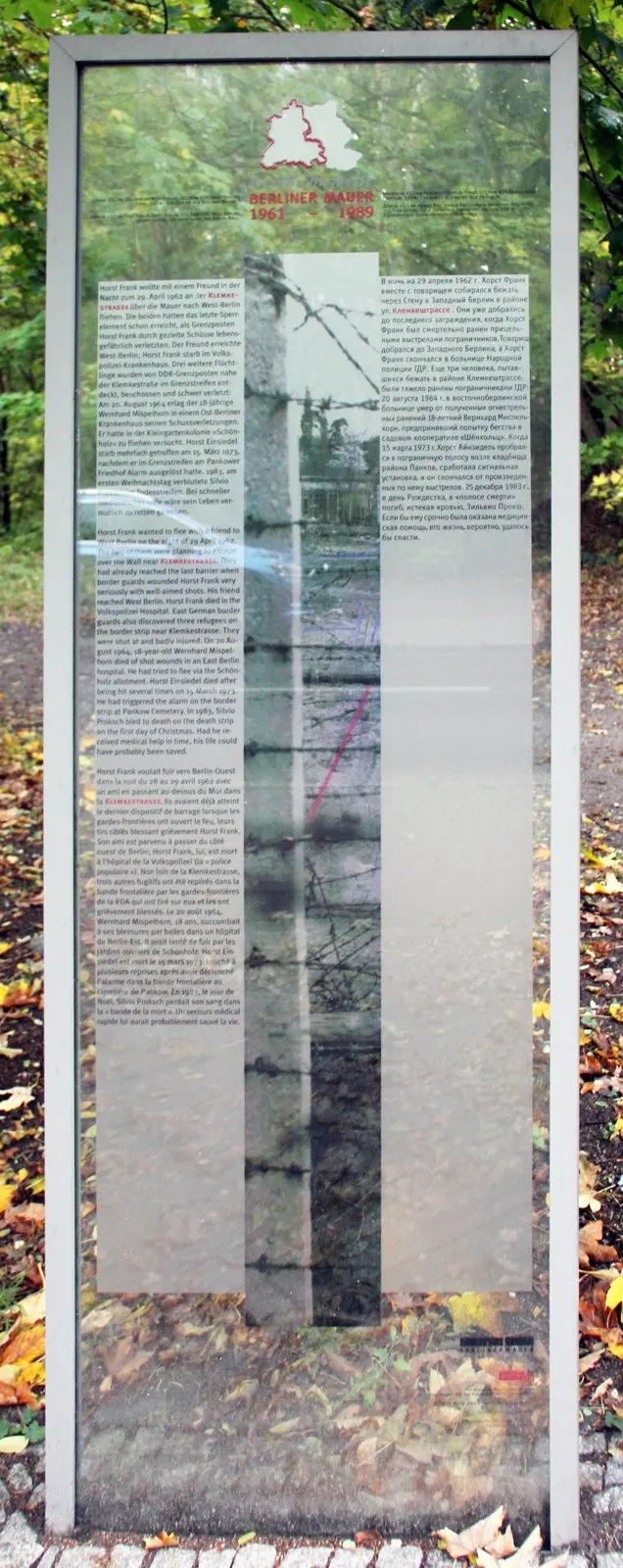
- Second memorial panel on Klemkestraße in Berlin-Reinickendorf, whose text tells of Wernhard Mispelhorn and three other victims, photographed in 2016. OTFW, Berlin, CC BY-SA 3.0, Wikimedia Commons.
Cite this page
“Wernhard Mispelhorn”, Victims of the Berlin Wall, Berlin Experiences. https://victimsofthewall.com/victims/mispelhorn-wernhard/
Map
The pin position is based on the place of death described in source 1. Base map © OpenStreetMap contributors; course of the Wall in 1989 from Geoportal Berlin (dl-de/zero-2.0). Accessed 23 September 2026.