Michael Schmidt
1964–1984
Michael Schmidt, a 20-year-old carpenter from Schwanebeck, was shot by border guards on 1 December 1984 as he climbed the last wall near the Wollankstrasse S-Bahn station, and died hours later after medical help was long delayed.

Michael Schmidt was born on 20 October 1964 in Bernau near Berlin and grew up in Schwanebeck with a brother and a sister. After school he trained as a carpenter with a building repair company in Pankow. His father said he was not someone to keep his views to himself. When the Bernau military district command pressed him to sign up for three years in the National People's Army he refused, and he flatly rejected service at the border; he is said to have told the recruiters that he had no intention of shooting unarmed people in the back.
He sometimes spoke to colleagues about leaving for the West, and in 1984, as the first large wave of departures from East Germany began, his intention to apply for an exit visa grew firmer. After talking with his parents, and knowing that families were often held to account for their children's actions, he decided against it out of consideration for his brother, who was at university. That November his company sent him to rebuild houses on Wollankstrasse and Schulzestrasse, right by the border, and from the upper floors he could study the fortifications closely.
On the evening of 30 November he went to a youth club disco in Pankow; his friends later felt he had been saying goodbye. He left before midnight. In the early hours of 1 December he and a companion who has never been identified fetched two ladders from his work brigade's tool store nearby and carried them to the inner wall behind the houses on Schulzestrasse. Once the ladder was in place the companion gave up, and he climbed over the first barrier alone. Crossing the signal fence set off an alarm; by then at the latest, the two guards in a nearby watchtower had seen him. One fired from the tower, while the other climbed down and fired from the ground. He had reached the last wall and was gripping its top when bullets struck him in the back and knee, and he fell. One of the guards who fired later claimed to have asked him, agitated, what on earth he was doing, and said that he had replied only that they had got him after all.
Witnesses in East Berlin had been sworn to secrecy by the Stasi, but after the Wall fell they described how three more guards arrived, one of whom prodded the wounded man with his foot, and how he was dragged by the legs to the patrol path, loaded onto a military vehicle and taken out of sight. The court that tried the guards found that he was dragged by his hands to a watchtower under construction nearby and left where he could not be seen from the West. He begged for help but was merely covered up. Almost an hour passed before he received medical care. Because of secrecy rules, the ambulance reached the gate in the inner wall only at about 4:25 a.m.; he was then driven not to the nearest hospital but to the People's Police Hospital in Mitte, where he was admitted more than two hours after he had been shot, and died at about 6:20 a.m. He was recorded there as "XY". A 1991 medical opinion concluded that quick surgery would almost certainly have saved him, but an investigation into killing by omission over the delay was discontinued in March 1992 because no one could be shown to be responsible.
That morning his parents found his room empty. After western news reported a presumably fatal escape attempt near Wollankstrasse station, they went to the police in Bernau and to nearby hospitals but could learn nothing; for four days the Stasi put them off. On 4 December 1984 the Stasi brought them to the military prosecutor's office, where, according to his father's account, they were told that their son had been shot trying to break through the border and had died despite all medical efforts, and, falsely, that the guard had acted "practically in self-defence". They were warned that their other son's studies would be ended if details spread. Michael Schmidt was buried in the cemetery in Buch on 10 December 1984 under Stasi surveillance; nearly all his work colleagues came; according to his father, Stasi cars followed them home, and a few days later their brigade leader was reprimanded because the whole brigade's attendance was deemed a provocation.
His father was already asking for answers in December 1989. On 5 February 1992 the youth chamber of the Berlin Regional Court convicted the two guards of manslaughter, as a less serious case: the post leader received one year and six months' youth custody and the other guard one year and nine months' imprisonment, both suspended on probation. On 3 November 1992 the Federal Court of Justice dismissed their appeals in its first judgment on the shootings at the Wall. His death was later among the main charges in the trials of members of the SED Politburo and the National Defence Council, and in the Politburo trial a member of both bodies was convicted of his manslaughter, a verdict the Federal Court of Justice upheld in 1999.
Read more
Also died on the sector border between Berlin-Pankow and Berlin-Reinickendorf
- Dorit Schmiel 19 February 1962
- Horst Frank 29 April 1962
- Wernhard Mispelhorn 20 August 1964
- Horst Einsiedel 15 March 1973
- Dr. Johannes Muschol 16 March 1981
- Silvio Proksch 25 December 1983
- Winfried Freudenberg 8 March 1989
Sources
This profile is a summary written for this site from the biography in source 1, which also gives the full account with archival references. Facts taken from other sources are listed below with what they support.
- Udo Baron, “Michael Schmidt”, biography in Chronik der Mauer, Federal Agency for Civic Education, Centre for Contemporary History Potsdam and Deutschlandradio. Accessed 23 September 2026. Read online. The biography from which this profile was written, and the source of the dates and place of death.
- German version of the same biography. Accessed 23 September 2026. Read online.
- Judgment of the Berlin Regional Court (Landgericht Berlin, youth chamber) of 5 February 1992, excerpts in Chronik der Mauer. Accessed 29 September 2026. Read online. Source for: the ladders, how he was moved after being shot, the ambulance’s arrival and the sentences.
- Bundesgerichtshof, judgment of 3 November 1992, 5 StR 370/92 (BGHSt 39, 1). Accessed 29 September 2026. Read online. Source for: the dismissal of the guards’ appeals, and his admission to hospital more than two hours after he was shot.
- Bundesgerichtshof, judgment of 8 November 1999, 5 StR 632/98 (the Politburo case), text on HRR-Strafrecht. Accessed 27 September 2026. Read online. Source for: that a member of the Politburo and the National Defence Council was convicted of his manslaughter, upheld in 1999.
- Horst Schmidt, “Kaltblütiger Mord” (his father’s account), in Werner Filmer and Heribert Schwan, Opfer der Mauer, 1991; reprinted in Chronik der Mauer. Accessed 29 September 2026. Read online. Source for: what his parents were told, and what happened to his colleagues after the funeral.
- BGH, Urteil vom 26.7.1994, 5 StR 98/94 (BGHSt 40, 218) Read online. Source for: the criminal proceedings after the death.
- BVerfG, Beschluss vom 24.10.1996, 2 BvR 1851/94 u.a. Read online. Source for: the criminal proceedings after the death.
- European Court of Human Rights (Grand Chamber), judgment of 22 March 2001, applications nos. 34044/96, 35532/97 and 44801/98 Read online. Source for: the criminal proceedings after the death.
- Hans-Hermann Hertle and Maria Nooke (eds.), The Victims at the Berlin Wall, 1961–1989: A Biographical Handbook. Centre for Contemporary History Potsdam and Berlin Wall Foundation, Berlin 2011. The printed handbook from which the online biography is taken.
- Hans-Hermann Hertle and Maria Nooke, “140 Victims at the Berlin Wall, 1961–1989” (list), Centre for Contemporary History Potsdam and Berlin Wall Foundation, August 2017. PDF. Used to cross-check names and dates.
- Hans-Hermann Hertle and Maria Nooke, “The Victims at the Berlin Wall, 1961–1989: Findings of a Research Project”, August 2017. PDF. Source of the classification into escapees, people with no intent to escape, and border soldiers.
Corrections
This profile was corrected on 24 and 28 September and 3 October 2026. Each round of corrections is described in the corrections log:
-
: Court outcomes checked against the German originals
- Corrected the proceedings over the delay in getting him medical help: an investigation into killing by omission was discontinued in March 1992; no charges had been brought.
- Corrected the name of the court: the Berlin Regional Court (Landgericht Berlin), not the “Berlin district court”.
- : All profiles and articles cross-checked against the German originals
-
: Every profile checked against all the sources
- Set out the 1992 sentences (youth custody for the post leader, imprisonment for the other guard, both suspended), added that the Federal Court of Justice dismissed their appeals in its first ruling on the Wall shootings, and added that a member of the Politburo and National Defence Council was convicted of his manslaughter, upheld in 1999.
Image credits
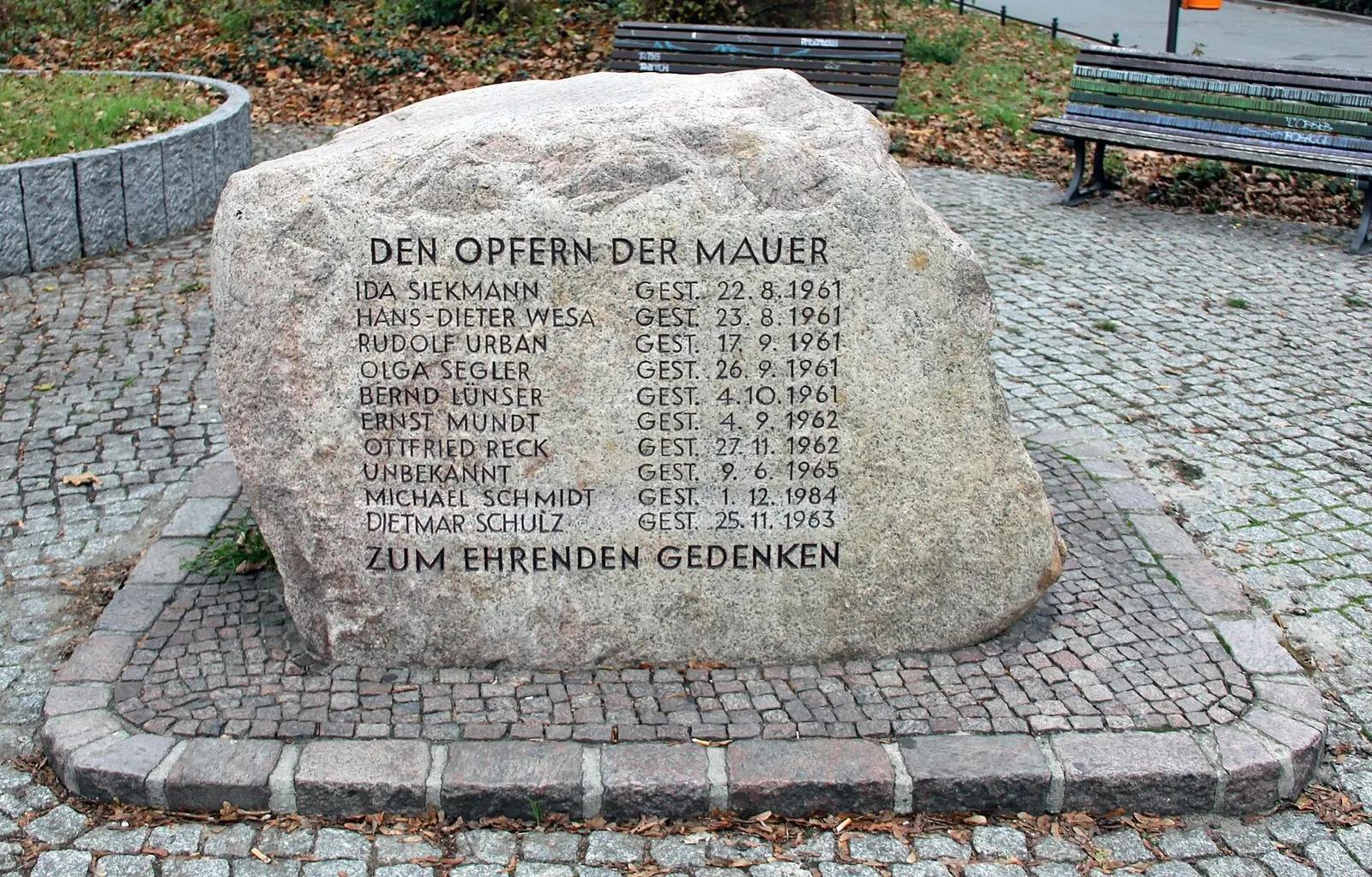
- Memorial stone "Den Opfern der Mauer" on Bernauer Straße in Berlin-Gesundbrunnen, which lists Michael Schmidt. OTFW, Berlin, CC BY-SA 3.0, Wikimedia Commons.
Cite this page
“Michael Schmidt”, Victims of the Berlin Wall, Berlin Experiences. https://victimsofthewall.com/victims/schmidt-michael/
Map
The pin position is based on the place of death described in source 1. Base map © OpenStreetMap contributors; course of the Wall in 1989 from Geoportal Berlin (dl-de/zero-2.0). Accessed 23 September 2026.