Horst Einsiedel
1940–1973
Horst Einsiedel, a 33-year-old engineer and father from East Berlin, was shot dead on 15 March 1973 as he climbed the Wall from the Pankow municipal cemetery, where his father was buried. The Stasi hid his death from his wife for months.
_Horst_Frank3.jpg)
Horst Einsiedel was born in Berlin-Pankow on 8 February 1940. After an apprenticeship in metalwork he gained a high school degree at a workers' and farmers' faculty, then studied mechanical engineering at the Technical University in Dresden. In 1967, now an engineer, he moved with his wife and their daughter, born in 1966, to Berlin-Weissensee. His last job was with a state-owned firm in Heinersdorf.
Because he refused to join the SED, the ruling party, he had little prospect of promotion, while his superiors, promoted as party members, were often no match for him professionally. He talked with his wife about fleeing to West Berlin, where his sister had lived since 1951 and his mother since 1969, but she felt it was too dangerous with their young daughter. She later attributed his decision to go alone to his not wanting to put his family in unnecessary danger, and told the Berlin police as a witness in 1992 that he had probably hoped to bring them over later.
Early on 15 March 1973 he told his wife he was going to an emergency dentist for a bad toothache, and drove his Trabant to the Pankow cemetery, where he often visited his father's grave. The last cemetery fence was only 30 metres from the first house in West Berlin. He had planned carefully: he cut the chain holding two ladders at a tool shed, climbed the inner fence, and crossed the signal fence, setting off an alarm. He had set the folding ladder against the concrete wall and was climbing up to its top when the two guards in a watchtower 200 metres away, who had spotted him, opened fire at once. Hit in the neck and chest, he fell from the ladder and died shortly afterwards from his wounds.
While the West German government and the West Berlin Senate protested that same day, the guards were awarded a medal for exemplary border service and a cash bonus that afternoon. When her husband had still not come home by about 8 a.m., his wife called the emergency dental service and learned he had never been there; the next day she noticed that all his personal papers were missing and realised what must have happened.
The Stasi drafted cover stories for his disappearance and ordered all 42 people who knew the truth to stay silent. Not knowing that she was by now a widow, his wife was questioned repeatedly by Stasi officers at the police headquarters on Alexanderplatz and even asked for photographs of her husband to help the search for him. At the end of March she was told his car had been found unlocked in a forest and that he had probably been the victim of a violent crime. At the end of May she was told that he had drowned and been found in the Havel near Potsdam, and was advised by the Stasi not to identify the body, which was said to be badly decomposed and had in fact already been cremated without her knowledge. All she was given was a falsified death certificate giving 17 March as the date of death.
On 5 July 1973, under Stasi surveillance, his urn was buried in his father's grave, at the very place where his escape had begun. In early 1999 the Berlin Regional Court convicted the two guards of manslaughter and gave them suspended prison sentences of a year and three months; the case against their commander, for aiding and abetting manslaughter, was discontinued in 2002 because he was permanently unfit to stand trial. At the end of an investigation opened in 1996 against Stasi officers and a doctor, the Berlin public prosecutor's office concluded that the cover-up amounted to falsification of records, but the case had to be discontinued in August 1997 because the offence was by then time-barred.
_Horst_Frank4.jpg)
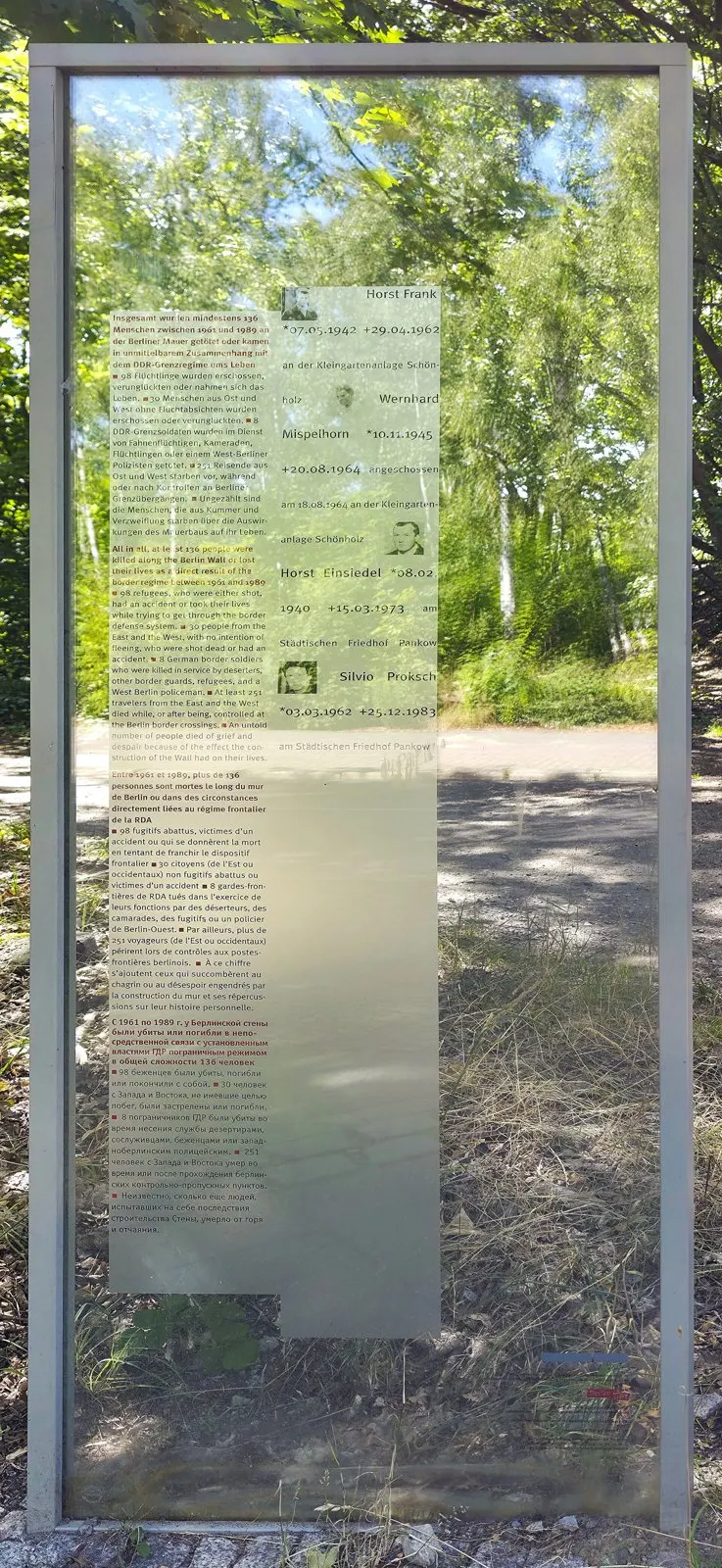
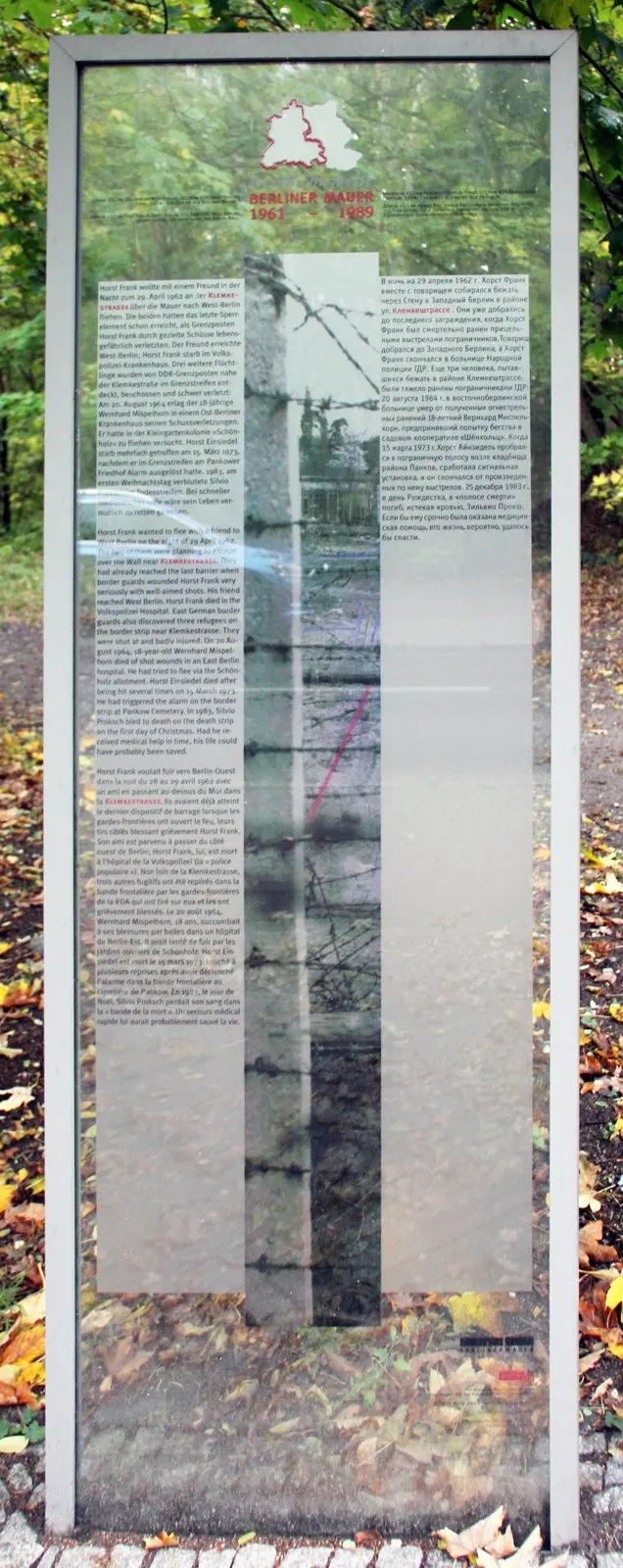
Also died on the sector border between Berlin-Pankow and Berlin-Reinickendorf
- Dorit Schmiel 19 February 1962
- Horst Frank 29 April 1962
- Wernhard Mispelhorn 20 August 1964
- Dr. Johannes Muschol 16 March 1981
- Silvio Proksch 25 December 1983
- Michael Schmidt 1 December 1984
- Winfried Freudenberg 8 March 1989
Sources
This profile is a summary written for this site. Every fact in it is taken from source 1, which also gives the full account with archival references.
- Martin Ahrends/Udo Baron, “Horst Einsiedel”, biography in Chronik der Mauer, Federal Agency for Civic Education, Centre for Contemporary History Potsdam and Deutschlandradio. Accessed 23 September 2026. Read online. Basis for every fact in this profile, including the dates and place of death.
- German version of the same biography. Accessed 23 September 2026. Read online.
- Hans-Hermann Hertle and Maria Nooke (eds.), The Victims at the Berlin Wall, 1961–1989: A Biographical Handbook. Centre for Contemporary History Potsdam and Berlin Wall Foundation, Berlin 2011. The printed handbook from which the online biography is taken.
- Hans-Hermann Hertle and Maria Nooke, “140 Victims at the Berlin Wall, 1961–1989” (list), Centre for Contemporary History Potsdam and Berlin Wall Foundation, August 2017. PDF. Used to cross-check names and dates.
- Hans-Hermann Hertle and Maria Nooke, “The Victims at the Berlin Wall, 1961–1989: Findings of a Research Project”, August 2017. PDF. Source of the classification into escapees, people with no intent to escape, and border soldiers.
Further reading
Image credits
- Memorial panel for Horst Frank, Wernhard Mispelhorn, Horst Einsiedel and Silvio Proksch on the Klemkestraße in Berlin-Reinickendorf, photographed in 2016. OTFW, Berlin, CC BY-SA 3.0, Wikimedia Commons.
- Other side of the memorial panel on the Klemkestraße, with texts on Horst Frank, Wernhard Mispelhorn, Horst Einsiedel and Silvio Proksch. OTFW, Berlin, CC BY-SA 3.0, Wikimedia Commons.
Cite this page
“Horst Einsiedel”, Victims of the Berlin Wall, Berlin Experiences. https://victimsofthewall.com/victims/einsiedel-horst/
Map
The pin position is based on the place of death described in source 1. Base map © OpenStreetMap contributors; course of the Wall in 1989 from Geoportal Berlin (dl-de/zero-2.0). Accessed 23 September 2026.