Winfried Freudenberg
1956–1989
Winfried Freudenberg, a 32-year-old electronics engineer, flew over the border in a home-made gas balloon on 8 March 1989. After hours adrift over West Berlin, he fell to his death in Zehlendorf, the last person in Berlin to die because of the Wall.
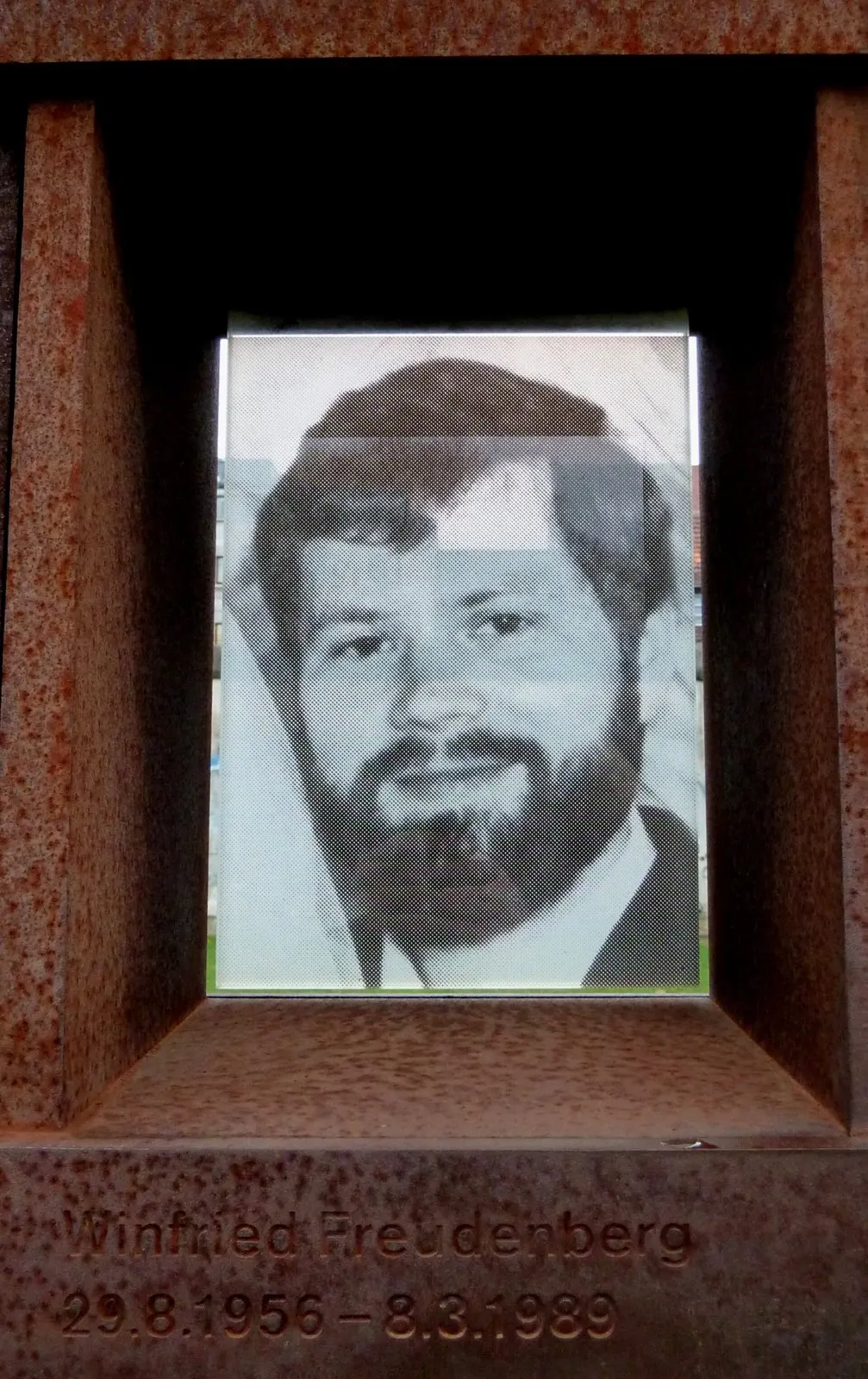

Winfried Freudenberg was born on 29 August 1956 in Osterwieck in the Harz and grew up in Lüttgenrode in Saxony-Anhalt, close to the inner-German border. After an electrician's apprenticeship he gained his high school degree at evening classes in Halberstadt, then studied information technology in Ilmenau and graduated as an electronics engineer. While he was a student he met Sabine W., who later qualified as a chemist, at a student club, and they married in autumn 1988.
The couple saw no career prospects for themselves in East Germany and, as his wife later explained, would no longer accept being denied the chance to travel, research and have contact with the West. His wife later said that living in the border area, right by the barbed wire and only a few hundred metres from a country he was never allowed to enter, had made his longing for freedom especially strong. Visiting relatives in West Germany shortly before the wedding, he said he was determined to leave, but only with her.
Straight after the wedding they began planning an escape by gas balloon. He took a job in the gas supply department of an energy combine, and they moved to Prenzlauer Berg. Buying polyethylene sheeting in small amounts, from January 1989 they taped together a balloon 13 metres high in their flat and wrapped it in a net of packing string. He kept away from his relatives during this time, which puzzled them; they later understood he had wanted to protect them. By February everything was ready, and they waited for the right wind.
On the evening of 7 March, with a moderate north-easterly wind, they drove to a gas control station near Blankenburg S-Bahn station, to which he had a key through his work, and at around midnight he began filling the balloon. A young man on his way home after finishing work at about 1:30 a.m. saw it and alerted the police. When a police car arrived just after 2 a.m., the couple feared the balloon could not yet carry both of them, and decided he should go alone. He cut the anchor rope and rose into the night.
Alone in the balloon, he rose far too fast and higher than he had calculated. The reconstruction of his route suggests that he crossed into West Berlin unnoticed and reached Tegel airfield, where he probably tried to land, but the release cord seems not to have worked at first. He lost ballast, or dropped it over the airport as a sign that he was in trouble, and now rose higher still. Over Tegel he was caught by a northerly current; the evidence suggests he had risen well above 2,000 metres. Instead of the half-hour flight he had expected, he drifted for hours in freezing cold. At about 7:30 a.m. he was over Zehlendorf, a few hundred metres from East German territory. The exact cause of the crash is unknown; the empty balloon came down in a tree at the corner of Potsdamer Chaussee and Spanische Allee, and he fell into the garden of a villa a few hundred metres away. He died instantly.
Sabine Freudenberg was arrested that morning at their flat, identified from papers lost when the balloon took off; proceedings were opened against her for attempting to breach the border. She refused to be bought free to the West, was given a three-year suspended sentence, and was amnestied on 27 October 1989. Coming weeks after East Germany had signed the Vienna CSCE document on the right to leave one's country, the death caused shock in both East and West.
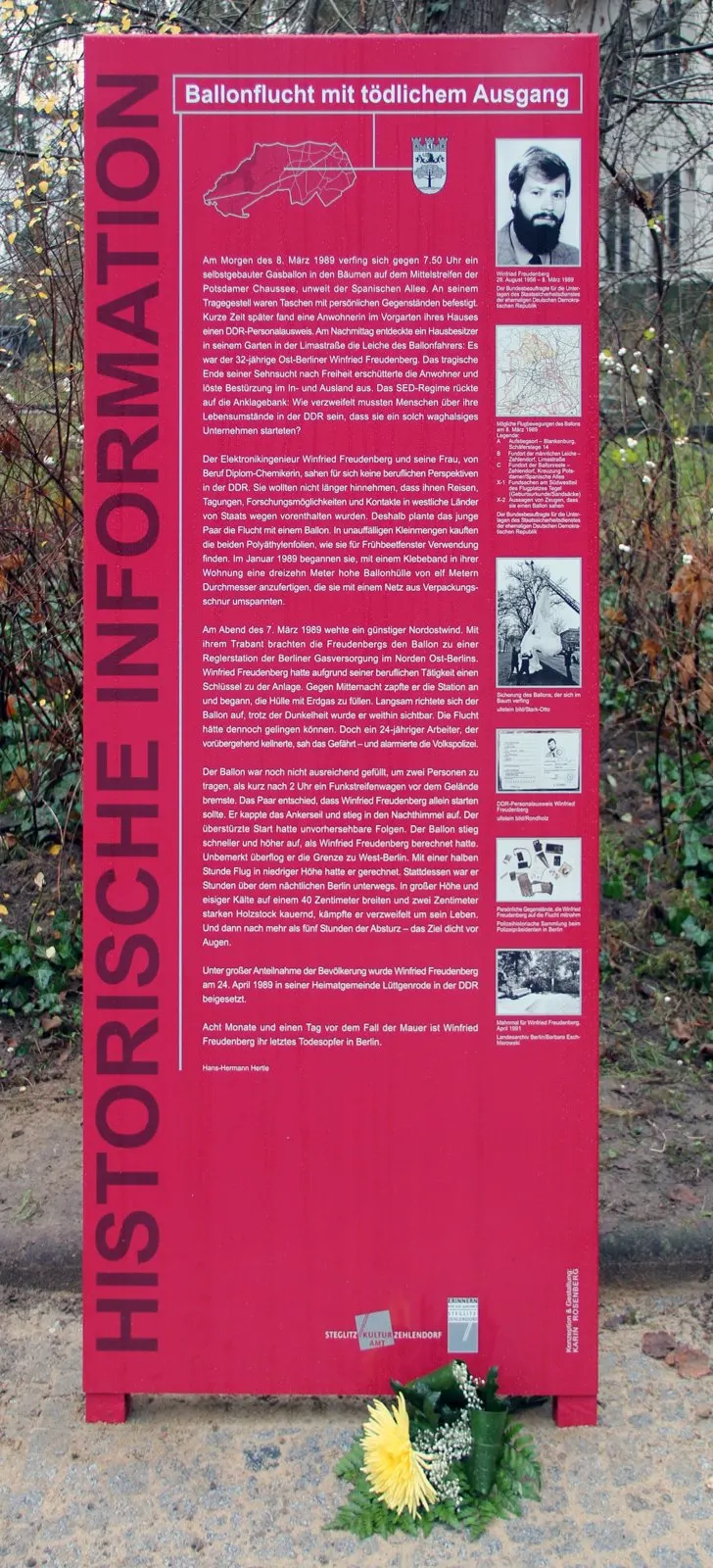
His body was returned to East Berlin on 7 April 1989, and on 24 April he was buried in Lüttgenrode, with great public sympathy and under Stasi surveillance. The Wall fell eight months and one day after his death. In 2012 a memorial column was dedicated to him on Erdmann-Graeser-Weg in Zehlendorf, near the place where he fell.
_Winfried_Freudenberg.jpg)
Read more
Also died on the sector border between Berlin-Pankow and Berlin-Reinickendorf
- Dorit Schmiel 19 February 1962
- Horst Frank 29 April 1962
- Wernhard Mispelhorn 20 August 1964
- Horst Einsiedel 15 March 1973
- Dr. Johannes Muschol 16 March 1981
- Silvio Proksch 25 December 1983
- Michael Schmidt 1 December 1984
Sources
This profile is a summary written for this site. Every fact in it is taken from source 1, which also gives the full account with archival references.
- Martin Ahrends/Udo Baron/Hans-Hermann Hertle, “Winfried Freudenberg”, biography in Chronik der Mauer, Federal Agency for Civic Education, Centre for Contemporary History Potsdam and Deutschlandradio. Accessed 23 September 2026. Read online. Basis for every fact in this profile, including the dates and place of death.
- German version of the same biography. Accessed 23 September 2026. Read online.
- Hans-Hermann Hertle and Maria Nooke (eds.), The Victims at the Berlin Wall, 1961–1989: A Biographical Handbook. Centre for Contemporary History Potsdam and Berlin Wall Foundation, Berlin 2011. The printed handbook from which the online biography is taken.
- Hans-Hermann Hertle and Maria Nooke, “140 Victims at the Berlin Wall, 1961–1989” (list), Centre for Contemporary History Potsdam and Berlin Wall Foundation, August 2017. PDF. Used to cross-check names and dates.
- Hans-Hermann Hertle and Maria Nooke, “The Victims at the Berlin Wall, 1961–1989: Findings of a Research Project”, August 2017. PDF. Source of the classification into escapees, people with no intent to escape, and border soldiers.
Further reading
Image credits
- Portrait of Winfried Freudenberg in the Window of Remembrance at the Berlin Wall Memorial, Bernauer Straße. Brewer Bob, CC BY-SA 4.0, Wikimedia Commons.
- Information panel "Ballonflucht mit tödlichem Ausgang" about Winfried Freudenberg on Erdmann-Graeser-Weg in Berlin-Zehlendorf. OTFW, Berlin, CC BY-SA 3.0, Wikimedia Commons.
Cite this page
“Winfried Freudenberg”, Victims of the Berlin Wall, Berlin Experiences. https://victimsofthewall.com/victims/freudenberg-winfried/
Map
The pin position is based on the place of death described in source 1. Base map © OpenStreetMap contributors; course of the Wall in 1989 from Geoportal Berlin (dl-de/zero-2.0). Accessed 23 September 2026.