Who Was the Last Person Killed at the Berlin Wall?
Chris Gueffroy, shot on 5 February 1989, was the last person shot dead at the Berlin Wall; Winfried Freudenberg, who fell from a balloon, was the last to die.
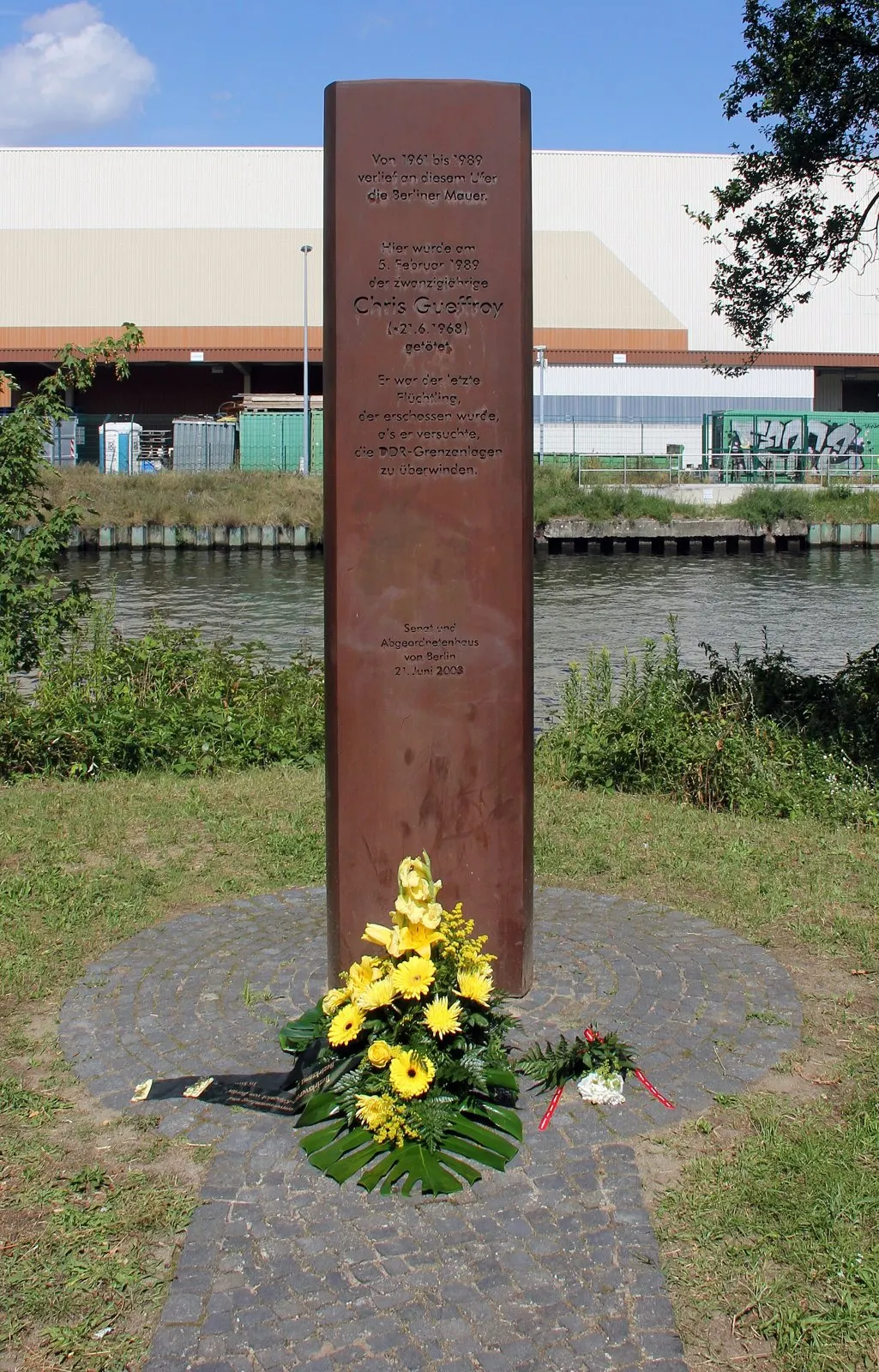
_Chris_Gueffroy.jpg)
The last person shot dead at the Berlin Wall was Chris Gueffroy, a 20-year-old waiter who was killed on the night of 5 February 1989 at the Britzer Zweigkanal between Treptow and Neukölln. Of the 140 people now counted as victims of the Wall, the last to die was Winfried Freudenberg, who fell to his death from his home-made gas balloon over the West Berlin district of Zehlendorf on 8 March 1989, eight months and one day before the Wall fell.
They were two of the three people who died at the Wall in its final year. The first, in January 1989, was Ingolf Diederichs. This article tells their stories and those of the people who died in the mid- and late 1980s, drawing on the biographies from the joint research project of the Berlin Wall Foundation and the Centre for Contemporary History Potsdam. For the overall figures, see how many people died at the Berlin Wall.
Fewer deaths in the later years, but no end to the shooting
The research project that established the figure of 140 victims found a clear fall in deaths over time. Between 1961 and 1975, 120 people died in connection with the border regime; the almost equally long period from 1976 to 1989 saw 20 deaths. The researchers attribute the fall mainly to the continued technical improvement of the border fortifications and closer guarding of the area in front of the Wall, and also to the Helsinki Accords of 1975, after which fewer people attempted to escape across the border and more applied to emigrate.
The study’s year-by-year table records one death in 1984, none in 1985, four in 1986, one in 1987, none in 1988 and three in 1989. Behind each of those numbers is a person.
1984 to 1987
Michael Schmidt, a 20-year-old carpenter born in Bernau, was shot while climbing the Wall on Schulzestrasse in Pankow on 1 December 1984. His biography records that almost an hour passed before he received medical care; he died in the People’s Police Hospital that morning. The study names him among those whom, according to later expert reports, faster help could have saved.
In 1986 four people died. Rainer Liebeke, a taxi driver and licensed motorcycle racer from Gotha, drowned in Sacrower Lake on 3 September 1986 while trying to swim to the West with a friend, shortly before his 35th birthday. His friend reached West Berlin.
In the early hours of 21 November 1986, Manfred Mäder and René Gross, two professional drivers who had both applied to leave East Germany, drove a stolen truck into the border strip between Treptow and Neukölln, breaking through a gate in the inner wall. Border guards opened automatic fire and both men were killed. The soldiers involved were decorated the same day. Almost 18 years later, the Berlin Regional Court convicted the guard who had shot Manfred Mäder of manslaughter, treating it as a less serious case, and gave him a suspended ten-month prison sentence; it could not be established who had shot René Gross.
Three days later, on 24 November 1986, Michael Bittner, a 25-year-old mason from Pankow whose applications to leave had been turned down more than once, was shot as he reached the top of the Wall in Glienicke/Nordbahn. His body was collected by a Stasi vehicle on 28 November 1986, and according to his biography it has never been traced.
On 12 February 1987 Lutz Schmidt, who as a young racing cyclist had been regarded in his club as a great talent and who was raising two children with his wife Karin, tried to cross the Wall near Rheingoldstrasse with a colleague on a foggy night. His friend got over; Lutz Schmidt was shot in the death strip. His wife and father were told to say he had died in a traffic accident. In 1995 the Berlin Regional Court convicted the two guards of joint manslaughter and gave each of them a suspended two-year sentence.
Ingolf Diederichs: 13 January 1989
Ingolf Diederichs was born in Wismar in 1964 and trained as a maintenance mechanic before studying at the Technical University of Dresden, where he was later exmatriculated. On the evening of 13 January 1989 he boarded an S-Bahn train from Pankow towards Schönhauser Allee, carrying a folding wooden ladder he had made himself. On this line, near Bornholmer Strasse, only just over 20 metres separated passengers from West Berlin. Near the Bornholmer Strasse border crossing he jumped from the moving train and was killed instantly. He was 24.
His biography notes that his reasons are not known. The Stasi presented his death as a mere accident, and his relatives were only to be told that he had died in a fall from a moving train. A preliminary investigation opened by the Berlin public prosecutor’s office in 1994 was closed the following month for lack of evidence that anyone else was involved.
Chris Gueffroy: the last person shot dead at the Berlin Wall
Who he was
Chris Gueffroy was born in Pasewalk on 21 June 1968 and moved to Berlin with his mother at the age of five. Spotted as a gifted gymnast while he was still in the third grade, he was sent to the children’s and youth sports school of Dynamo Berlin. Because he refused to commit himself to a career as an officer in the National People’s Army after school, he was not allowed to take the Abitur, the school-leaving examination needed for university; with it went his hope of becoming an actor or a pilot. In September 1985 he started an apprenticeship at the restaurant of Schönefeld airport, and he then worked as a waiter in several restaurants.
In early 1989 he learned that he was to be called up to the National People’s Army in May, and in mid-January he and his friend Christian G. decided to leave East Germany. They had heard from friends that the order to shoot at the border had been suspended, and they expected that no one would be shot during a state visit by the Swedish prime minister. Both assumptions were wrong: the order was still in force, and the prime minister had already left East Berlin.
5 February 1989
Late that night the two friends climbed the inner wall near the “Harmonie” garden colony in Treptow and set off an alarm as they crossed the signal fence. As they ran towards the last fence before the Britzer Zweigkanal, a pair of border guards opened fire on them; running along the fence to get away from the shots, they came into the line of fire of a second pair of guards, who also opened fire. Chris Gueffroy was hit and died within minutes. Christian G. was injured and arrested; in May 1989 he was sentenced to three years in prison, and in mid-October 1989 he was released to the West after the West German government paid for his release.
His mother was taken in for questioning by the Stasi two days later and learned only in the course of hours of questioning that her son was dead. The authorities tried to keep his death secret, but his brother managed to place a death notice in the Berliner Zeitung, and western media connected it with the shots heard at the border. Well over 100 people attended his funeral at Baumschulenweg Cemetery on 23 February 1989, under Stasi observation.
What followed
According to his biography, the shooting threatened to isolate the East German leadership politically in the spring of 1989, as protests and diplomatic steps against the order to shoot continued. Erich Honecker’s instruction that the order to shoot, whose existence had always been officially denied, was no longer to be applied was given orally: according to the Federal Archives, in a conversation with Egon Krenz, who passed it on to the deputy defence minister on 2 April 1989. A Stasi note records that from the evening of 3 April the border units were told not to use firearms to prevent people breaking through the border; guards could still fire if their own lives were threatened. His biography also records that no one was shot dead at the Berlin Wall after Chris Gueffroy. More on the orders themselves is in our article on the shoot-to-kill order.
After the Wall fell, his mother, Karin Gueffroy, filed a criminal complaint on 12 January 1990. The Berlin public prosecutor charged four former border guards on 27 May 1991, and their trial was the first of the many trials of guards who had fired at people escaping at the Wall. On 20 January 1992 the Berlin Regional Court convicted the soldier who fired the fatal shot of manslaughter and sentenced him to three and a half years; the others received suspended sentences or were acquitted. The Federal Court of Justice overturned the verdict on 25 March 1993, and on 14 March 1994, in the retrial, the Berlin Regional Court gave him a suspended two-year sentence. The wider story is told in our article on the Berlin Wall shooting trials.
A memorial column was erected at the Britzer Zweigkanal in 2003, and on 13 August 2010 Britzer Allee was renamed Chris-Gueffroy-Allee.
Winfried Freudenberg: the last death at the Wall
Winfried Freudenberg was born on 29 August 1956 in Osterwieck in the Harz and grew up in Lüttgenrode, close to the inner-German border. He trained as an electrician, studied in Ilmenau and qualified as an electronics engineer. In autumn 1988 he married Sabine, whom he had met at a student club while he was at university. But they saw no career prospects for themselves in East Germany.
To obtain gas for an escape by balloon, he took a job in the gas supply department of an energy combine, and the couple moved to Prenzlauer Berg. From January 1989 they built a balloon 13 metres high from strips of polyethylene sheeting in their flat. On the evening of 7 March a moderate north-east wind was blowing at last. They took the balloon by car to a gas regulating station near Blankenburg S-Bahn station, and at around midnight he began filling it.
A passer-by saw the balloon and alerted the police. When a police car slowed outside the station shortly after 2 a.m., the couple decided he should go alone, since they feared there was not yet enough gas in the balloon to lift two people. Carrying only one person, the balloon climbed far higher and faster than he had intended, and he drifted over West Berlin for hours. At around 7:30 in the morning, over Zehlendorf and only a few hundred metres from East German territory, he fell from a great height into the garden of a villa; the empty envelope of the balloon ended up in a tree a few hundred metres away. What exactly caused the fall has not been established. He died immediately. He was 32.
Sabine Freudenberg was arrested that morning, and proceedings were opened against her for attempting to breach the border. She was given a three-year suspended sentence and was granted amnesty on 27 October 1989. Winfried Freudenberg was buried in Lüttgenrode on 24 April 1989, under Stasi surveillance. His biography calls him “the last person to die in Berlin as a consequence of the Berlin Wall”, which fell exactly eight months and one day later. Escapes under, over and through the Wall are documented at Berlin Wall Escapes.
In 2012 a memorial column was dedicated to him on Erdmann-Graeser-Weg in Zehlendorf, not far from where he fell.
How families were told
In the late 1980s, as in earlier years, the East German state tried to keep shootings at the Wall as secret as possible. The research project found that in more than 30 cases relatives were told of the death but obliged to stay silent or lie about it, or were deceived about the cause; its examples of families obliged to describe the death as a traffic accident run up to the widow and parents of Lutz Schmidt. It also records that a Stasi report on Michael Bittner’s death stated that the “political sensitivity” of the border to West Berlin made it necessary to conceal the incident. The fate of many of these families is described in their individual profiles, and the places where the victims are remembered today are covered in our guide to Berlin Wall memorials.
Questions and answers
- Who was the last person shot dead at the Berlin Wall?
- Chris Gueffroy, a 20-year-old waiter, was shot on the night of 5 February 1989 at the Britzer Zweigkanal. According to his biography, no one was shot dead at the Berlin Wall after him.
- Who was the last person to die at the Berlin Wall?
- Winfried Freudenberg, an electronics engineer, died on 8 March 1989 when he fell from his home-made gas balloon over the West Berlin district of Zehlendorf. According to his biography, he was the Wall's last victim in Berlin.
- How many people died at the Berlin Wall in 1989?
- Three: Ingolf Diederichs on 13 January, Chris Gueffroy on 5 February and Winfried Freudenberg on 8 March 1989.
- Was anyone convicted for the killing of Chris Gueffroy?
- Yes. In 1992 the Berlin Regional Court convicted the soldier who fired the fatal shot of manslaughter. After the Federal Court of Justice overturned the verdict in 1993, a retrial in 1994 ended in a suspended two-year sentence.
Sources
- Hertle/Nooke, The Victims at the Berlin Wall, 1961–1989: Findings (2017)
- Chronik der Mauer: Chris Gueffroy
- Chronik der Mauer: Winfried Freudenberg
- Chronik der Mauer: Ingolf Diederichs
- Chronik der Mauer: Lutz Schmidt
- Chronik der Mauer: Michael Bittner
- Chronik der Mauer: René Gross
- Chronik der Mauer: Manfred Mäder
- Chronik der Mauer: Rainer Liebeke
- Chronik der Mauer: Michael Schmidt
- Bundesarchiv: April 1989 – Aufhebung des Schießbefehls und Differenzen mit dem KGB
- Chronik der Mauer: Zur Aufhebung des Schießbefehls, 12. April 1989
Every fact in this article was checked against these sources. To report an error, email info@berlinexperiences.com.
Cite this page
“Who Was the Last Person Killed at the Berlin Wall?”, Victims of the Berlin Wall, Berlin Experiences. https://victimsofthewall.com/articles/last-victims-of-the-berlin-wall/
A Berlin Experiences project