Michael Bittner
1961–1986
Michael Bittner, a 25-year-old mason from Pankow whose applications to leave East Germany had been repeatedly refused, was shot at the last border wall in Glienicke/Nordbahn on 24 November 1986. The Stasi concealed his death, and his body was never found.
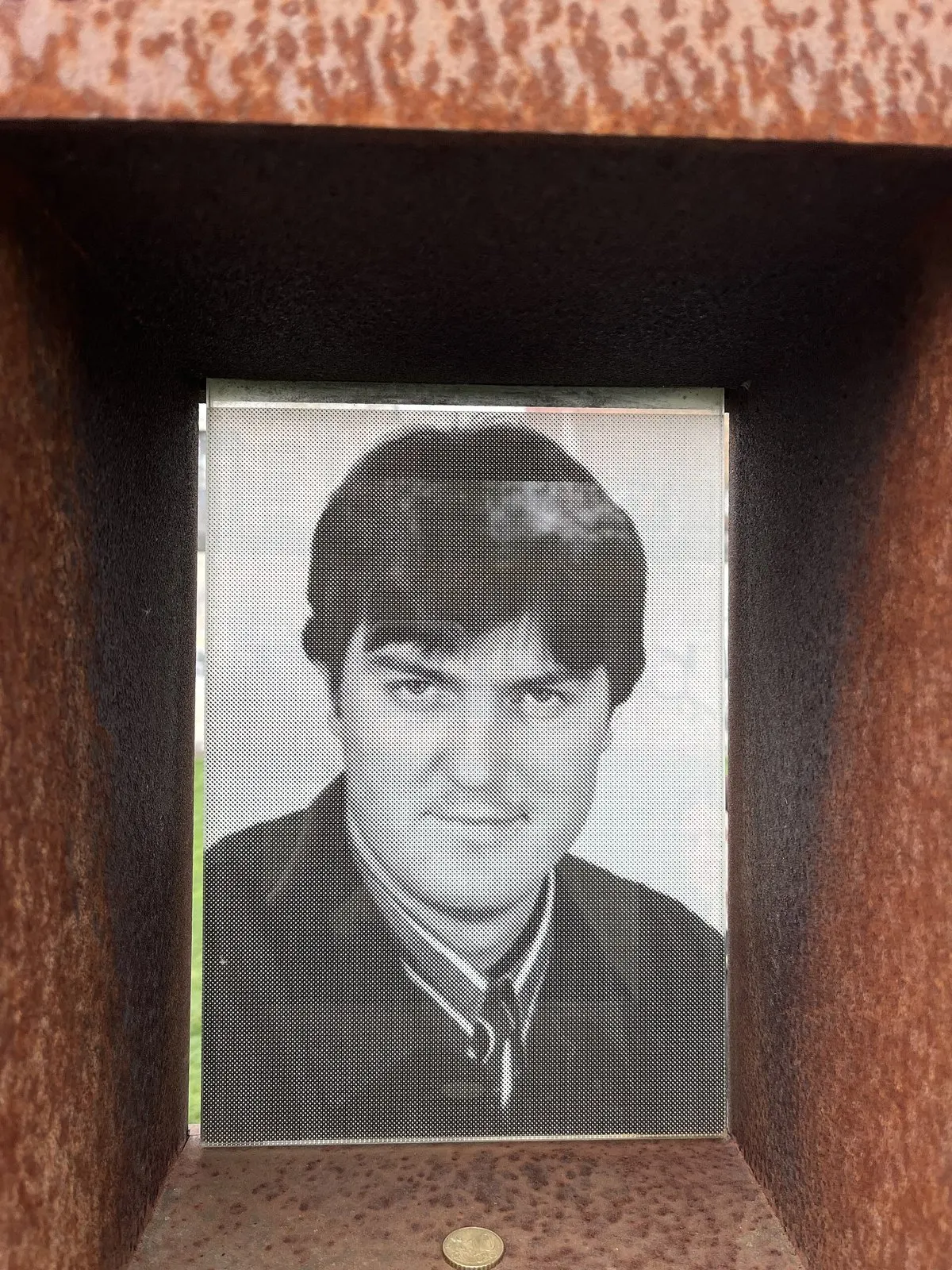

Michael Bittner was born in East Berlin on 31 August 1961. His father died early, and he grew up in Pankow with his mother and his siblings. After school he trained as a mason with a state-owned building repair firm in Pankow, and he spent much of his spare time doing masonry work on his mother's house.
Called up to the National People's Army in May 1980, he was, according to his mother, often harassed there and put in the detention cell for the slightest reason. When he was discharged in October 1981 he was a different person: looking back, she described him as quiet and withdrawn, somehow cowed, and always on edge about being called up again as a reservist. From April 1984 he tried to leave East Germany through applications to emigrate; an official record of his motives noted that he wanted to be free and not be told by the state what to do. He worded his request carefully so as not to harm his mother's and siblings' careers. When yet another application failed in 1986, he decided to escape.
On 23 November 1986 he said goodbye to his brother, telling him that his application had been approved but he did not yet know when he could go; he did not tell his brother or mother that he planned to flee. At around 1:20 a.m. on 24 November he approached the border in Glienicke/Nordbahn, carrying the personal documents he would need in the West. He crossed the inner wall with a wooden ladder, setting off an alarm, and ran across the narrow strip to the final wall. As his hands reached the top, the guards, who had spotted him from about 200 metres away, opened aimed fire. Hit in the back by two bullets, he fell backwards to the ground. At 1:50 a.m. the regiment's doctor declared him dead.
Residents on the West Berlin side, alerted by the shots, watched through gaps in the Wall as he was carried away, and West Berlin police, customs officers and French gendarmes arrived shortly afterwards and tried to take photographs and film of the scene. The shooting was reported widely in the western media, and the Berlin Senate and the West German government condemned the use of firearms, while the three western Allies reacted with outrage.
The Stasi set out to hide his death entirely. Guards and medical staff were sworn to silence, and his death certificate and post-mortem report were destroyed, as was the record of his cremation and burial. To explain his disappearance to his family, the Stasi invented a story that a smuggling gang had taken him to the West, opened a sham investigation against him, and recorded in the Pankow registry that he had emigrated. His body, taken for autopsy to Bad Saarow and collected by a Stasi vehicle on 28 November 1986, has never been traced. His mother feared he was the man reported killed; the East German authorities denied any fatal incident and maintained to the end that he had fled safely to the West.
In January 1990 his mother asked the East German justice minister what had become of her son, but a systematic investigation began only after reunification. At the end of 1997 the youth chamber of the Berlin Regional Court gave the two guards who had fired youth sentences of one year and three months each for manslaughter, suspended; the court held them jointly responsible, although it could not say whose bullets had struck him. Half a year later, in a separate trial, the Berlin Regional Court gave their superiors suspended prison sentences of two years and of ten months. His body was never located, and his mother has continued to hope that someone who knew what happened then will find the courage to tell her where his urn ended up.
Read more
Sources
This profile is a summary written for this site. Every fact in it is taken from source 1, which also gives the full account with archival references.
- Udo Baron, “Michael Bittner”, biography in Chronik der Mauer, Federal Agency for Civic Education, Centre for Contemporary History Potsdam and Deutschlandradio. Accessed 23 September 2026. Read online. Basis for every fact in this profile, including the dates and place of death.
- German version of the same biography. Accessed 23 September 2026. Read online.
- Hans-Hermann Hertle and Maria Nooke (eds.), The Victims at the Berlin Wall, 1961–1989: A Biographical Handbook. Centre for Contemporary History Potsdam and Berlin Wall Foundation, Berlin 2011. The printed handbook from which the online biography is taken.
- Hans-Hermann Hertle and Maria Nooke, “140 Victims at the Berlin Wall, 1961–1989” (list), Centre for Contemporary History Potsdam and Berlin Wall Foundation, August 2017. PDF. Used to cross-check names and dates.
- Hans-Hermann Hertle and Maria Nooke, “The Victims at the Berlin Wall, 1961–1989: Findings of a Research Project”, August 2017. PDF. Source of the classification into escapees, people with no intent to escape, and border soldiers.
Further reading
Image credits
- Portrait of Michael Bittner in the Window of Remembrance at the Berlin Wall Memorial, Bernauer Straße. Ankermast, CC BY-SA 4.0, Wikimedia Commons.
Cite this page
“Michael Bittner”, Victims of the Berlin Wall, Berlin Experiences. https://victimsofthewall.com/victims/bittner-michael/
Map
The pin position is based on the place of death described in source 1. Base map © OpenStreetMap contributors; course of the Wall in 1989 from Geoportal Berlin (dl-de/zero-2.0). Accessed 23 September 2026.