Siegfried Noffke
1939–1962
Siegfried Noffke, a 22-year-old West Berlin driver and young father, was fatally shot in a Stasi ambush on 28 June 1962 as he broke through an escape tunnel into the basement of Heinrich-Heine-Strasse 49, hoping to bring his wife and son to the West.
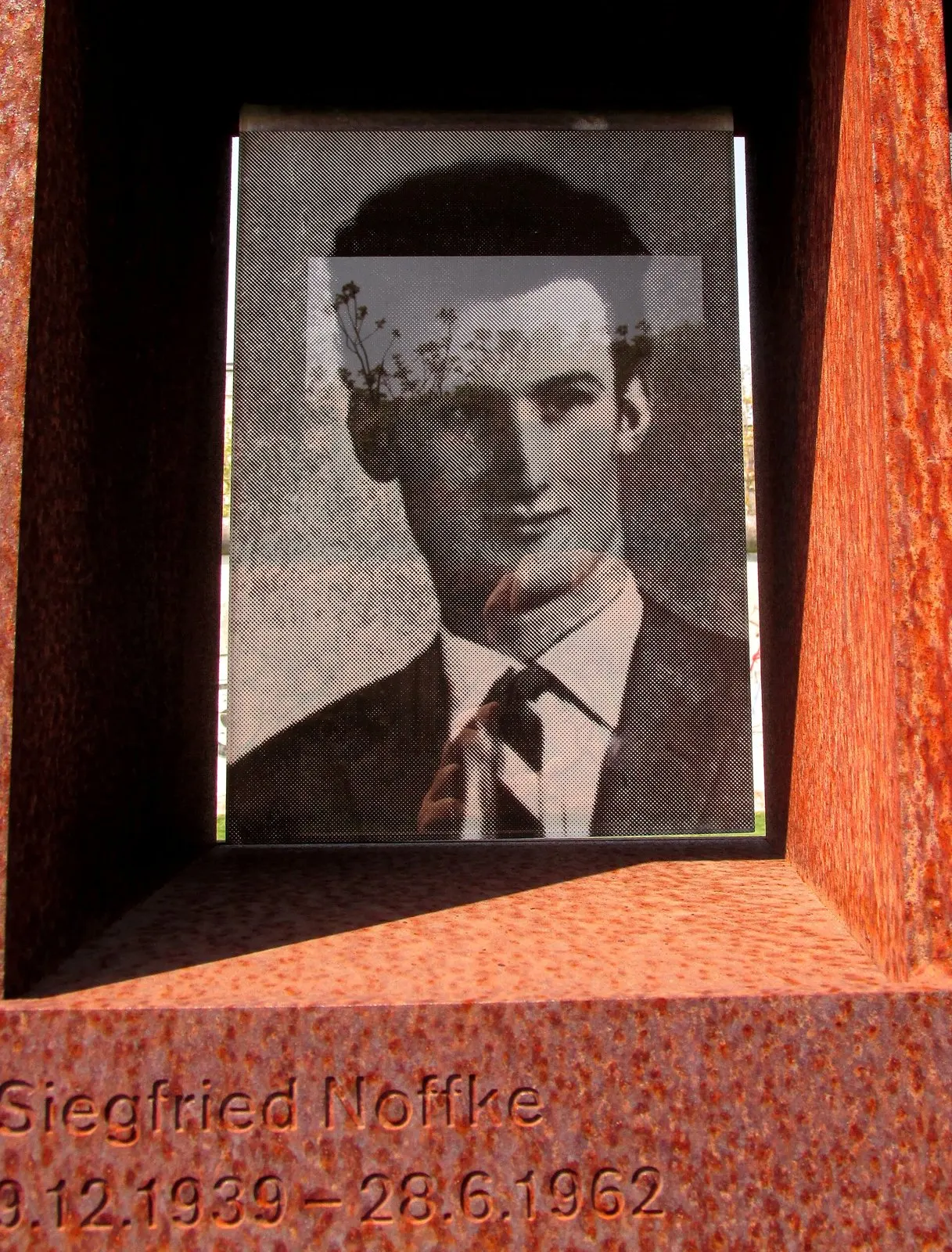

Siegfried Noffke was born in Berlin on 9 December 1939 and grew up in the Soviet sector. A bricklayer by training, he fled west during the 1950s, settled in Kreuzberg and earned his living as a driver. In May 1961, after the birth of their son, he married Hannelore, who lived in Prenzlauer Berg in the East. The young couple had apparently assumed that after the wedding she and the baby would be allowed to move to the western part of the city, but the East Berlin authorities refused an exit permit, and when the border was sealed the family was suddenly divided.
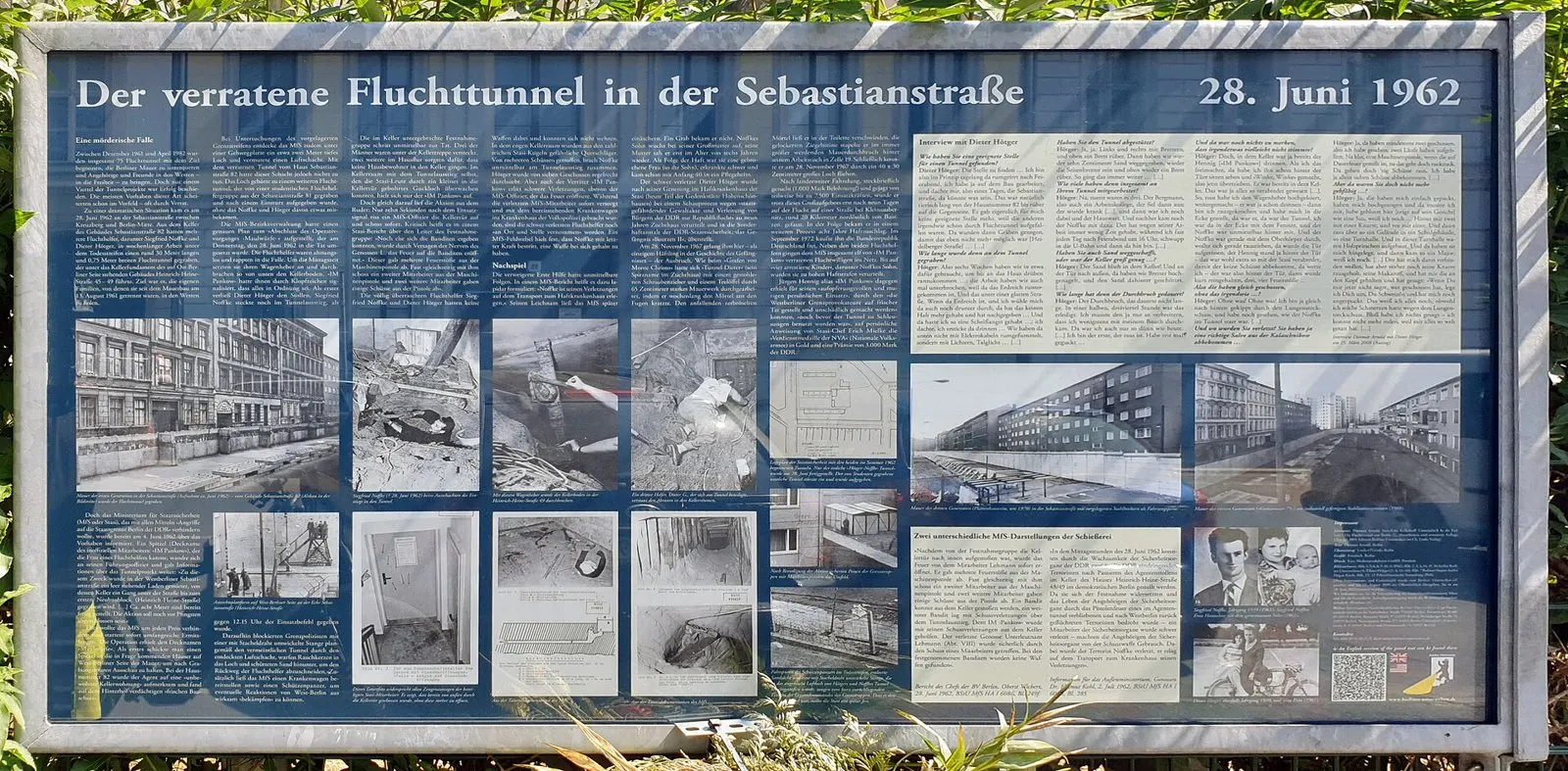
For almost a year the couple, like many others, could only meet secretly near the border and exchange a few words across the barrier. At one of these meetings he met another West Berliner in the same situation, who invited him to join a tunnel project to bring their wives across. The digging, which he now carried out together with Dieter Hötger and Dieter G., was already well under way; it started from a basement on Sebastianstrasse in Kreuzberg towards a house at Heinrich-Heine-Strasse 48/49. It was a private undertaking by men trying to reunite their families.
The plan had been betrayed early, even before he joined it, and only by chance. A woman planning to escape through the tunnel had told her brother, not knowing he was a Stasi informer, and he reported it at once. The Stasi set up an operation code-named 'Maulwürfe' (moles) to arrest everyone when the tunnel was complete, and the informer joined the group posing as a would-be refugee. He was there at midday on 28 June 1962 when the tunnel was opened, and helped the three tunnel builders break through into the basement, where Stasi officers were waiting.
Surviving tunnel builders said that the shooting began the moment Siegfried Noffke and Dieter Hötger stepped into the basement, although the tunnel builders were unarmed; Stasi files record that one agent lost his nerve and started shooting despite the plan to arrest them. Siegfried Noffke was fatally wounded and Dieter Hötger badly injured; the informer and a Stasi officer were also wounded. Though critically hurt, Siegfried Noffke was questioned on the spot, in order, as Stasi reports put it, to extract a "confession". He is said to have died a little later on the way to hospital.
His wife was arrested with the other East Berliners who had planned to escape, and in November 1962 the Berlin-Mitte city court sentenced them to between one and two years in prison for attempting to leave the GDR illegally; Dieter Hötger was sentenced in October 1962 to nine years' penal servitude. Their son was raised by his grandmother; he was six years old before he saw his mother again. He later said that prison left her a broken woman; she became seriously ill and was placed in a nursing home in her early 40s.
About two weeks after his death, unknown mourners laid a wreath in Kreuzberg, not far from the Heinrich-Heine-Strasse crossing, its ribbon saying farewell from his friends to a victim of the Wall. After the collapse of East Germany the presumed gunmen and the former informer remained silent about what had happened, and criminal investigations opened in the 1990s on the basis of Stasi files were discontinued for lack of evidence, without charges being brought. In 2009 the association Berliner Unterwelten put up a memorial plaque on Sebastianstrasse.
_Fluchttunnel.jpg)
Also died on the sector border between Berlin-Kreuzberg and Berlin-Mitte
- Klaus Brueske 18 April 1962
- Reinhold Huhn 18 June 1962
- Peter Fechter 17 August 1962
- Paul Schultz 25 December 1963
- Heinz Schöneberger 26 December 1965
- Johannes Lange 9 April 1969
- Burkhard Niering 5 January 1974
- Herbert Halli 3 April 1975
Sources
This profile is a summary written for this site. Every fact in it is taken from source 1, which also gives the full account with archival references.
- Christine Brecht, “Siegfried Noffke”, biography in Chronik der Mauer, Federal Agency for Civic Education, Centre for Contemporary History Potsdam and Deutschlandradio. Accessed 23 September 2026. Read online. Basis for every fact in this profile, including the dates and place of death.
- German version of the same biography. Accessed 23 September 2026. Read online.
- Hans-Hermann Hertle and Maria Nooke (eds.), The Victims at the Berlin Wall, 1961–1989: A Biographical Handbook. Centre for Contemporary History Potsdam and Berlin Wall Foundation, Berlin 2011. The printed handbook from which the online biography is taken.
- Hans-Hermann Hertle and Maria Nooke, “140 Victims at the Berlin Wall, 1961–1989” (list), Centre for Contemporary History Potsdam and Berlin Wall Foundation, August 2017. PDF. Used to cross-check names and dates.
- Hans-Hermann Hertle and Maria Nooke, “The Victims at the Berlin Wall, 1961–1989: Findings of a Research Project”, August 2017. PDF. Source of the classification into escapees, people with no intent to escape, and border soldiers.
Further reading
Image credits
- Portrait of Siegfried Noffke in the Window of Remembrance, Bernauer Strasse. Brewer Bob, CC BY-SA 4.0, Wikimedia Commons.
- Information board "Der verratene Fluchttunnel in der Sebastianstraße – 28. Juni 1962", Sebastianstrasse 82, Berlin-Kreuzberg. OTFW, Berlin, CC BY-SA 3.0, Wikimedia Commons.
Cite this page
“Siegfried Noffke”, Victims of the Berlin Wall, Berlin Experiences. https://victimsofthewall.com/victims/noffke-siegfried/
Map
The pin position is based on the place of death described in source 1. Base map © OpenStreetMap contributors; course of the Wall in 1989 from Geoportal Berlin (dl-de/zero-2.0). Accessed 23 September 2026.