Günter Seling
1940–1962
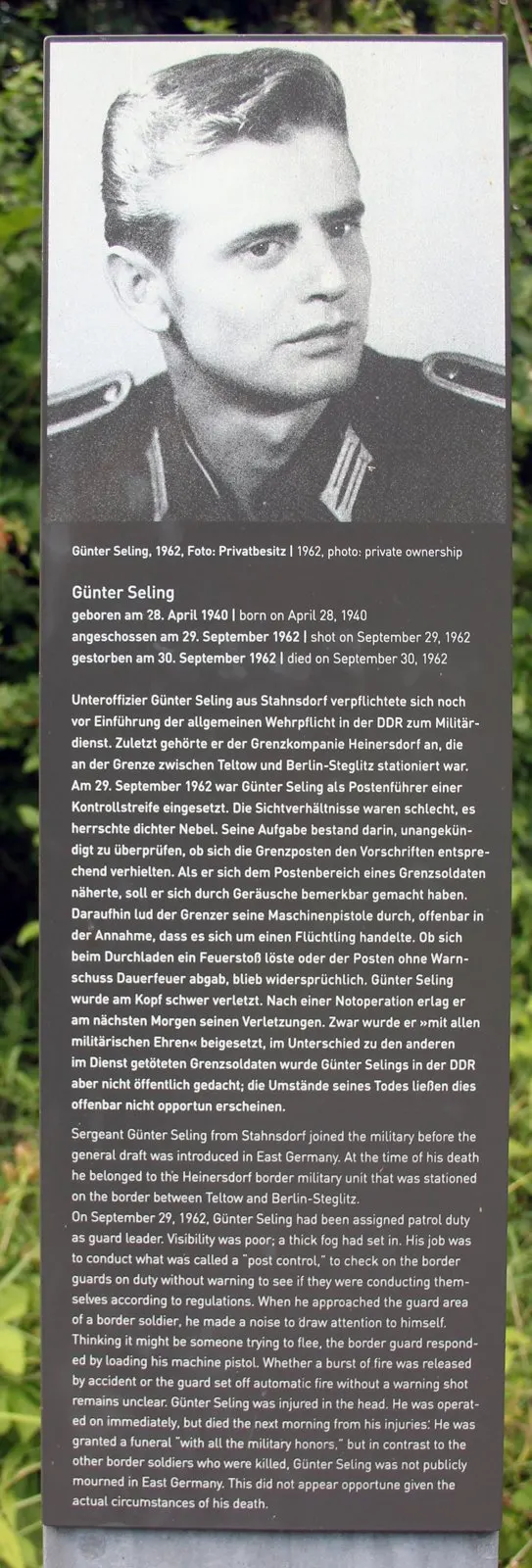
Günter Seling, a 22-year-old non-commissioned officer in the border troops from Stahnsdorf, was shot in thick fog on 29 September 1962 in Teltow-Seehof by a fellow soldier who took him for a fugitive, and died of his wounds the next day.
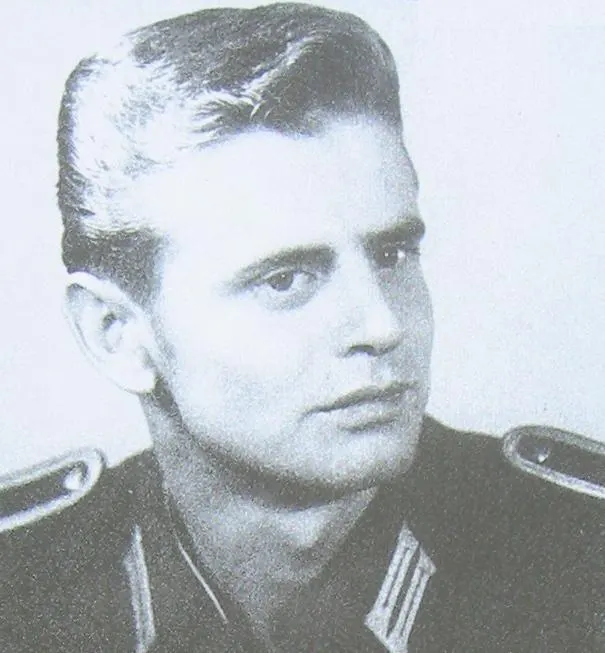

Günter Seling was born on 28 April 1940. He came from Stahnsdorf near Berlin and lived in his parents' house there until his death. He had served in the National People's Army since April 1959, having joined before general conscription was introduced in East Germany. By 1962 he was a non-commissioned officer in the Heinersdorf border company, stationed on the southern edge of the city along the border between West Berlin and Teltow.
On 29 September 1962 he was on patrol duty as guard leader. His task was to make unannounced checks on the guards at their posts. At about 5 a.m., in thick fog and poor visibility, he approached the post of a 19-year-old soldier and is said to have made a noise to draw attention to himself. The soldier then loaded his machine pistol, apparently thinking it was someone trying to escape.
The surviving reports describe what happened next with slight differences. A report prepared for Erich Honecker said that a burst of four shots went off accidentally as the weapon was being loaded. An earlier report, from the Berlin city command, suggested instead that the soldier had fired deliberately at the noise, without a call or warning shot. Either way, Günter Seling was badly wounded in the head. He was taken as quickly as possible to a hospital in Kleinmachnow and operated on at once, but he died of his injuries at about three o'clock the following morning, 30 September 1962.
A funeral with full military honours was ordered for him; according to West German and West Berlin newspapers, he was buried with military honours at the cemetery in Stahnsdorf. The soldier who had fired was detained and investigated by the military prosecutor for negligent use of a weapon; the outcome is not recorded. Unlike other border soldiers who were killed, he was not publicly commemorated in East Germany; given how he died, the political and military leaders evidently did not think it opportune.
Border guards who later fled to the West made the incident known in the West, though not the victim's identity, and in September 1968 his death was added to the West Berlin police list of victims of the Wall. In 1994 the Berlin public prosecutor's office, which opened preliminary inquiries, found no evidence of an intentional killing and concluded that in legal terms it was merely negligent homicide; the shooter was not prosecuted. In the view of his biographer, his death shows how great the pressure on guards to stop escapes was: in cases of doubt, they would fire even on their own comrades.
_G%C3%BCnter_Seling.jpg)
_Seling_Hoff.jpg)
Read more
Sources
This profile is a summary written for this site. Every fact in it is taken from source 1, which also gives the full account with archival references.
- Christine Brecht, “Günter Seling”, biography in Chronik der Mauer, Federal Agency for Civic Education, Centre for Contemporary History Potsdam and Deutschlandradio. Accessed 23 September 2026. Read online. Basis for every fact in this profile, including the dates and place of death.
- German version of the same biography. Accessed 23 September 2026. Read online.
- Hans-Hermann Hertle and Maria Nooke (eds.), The Victims at the Berlin Wall, 1961–1989: A Biographical Handbook. Centre for Contemporary History Potsdam and Berlin Wall Foundation, Berlin 2011. The printed handbook from which the online biography is taken.
- Hans-Hermann Hertle and Maria Nooke, “140 Victims at the Berlin Wall, 1961–1989” (list), Centre for Contemporary History Potsdam and Berlin Wall Foundation, August 2017. PDF. Used to cross-check names and dates.
- Hans-Hermann Hertle and Maria Nooke, “The Victims at the Berlin Wall, 1961–1989: Findings of a Research Project”, August 2017. PDF. Source of the classification into escapees, people with no intent to escape, and border soldiers.
Further reading
Image credits
- Portrait of Günter Seling on his memorial stele on the Berlin Wall Trail north of Lichterfelder Allee (the stele credits the 1962 photo to private ownership). Assenmacher, CC BY-SA 3.0, Wikimedia Commons.
- Memorial stele for Günter Seling on Lichterfelder Allee, Teltow. OTFW, Berlin, CC BY-SA 3.0, Wikimedia Commons.
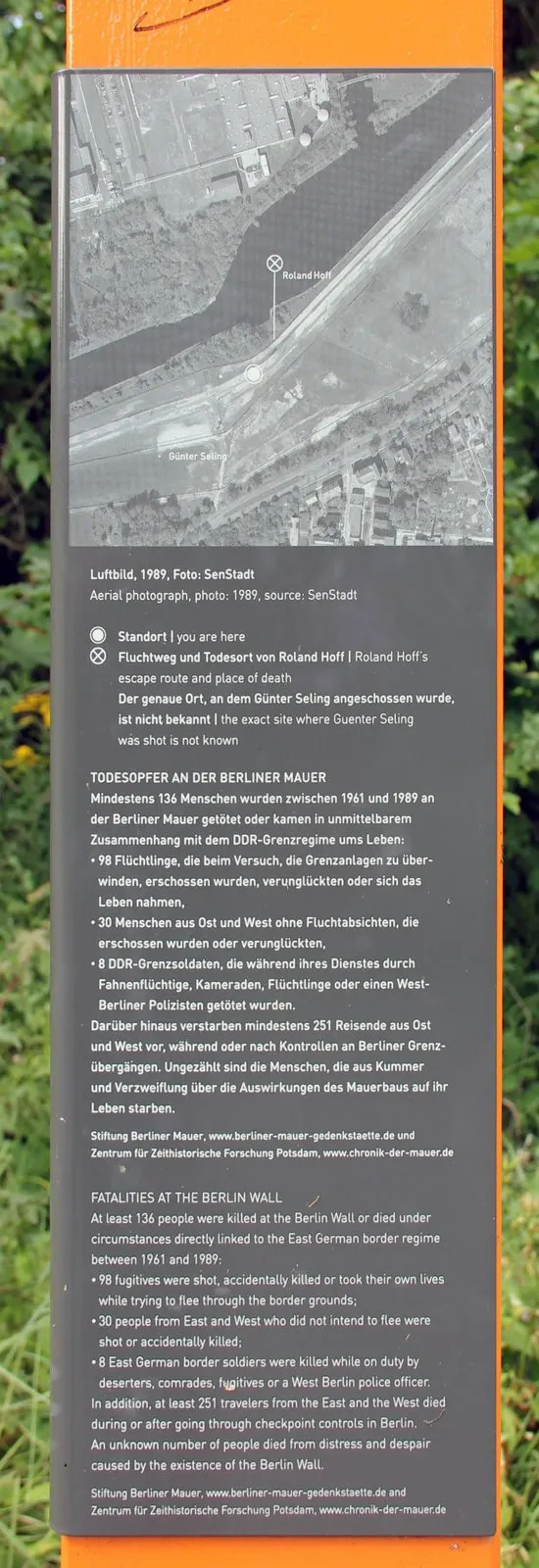
- Information stele at Lichterfelder Allee, Teltow, for Günter Seling and Roland Hoff, with an aerial photograph of the border area; the panel notes that the exact spot where Günter Seling was shot is not known. OTFW, Berlin, CC BY-SA 3.0, Wikimedia Commons.
Cite this page
“Günter Seling”, Victims of the Berlin Wall, Berlin Experiences. https://victimsofthewall.com/victims/seling-guenter/
Map
The pin position is based on the place of death described in source 1. Base map © OpenStreetMap contributors; course of the Wall in 1989 from Geoportal Berlin (dl-de/zero-2.0). Accessed 23 September 2026.