Herbert Kiebler
1952–1975
Herbert Kiebler, a 23-year-old metal worker from Mahlow, was shot dead by border guards near Highway 96 on 27 June 1975; the Stasi disguised his death as a suicide far from the border.
_Herbert_Kiebler4.jpg)
Herbert Kiebler was born in Mahlow, on the southern edge of Berlin, on 24 March 1952. His father died in 1965. Herbert lived with his mother and his younger sister; his three older siblings had already left home. From February 1975 he worked as a presser at a metal plant in Berlin that produced semi-finished goods.
On the warm evening of 26 June 1975, the 23-year-old was at a tavern in Mahlow with his group of friends when a fight broke out, probably over card-sharping and gambling debts. He came off worst. He arrived home the worse for drink at around 10 p.m., hurt in body and spirit; his sister, then 15, later told the People's Police that he had wept with shame and spoken of suicide. Half an hour later he left, leaving a farewell note in which he told his mother they would meet again either in prison or in West Germany, and that if he should die he wished her every happiness. He told his little sister he wanted to go over to the other side; she tried to stop him and ran after him but lost sight of him.
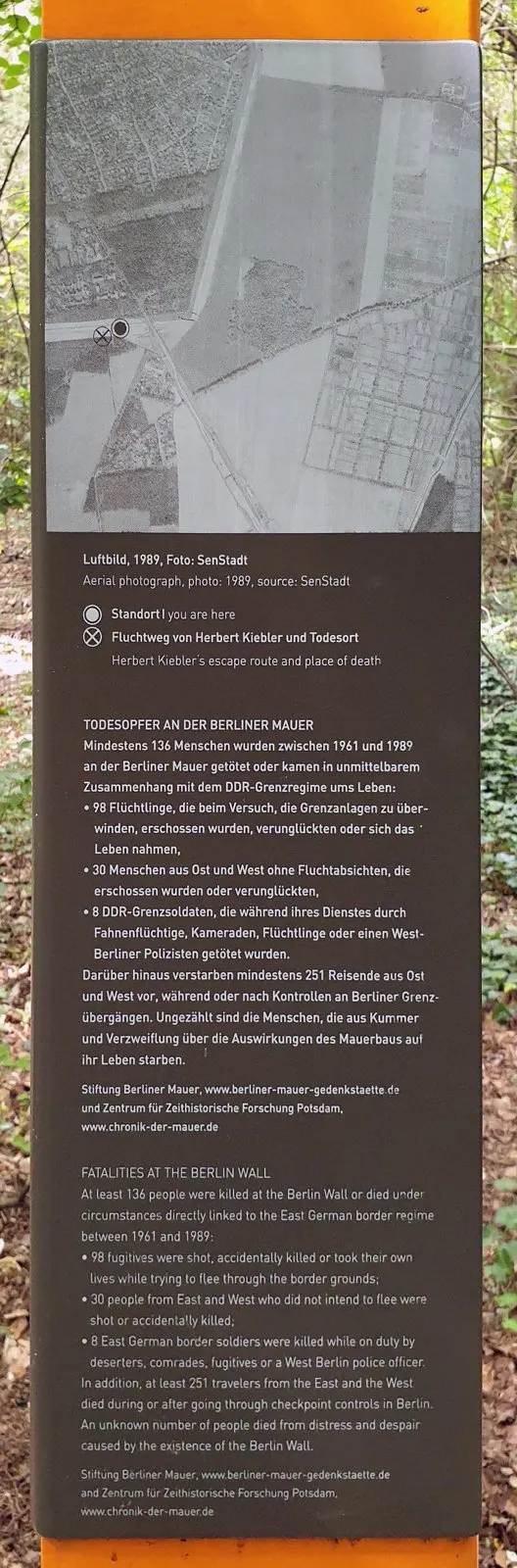
He spent the night on the move, and his brother later learned that he had taken a bus to Drewitz and then come back to Mahlow. At around 12.30 a.m. he got past the signal fence near what was then Highway 96, not knowing that he had triggered an alarm. Two border guards drove out to search, found the tracks where he had crawled, and took up position. As he was about to climb out of the anti-vehicle trench, they spotted him and opened fire, although, as they later admitted, they could easily have arrested him. Hit by a bullet in the chest and upper arm, he collapsed and bled to death at the scene.
It was only weeks before the final act of the CSCE was due to be signed in Helsinki, and the party leadership wanted no reports of deaths at the Wall. Because nobody seemed to have noticed the escape attempt, the Stasi staged his death as a suicide and moved the scene to woodland far from the border. Foresters, People's Police officers, registrars, pathologists and state attorneys were all drawn into the deception.
His mother, alarmed by the farewell letter, reported him missing on the morning of 27 June. On 3 July the family was told that a forester had found his body in woodland in Potsdam-West and that he had taken his own life with a knife. His older brother could not understand why Herbert would have travelled more than 40 kilometres in the middle of the night to do so; when he asked, the Potsdam state attorney repeated the official story but refused to show any photographs of the body. The family did not believe the official version. They feared he might have fallen victim to the men who had beaten him that evening, and, having heard rumours of shooting at the border on the night he disappeared, they did not rule out an escape attempt either. He was buried in Mahlow cemetery on 11 July 1975, with the mourners watched by the Stasi. Denied a last look at him, his relatives secretly entered the chapel at night, opened the coffin and saw the bullet wounds.
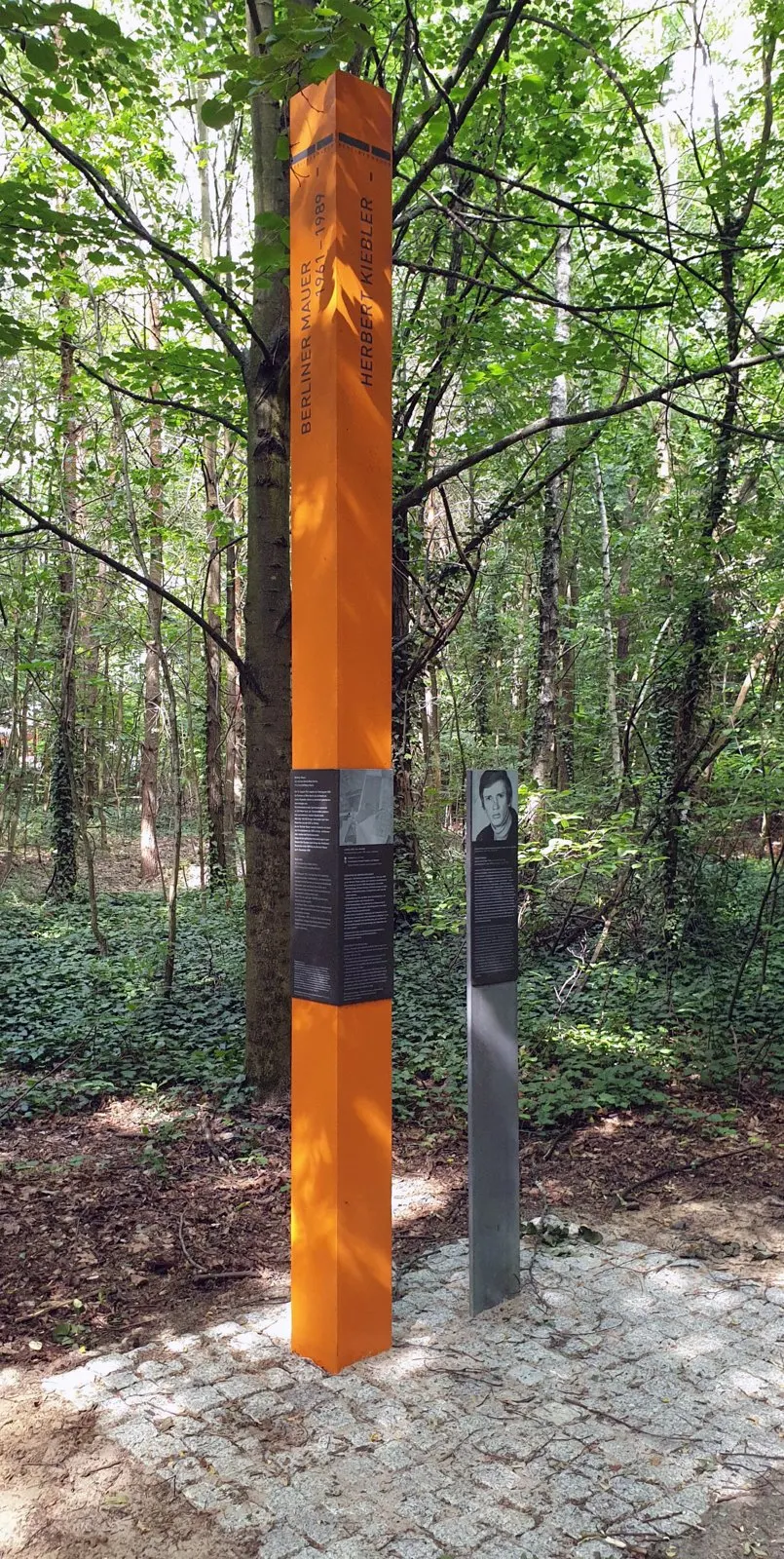
His mother kept asking the police for the truth. Her daughter later said that the lies had destroyed her; she received psychiatric treatment and died, embittered, in 1993. Only in the 1990s, when prosecutors investigated and the family could read the Stasi files, did the truth emerge. The guard who fired the fatal shot had been decorated, and his company commander, who had given the guards their orders, had also been honoured. A quarter of a century later the Potsdam Regional Court convicted them of manslaughter and of aiding and abetting manslaughter respectively, and gave them suspended sentences of 24 and 15 months. His sister, a witness at the trial, sensed no remorse. Since 2012 a memorial column has stood near the place where he died, where for some years the district of Teltow-Fläming, the Berlin borough of Tempelhof-Schöneberg and the municipality of Blankenfelde-Mahlow have remembered him on anniversaries.
_Herbert_Kiebler.jpg)
_Herbert_Kiebler2.jpg)
Also died on the outer ring between Berlin-Tempelhof and Mahlow
- Eduard Wroblewski 26 July 1966
Sources
This profile is a summary written for this site. Every fact in it is taken from source 1, which also gives the full account with archival references.
- Martin Ahrends/Udo Baron/Hans-Hermann Hertle, “Herbert Kiebler”, biography in Chronik der Mauer, Federal Agency for Civic Education, Centre for Contemporary History Potsdam and Deutschlandradio. Accessed 23 September 2026. Read online. Basis for every fact in this profile, including the dates and place of death.
- German version of the same biography. Accessed 23 September 2026. Read online.
- Hans-Hermann Hertle and Maria Nooke (eds.), The Victims at the Berlin Wall, 1961–1989: A Biographical Handbook. Centre for Contemporary History Potsdam and Berlin Wall Foundation, Berlin 2011. The printed handbook from which the online biography is taken.
- Hans-Hermann Hertle and Maria Nooke, “140 Victims at the Berlin Wall, 1961–1989” (list), Centre for Contemporary History Potsdam and Berlin Wall Foundation, August 2017. PDF. Used to cross-check names and dates.
- Hans-Hermann Hertle and Maria Nooke, “The Victims at the Berlin Wall, 1961–1989: Findings of a Research Project”, August 2017. PDF. Source of the classification into escapees, people with no intent to escape, and border soldiers.
Further reading
Image credits
- Memorial column for Herbert Kiebler on the Berlin Wall Trail (Mauerweg) in Blankenfelde-Mahlow. OTFW, Berlin, CC BY-SA 3.0, Wikimedia Commons.
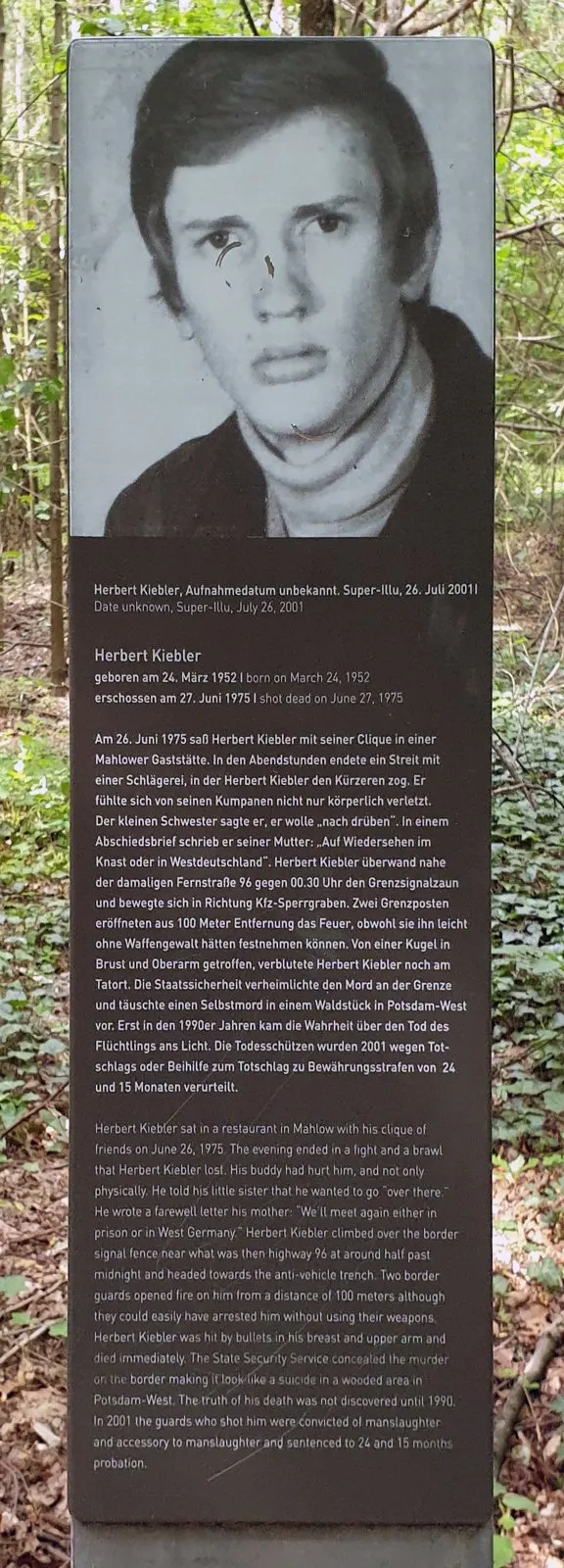
- Information panel with a portrait of Herbert Kiebler at his memorial on the Mauerweg in Blankenfelde-Mahlow. OTFW, Berlin, CC BY-SA 3.0, Wikimedia Commons.
- Panel on the memorial column with a 1989 aerial photograph marking Herbert Kiebler's escape route and place of death. OTFW, Berlin, CC BY-SA 3.0, Wikimedia Commons.
Cite this page
“Herbert Kiebler”, Victims of the Berlin Wall, Berlin Experiences. https://victimsofthewall.com/victims/kiebler-herbert/
Map
The pin position is based on the place of death described in source 1. Base map © OpenStreetMap contributors; course of the Wall in 1989 from Geoportal Berlin (dl-de/zero-2.0). Accessed 23 September 2026.