Eduard Wroblewski
1933–1966
Eduard Wroblewski, a 33-year-old father of two from Zahna near Wittenberg, was shot from behind by border soldiers on 26 July 1966 while trying to cross the border from Mahlow to Lichtenrade along disused S-Bahn tracks.
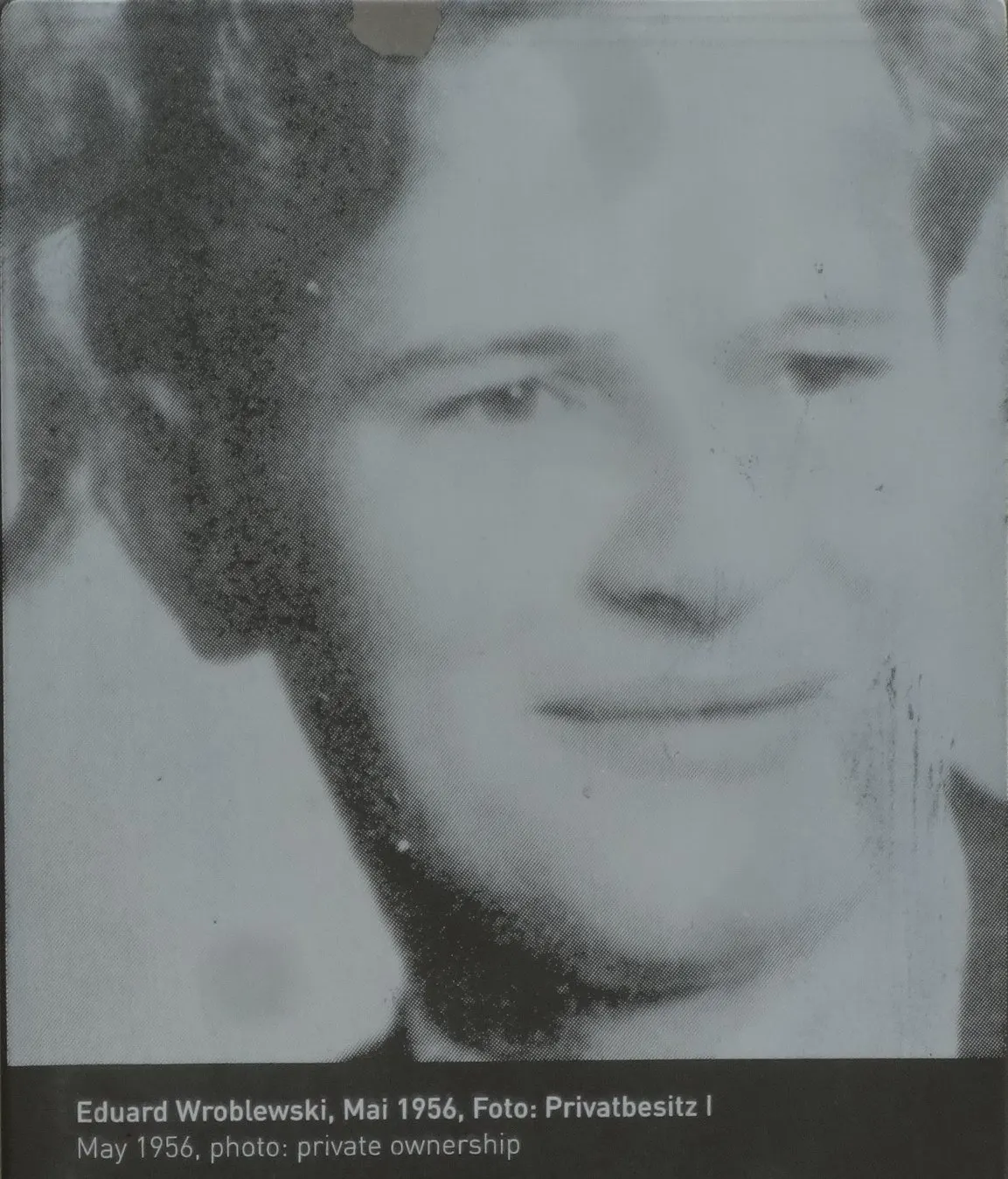

Eduard Wroblewski was born on 3 March 1933 in Wutschdorf, in the former Prussian district of Züllichau-Schwiebus, one of many children in a family that had made its home in the Fläming Heath before the war. He left school at 14 and worked on a farm. He was evidently never an enthusiastic supporter of socialism, possibly in part because an older brother had been convicted of alleged espionage and sent to serve his sentence in the Soviet Union. At 19, in 1952, he went to West Germany, but without training or family support he could not establish himself and returned after nine months.
He worked for a time as a trackman on the railway and later found jobs on the land and on building sites. He first married in 1956; that marriage failed. In 1962 he married again, and he and his second wife had a son and a daughter. Difficulties with superiors and the authorities strained the marriage, and in July 1966 he was facing dismissal once again. The family lived in Zahna, in the Wittenberg district.
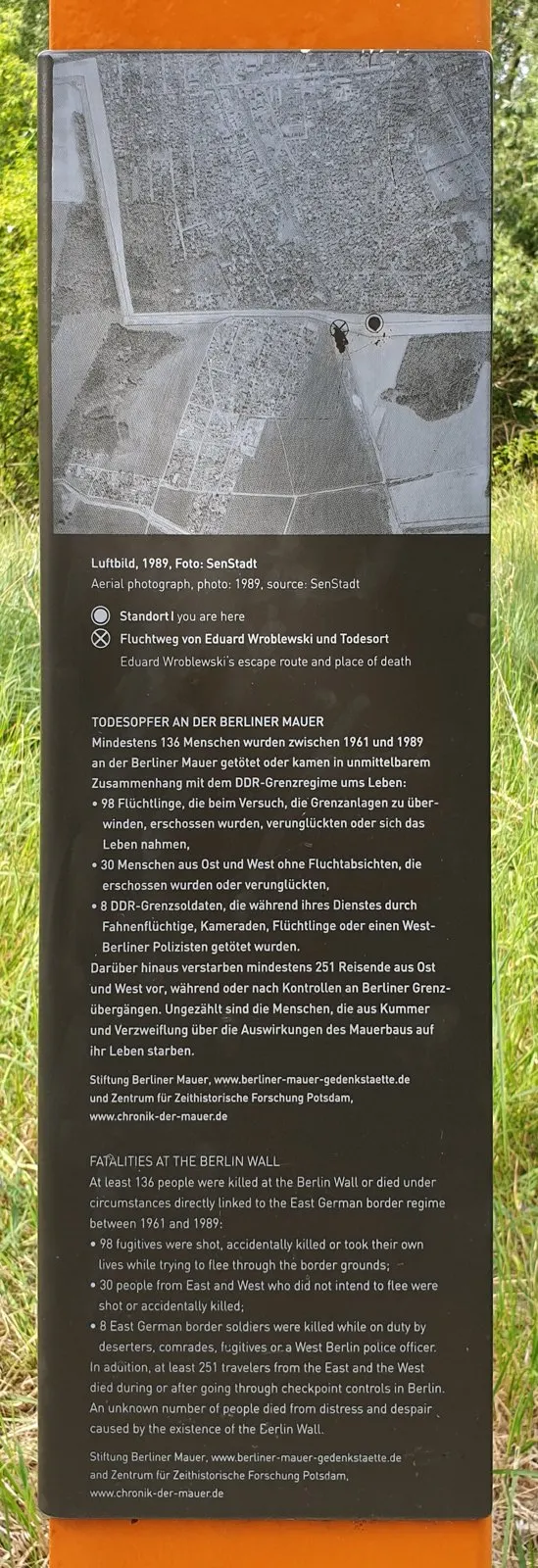
On the morning of 26 July 1966 his wife believed he was going to work at the mosaic plate factory in Zahna. Instead, without a word to his family, he travelled to Mahlow on the southern edge of Berlin. Early in the evening, probably having had a few drinks, he entered the border area along the disused S-Bahn tracks that once ran to Lichtenrade and got within 100 metres of the last fence unseen. Then shots rang out without warning. He ran and got over the first two rows of the three-row barbed-wire fence before he was struck from behind and collapsed in the wire. Five soldiers fired 274 rounds; twelve hit him, and he died at once.
Residents of Lichtenrade, who had just been sitting in their gardens or watching the World Cup semi-final, witnessed the shooting, and bullets struck houses on the western side. Heinrich Albertz, the senator for the interior, and the American city commander condemned it. In East Berlin, a newspaper denounced him as an antisocial element and a criminal wanted in the Halle district; the rumour that he had committed a crime was without foundation. The guards were honoured.
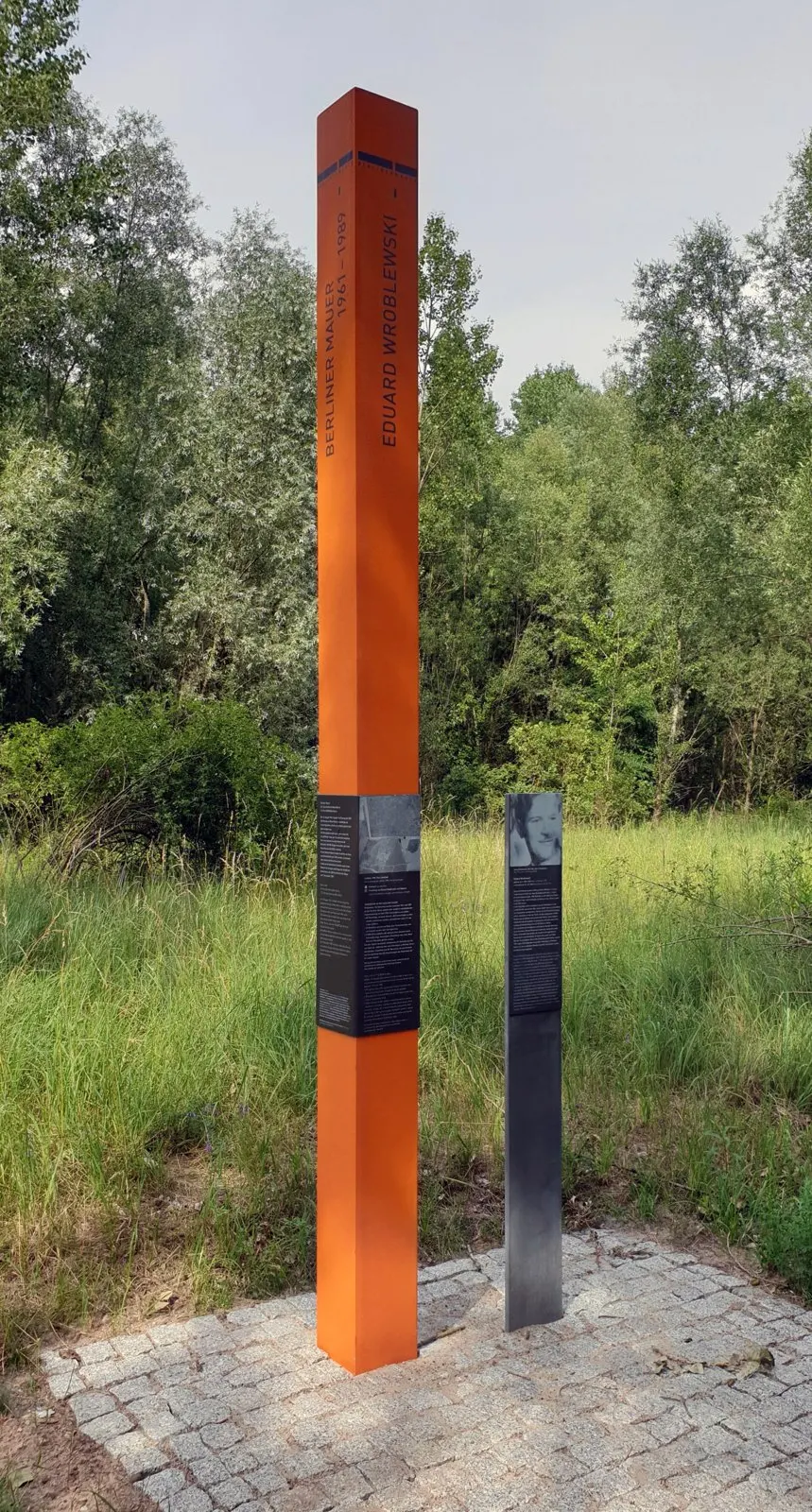
The slander followed his family for years. Out of shame and fear, his death was not spoken of at home; his son first learned of it when a classmate told him that his father had been a criminal who was shot at the border, and in 1982 he was refused radio operator training during military service because the files listed his father as a so-called border violator. After the collapse of the East German state, the Potsdam Regional Court found that of the six conscripts involved, one had not fired, one had deliberately missed and two had missed despite aiming. In August 1996 the two held responsible for the fatal shots were given 18-month suspended sentences for manslaughter. A commemorative column for him stands on the Berlin Wall Trail near Paplitzer Strasse.
_Eduard_Wroblewski4.jpg)
_Eduard_Wroblewski2.jpg)
Also died on the outer ring between Berlin-Tempelhof and Mahlow
- Herbert Kiebler 27 June 1975
Sources
This profile is a summary written for this site. Every fact in it is taken from source 1, which also gives the full account with archival references.
- Christine Brecht, “Eduard Wroblewski”, biography in Chronik der Mauer, Federal Agency for Civic Education, Centre for Contemporary History Potsdam and Deutschlandradio. Accessed 23 September 2026. Read online. Basis for every fact in this profile, including the dates and place of death.
- German version of the same biography. Accessed 23 September 2026. Read online.
- Hans-Hermann Hertle and Maria Nooke (eds.), The Victims at the Berlin Wall, 1961–1989: A Biographical Handbook. Centre for Contemporary History Potsdam and Berlin Wall Foundation, Berlin 2011. The printed handbook from which the online biography is taken.
- Hans-Hermann Hertle and Maria Nooke, “140 Victims at the Berlin Wall, 1961–1989” (list), Centre for Contemporary History Potsdam and Berlin Wall Foundation, August 2017. PDF. Used to cross-check names and dates.
- Hans-Hermann Hertle and Maria Nooke, “The Victims at the Berlin Wall, 1961–1989: Findings of a Research Project”, August 2017. PDF. Source of the classification into escapees, people with no intent to escape, and border soldiers.
Further reading
Image credits
- Eduard Wroblewski in May 1956 (photo: private ownership), photographed from his memorial stele on the Berlin Wall Trail in Blankenfelde-Mahlow. Assenmacher, CC BY-SA 4.0, Wikimedia Commons.
- Memorial column for Eduard Wroblewski on the Berlin Wall Trail in Blankenfelde-Mahlow, photographed in 2019. OTFW, Berlin, CC BY-SA 3.0, Wikimedia Commons.
- Panel at the Eduard Wroblewski memorial with a 1989 aerial photograph marking his escape route and place of death. OTFW, Berlin, CC BY-SA 3.0, Wikimedia Commons.
Cite this page
“Eduard Wroblewski”, Victims of the Berlin Wall, Berlin Experiences. https://victimsofthewall.com/victims/wroblewski-eduard/
Map
The pin position is based on the place of death described in source 1. Base map © OpenStreetMap contributors; course of the Wall in 1989 from Geoportal Berlin (dl-de/zero-2.0). Accessed 23 September 2026.