Vladimir Ivanovich Odintsov
1960–1979
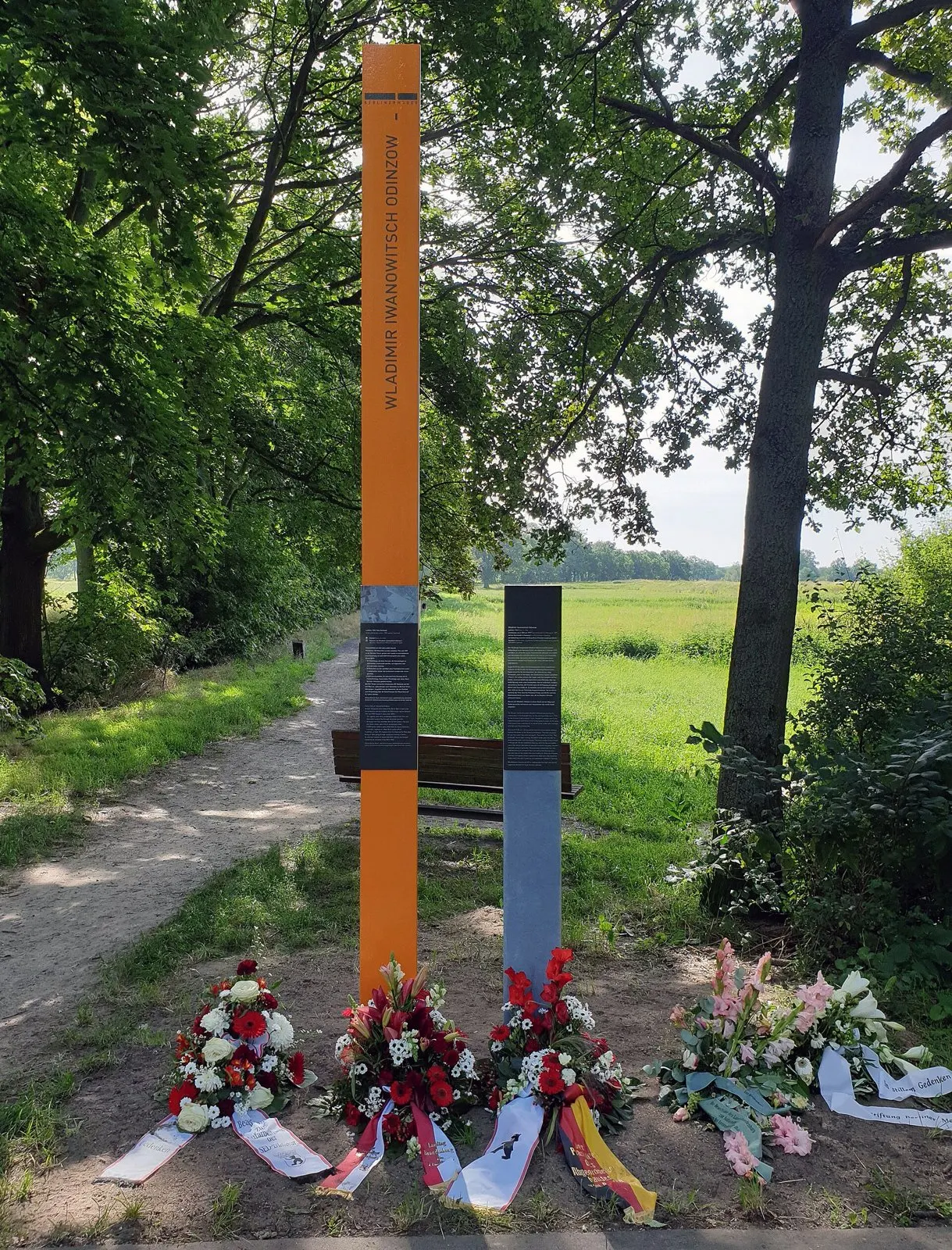
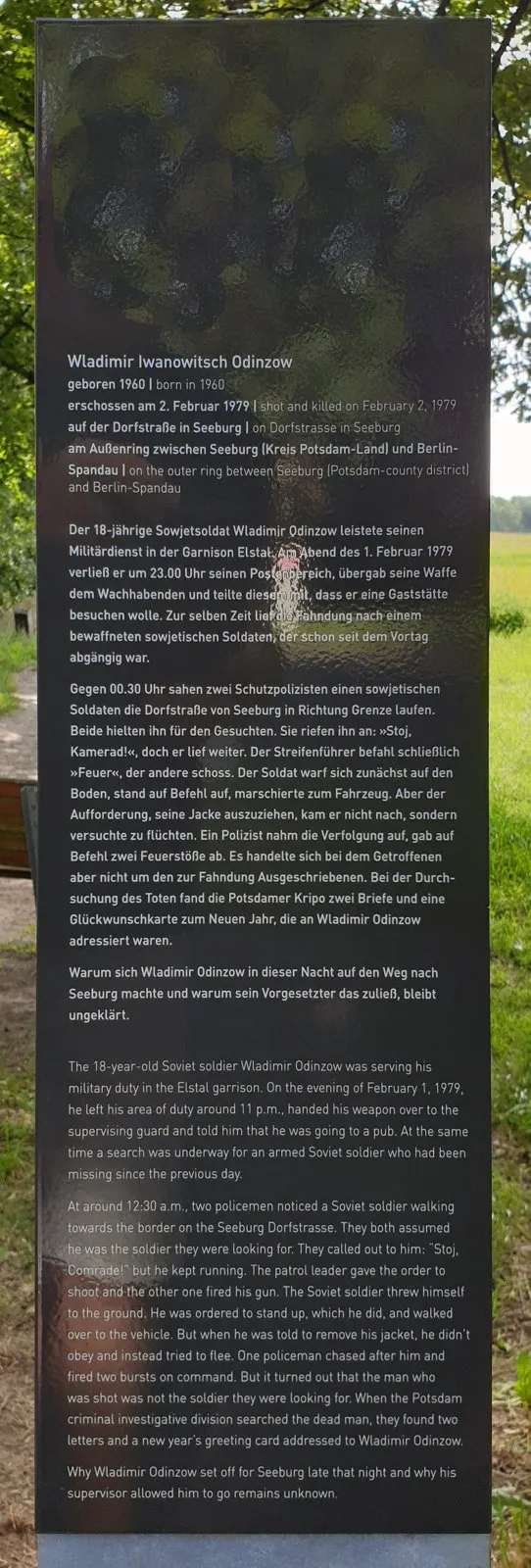
Vladimir Ivanovich Odintsov, an 18-year-old Soviet soldier from the Elstal garrison, was shot dead in Seeburg on the night of 2 February 1979 by an East German policeman; he and his patrol leader had taken him for a missing armed deserter.
_Wladimir_Iwanowitsch_Odinzow.jpg)
Vladimir Ivanovich Odintsov was born in 1960 and grew up in eastern Russia. At 18 he was doing his military service with the artillery regiment of the Soviet garrison at Elstal, west of Berlin, whose soldiers were housed in several places including the former 1936 Olympic Village. Two letters and a New Year card addressed to him were found on his body; the letters dealt mostly with ordinary personal matters and news of relatives. Little else about his life is recorded in the files.
According to later Soviet information, he had been assigned that day to guard the vehicle fleet in the winter camp. At about 11 p.m. on 1 February 1979 he handed his Kalashnikov to the sergeant on duty and said he was walking to Dallgow or Seeburg to visit a pub. His supervisor apparently let him go, although leaving was irregular. The files give no motive and do not show whether the pub was his true destination. It was a cold night, a few degrees below freezing, with snow a few centimetres deep on the ground; wearing a padded army jacket but no coat, he walked for nearly an hour and a half to Seeburg. He apparently did not know that the restaurant there was closed on Thursdays.
That evening two East German policemen had been posted in Seeburg, a kilometre from the West Berlin border, to watch for a different Soviet soldier, Wladimir Kisimow, who had gone missing with a Kalashnikov and ammunition. They had been told to act against Soviet soldiers only if absolutely necessary. At around half past midnight they saw a man walking down the middle of the main road and, by their own account, took him for the deserter, although he wore no coat and had handed in his Kalashnikov before leaving.
According to the policemen, they called on him to stop; when he kept going, the patrol guard fired a warning shot without orders and, on the patrol leader's order to fire, shot again. He lay down in the snow, stood up when told, but did not raise his hands; after a further warning shot he was on the ground again, and then, they said, he tried to run away once more. The patrol guard said that when the patrol leader called to him to shoot, he first fired a burst from the hip at about ten metres and then an aimed burst of about three shots from about 15 metres; forensic investigators put the distance of the fatal shot at 18 metres. A bullet entered his back and passed through his heart and lung. According to the patrol leader, when he returned from phoning headquarters about ten minutes later he found that Vladimir Odintsov was dead. No alcohol was found in his blood. Contrary to the policemen's statements, a police crime-scene sketch shows that he had been going back the way he came, not towards the F2 road and the border.
On 5 March 1979 it was decided not to open a preliminary investigation against the gunman, on the grounds that the officers had believed him to be the missing soldier and had acted within the rules on firearms. Twenty-two hours after the shooting, the soldier they had been searching for was arrested by Soviet troops near Merzdorf. Why Vladimir Odintsov set out for Seeburg that night, what his family was told, and where he is buried are questions the files found so far do not answer.
_Wladimir_Iwanowitsch_Odinzow2.jpg)
Read more
Sources
This profile is a summary written for this site. Every fact in it is taken from source 1, which also gives the full account with archival references.
- Translation: Miriamne Fields, “Vladimir Ivanovich Odintsov”, biography in Chronik der Mauer, Federal Agency for Civic Education, Centre for Contemporary History Potsdam and Deutschlandradio. Accessed 23 September 2026. Read online. Basis for every fact in this profile, including the dates and place of death.
- German version of the same biography. Accessed 23 September 2026. Read online.
- Hans-Hermann Hertle and Maria Nooke (eds.), The Victims at the Berlin Wall, 1961–1989: A Biographical Handbook. Centre for Contemporary History Potsdam and Berlin Wall Foundation, Berlin 2011. The printed handbook from which the online biography is taken.
- Hans-Hermann Hertle and Maria Nooke, “140 Victims at the Berlin Wall, 1961–1989” (list), Centre for Contemporary History Potsdam and Berlin Wall Foundation, August 2017. PDF. Used to cross-check names and dates.
- Hans-Hermann Hertle and Maria Nooke, “The Victims at the Berlin Wall, 1961–1989: Findings of a Research Project”, August 2017. PDF. Source of the classification into escapees, people with no intent to escape, and border soldiers.
Image credits
- Memorial column for Vladimir Odintsov on the Potsdamer Chaussee in Berlin-Wilhelmstadt, photographed in August 2021; the column gives his name as Wladimir Iwanowitsch Odinzow. OTFW, Berlin, CC BY-SA 3.0, Wikimedia Commons.
- Information panel with his story in German and English at the memorial for Vladimir Odintsov on the Potsdamer Chaussee, headed with the name Wladimir Iwanowitsch Odinzow. OTFW, Berlin, CC BY-SA 3.0, Wikimedia Commons.
Cite this page
“Vladimir Ivanovich Odintsov”, Victims of the Berlin Wall, Berlin Experiences. https://victimsofthewall.com/victims/odintsov-vladimir-ivanovich/
Map
The pin position is based on the place of death described in source 1. Base map © OpenStreetMap contributors; course of the Wall in 1989 from Geoportal Berlin (dl-de/zero-2.0). Accessed 23 September 2026.