Ulrich Steinhauer
1956–1980
A 24-year-old carpenter from the Baltic coast serving as an East German border soldier, Ulrich Steinhauer was shot dead on 4 November 1980 near Schönwalde by his junior guard, who then escaped to West Berlin.
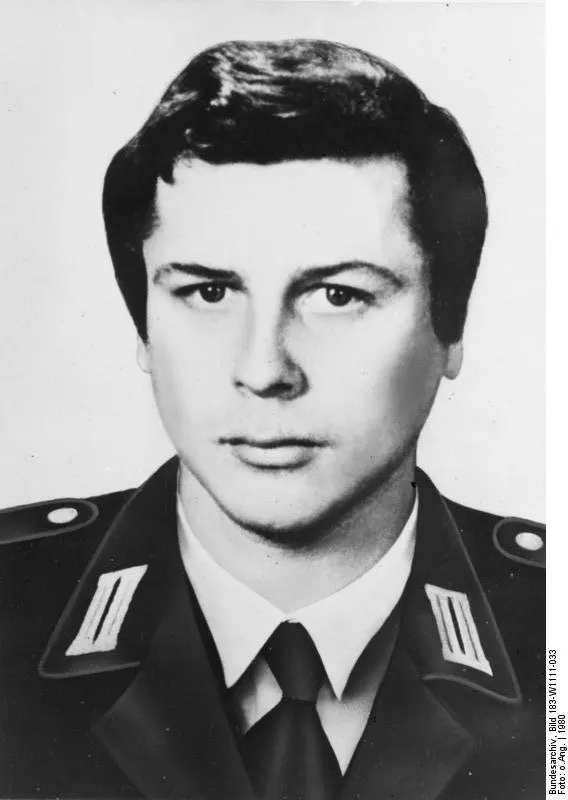

Ulrich Steinhauer was born on 13 March 1956 in Behrenshagen, near the Baltic Sea, the third of six children. His father worked as a warehouse clerk at a state-owned fibre board factory in Ribnitz-Damgarten, and his mother brought up the children at home. After school in Behrenshagen and Damgarten he trained as a carpenter, qualifying in 1973 and staying on with the agricultural enterprise as a skilled worker. His youngest sister, Ilona, remembered him as careful with money, saving for holidays; each summer he toured East Germany with a tent.
In November 1979 he was called up to the border troops, first with Border Training Regiment 40 in Oranienburg and, from May 1980, with Border Regiment 34 in Gross Glienicke. Like most of his comrades, he counted the days until release. He told his superiors he would use his weapon only in an extreme emergency, and, according to his sister, he hoped to get through his 18 months without ever having to shoot. On 2 November 1980 he wrote to his parents and sister that he had been made guard leader, ending the letter by counting the 172 days he still had to serve. The letter arrived on 7 November, three days after his death.
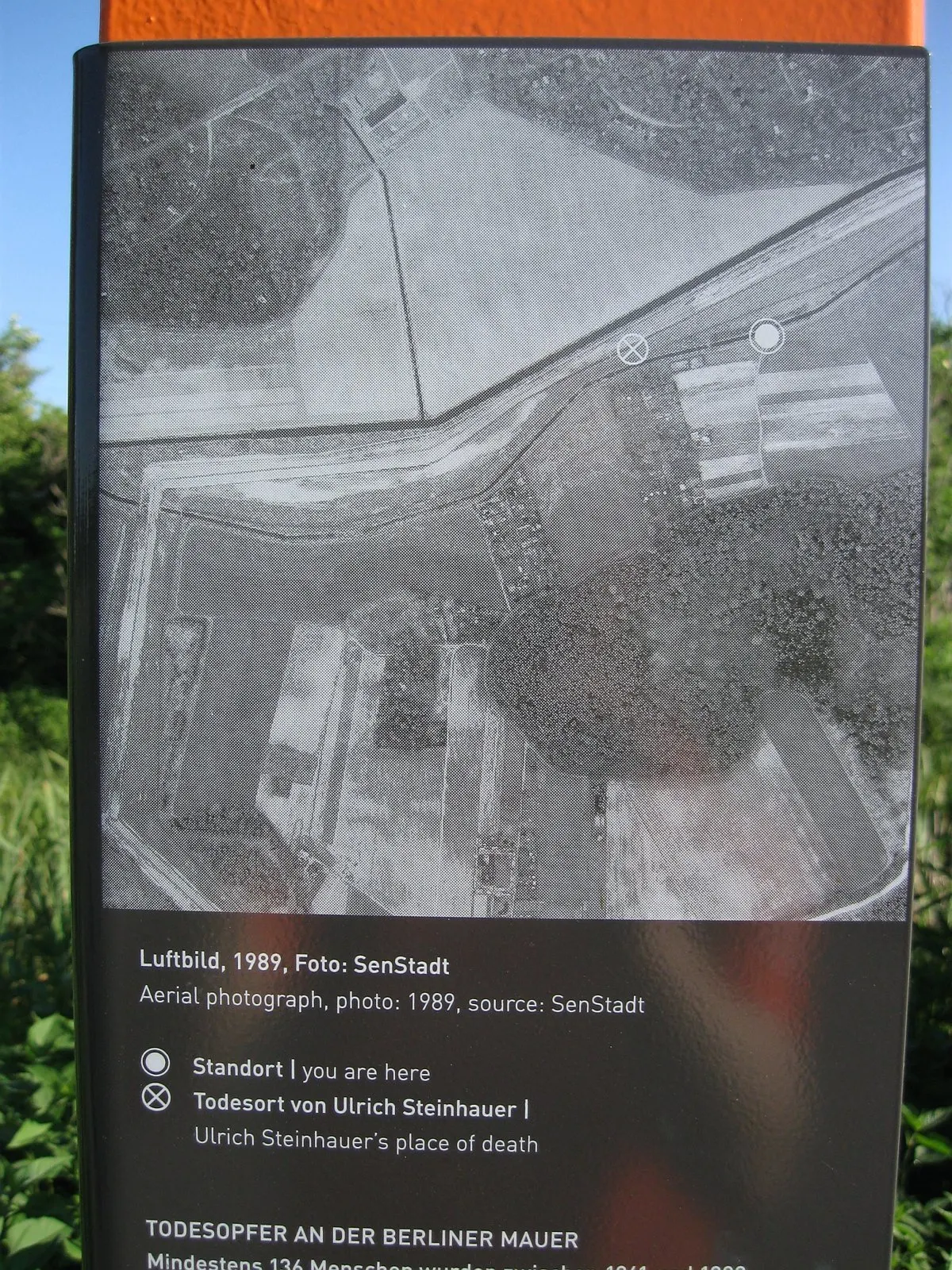
On 4 November 1980 he was on duty as guard leader from 1 p.m. on the Staaken-Schönwalde section, opposite Eiskeller in the West Berlin district of Spandau. His partner was a newly assigned junior guard who, unknown to him, had chosen this stretch of the border for an escape. Shortly after 4 p.m. the junior guard put his plan into action. If his own later account is to be believed, he unplugged the border communication system without his guard leader noticing, then readied his gun; the noise made Ulrich Steinhauer turn round and take his own gun from his shoulder. The junior guard said he then called on Ulrich Steinhauer to throw down his weapon, fired warning shots and then five shots when his guard leader supposedly aimed at him. The fatal bullet, however, had entered Ulrich Steinhauer's back and pierced his heart. He died before a doctor arrived.
Border soldiers first carried his body and weapon out of the death strip, then on orders put them back roughly where they had lain. This, and the fact that one of them could no longer recall where he had found which weapon, meant that a reliable forensic investigation, of the kind later falsely presented to the West Berlin prosecutor-general, was possible only to a limited extent. For a day his body lay in the border strip in view of western media. The junior guard climbed the Wall at a low point, reported to the West Berlin police and was taken into custody. The West Berlin prosecutor-general's office refused East Germany's extradition request.
West Berlin prosecutors charged him with murder, but the youth chamber of the Berlin Regional Court held that it was not proven with sufficient certainty that the fatal shot in the back had been fired first, so the trial was opened for manslaughter; in the autumn of 1981 he was convicted and given a youth sentence of six years. The court said that in a conflict between freedom and life, life takes priority. After further appeals, the sentence was reduced to four years and nine months, on probation. Through informants, the Stasi followed his new life in West Germany closely; it first planned to bring him back to East Germany and then tried to drive him to suicide with threatening letters.
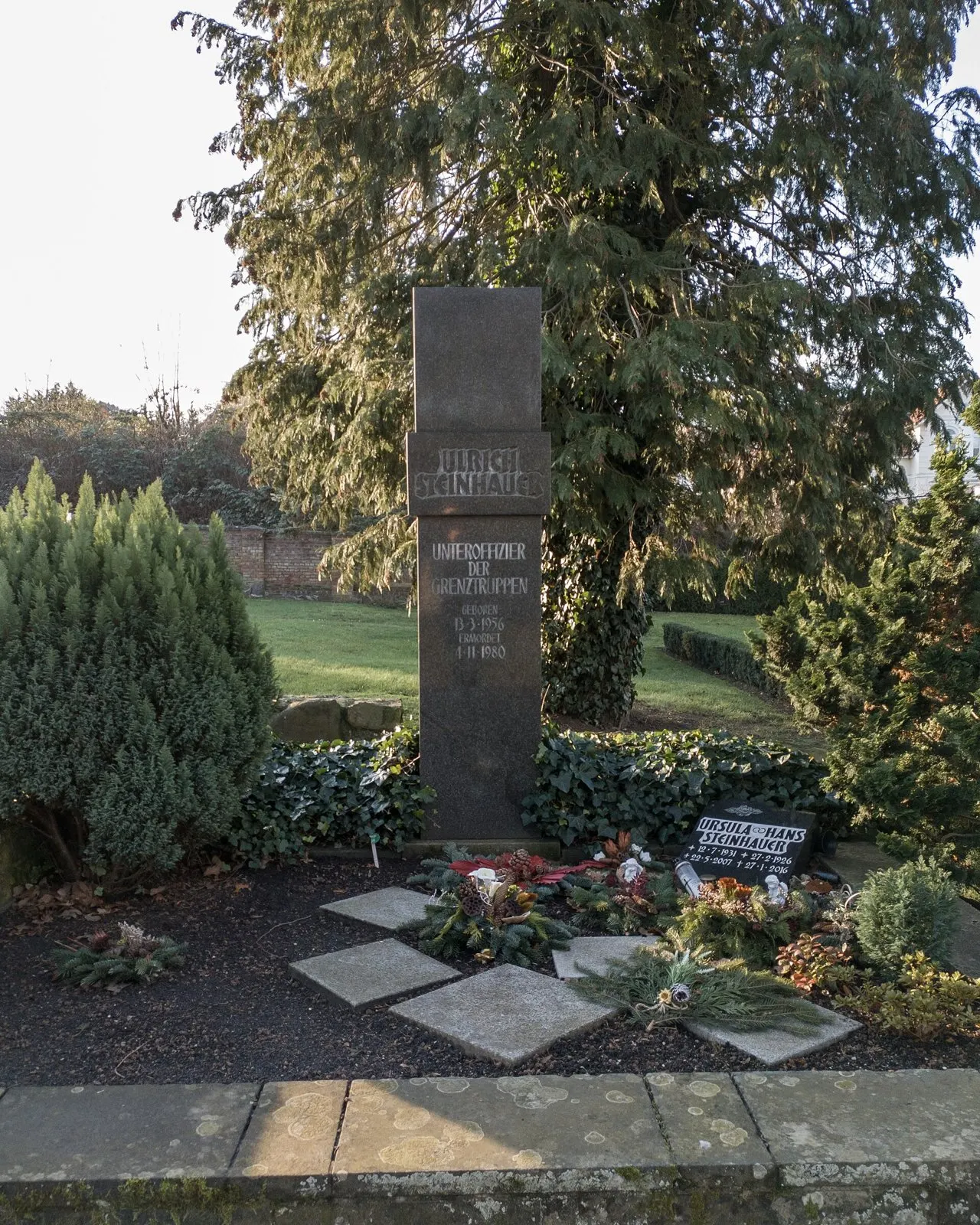
East Germany posthumously promoted him to sergeant and decorated him. He was buried with military honours on 12 November 1980 at the Old Cemetery in Ribnitz-Damgarten, in a funeral arranged by the authorities without any say from his family. A school, a border company, streets and a boxing tournament were named after him, and wreaths were laid on his grave on set dates. His family could not escape this. His sister Ilona later said that her brother had only been doing his service, and that he was taken from the family a second time when he was made into a hero.


.jpg)
Read more
Also died on the outer ring between Berlin-Spandau and Schönwalde
- Dietmar Schwietzer 16 February 1977
Sources
This profile is a summary written for this site. Every fact in it is taken from source 1, which also gives the full account with archival references.
- Martin Ahrends/Udo Baron/Hans-Hermann Hertle, “Ulrich Steinhauer”, biography in Chronik der Mauer, Federal Agency for Civic Education, Centre for Contemporary History Potsdam and Deutschlandradio. Accessed 23 September 2026. Read online. Basis for every fact in this profile, including the dates and place of death.
- German version of the same biography. Accessed 23 September 2026. Read online.
- Hans-Hermann Hertle and Maria Nooke (eds.), The Victims at the Berlin Wall, 1961–1989: A Biographical Handbook. Centre for Contemporary History Potsdam and Berlin Wall Foundation, Berlin 2011. The printed handbook from which the online biography is taken.
- Hans-Hermann Hertle and Maria Nooke, “140 Victims at the Berlin Wall, 1961–1989” (list), Centre for Contemporary History Potsdam and Berlin Wall Foundation, August 2017. PDF. Used to cross-check names and dates.
- Hans-Hermann Hertle and Maria Nooke, “The Victims at the Berlin Wall, 1961–1989: Findings of a Research Project”, August 2017. PDF. Source of the classification into escapees, people with no intent to escape, and border soldiers.
Further reading
Image credits
- Portrait of Ulrich Steinhauer in the uniform of the GDR border troops (Bundesarchiv, Bild 183-W1111-033). Bundesarchiv, Bild 183-W1111-033 / Unknown, CC BY-SA 3.0 DE, Wikimedia Commons.
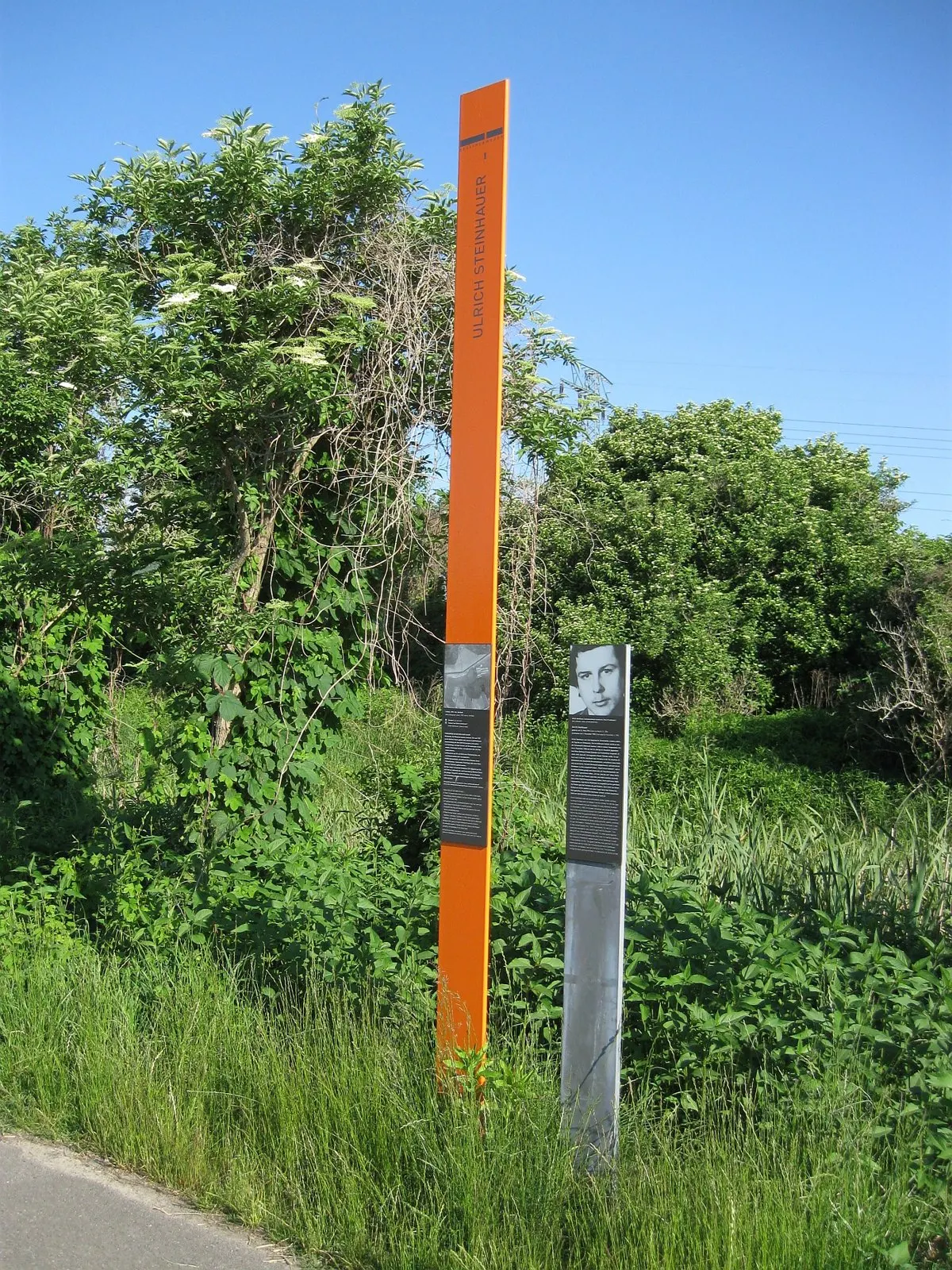
- Memorial column for Ulrich Steinhauer on the Mauerweg at Eiskeller in Berlin-Spandau. Christian Gering, CC BY-SA 3.0, Wikimedia Commons.
- Panel on the memorial column with a 1989 aerial photograph marking the place where Ulrich Steinhauer died, at Eiskeller. Christian Gering, CC BY-SA 3.0, Wikimedia Commons.
- Grave of Ulrich Steinhauer in Ribnitz-Damgarten. Matti Blume, CC BY-SA 4.0, Wikimedia Commons.
Cite this page
“Ulrich Steinhauer”, Victims of the Berlin Wall, Berlin Experiences. https://victimsofthewall.com/victims/steinhauer-ulrich/
Map
The pin position is based on the place of death described in source 1. Base map © OpenStreetMap contributors; course of the Wall in 1989 from Geoportal Berlin (dl-de/zero-2.0). Accessed 23 September 2026.